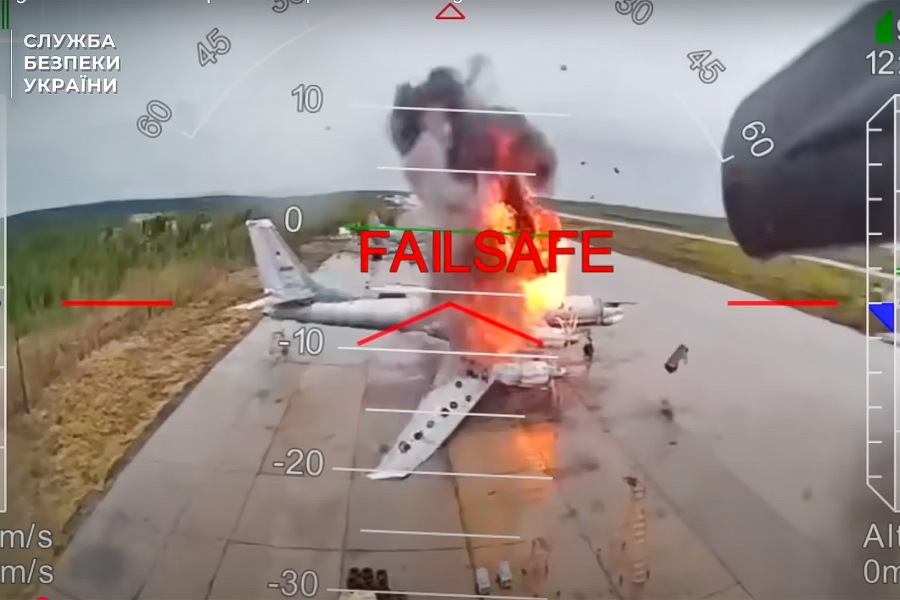
A freeze-frame captures a drone exploding, disabling a Russian Tu-95 bomber during Ukraine’s Operation Spiderweb, a covert drone attack in June. Ukraine's surprise attack unleashed small drones armed with explosives to destroy dozens of unprotected Russian aircraft at air bases across the country. Ukrainian Security Service / Air & Space Forces Magazine
Topics: 3D Printing, Civilization, Education, Existentialism, Fascism
“It was an attack of astonishing ingenuity – unprecedented, broad, and 18 months in the making.
“On 1 June, more than 100 Ukrainian drones struck air bases deep inside Russia, targeting nuclear-capable long-range bombers.
“The scale of the operation dubbed "Spider Web" became clear almost as soon as it began, with explosions reported across several time zones all over Russia - as far north as Murmansk above the Arctic Circle, and as far east as Irkutsk, over 4,000km from Ukraine.
“The Russian Defense Ministry confirmed the attacks had occurred in five regions of Russia - Murmansk, Irkutsk, Ivanovo, Ryazan and Amur - but stated planes had been damaged only in Murmansk and Irkutsk, while in other locations the attacks had been repelled.”
How Ukraine carried out daring 'Spider Web' attack on Russian bombers, Laura Gozzi & BBC Verify, 2 June 2025, BBC News
“On June 1, Russia’s Military Transport Aviation Day, a significant holiday for the Russian armed forces, the Security Service of Ukraine (SSU) carried out a bold and unprecedented coordinated drone strike deep inside Russian territory. The operation targeted four strategic air bases and delivered a major blow to Moscow’s long-range bomber fleet. Codenamed “Spider’s Web”—or simply “Web”—the operation was named for its wide geographic coverage across remote Russian locations previously thought to be beyond the reach of Ukraine’s long-range drone capabilities.
“Using small striking drones covertly smuggled into Russia and launched from hidden compartments inside cargo trucks, the operation struck more than 40 high-value aircraft—including strategic bombers Tu-95MS, Tu-22M3, and A-50 planes used for launching and coordinating missile attacks on Ukrainian cities. The meticulously planned operation marks a significant milestone in Ukraine’s evolving asymmetric warfare capabilities and signals a major vulnerability in Russia’s rear defenses.”
How Ukraine’s Operation “Spider’s Web” Redefines Asymmetric Warfare, Kateryna Bondar, June 2, 2025, Center for Strategic & International Studies
“On 1 June 2025, Ukraine pulled off what many now see as the boldest and most technologically advanced operation of the war: Operation Spiderweb. In a display of ingenuity and precision, Ukraine’s Security Service (SBU) deployed 117 first-person view (FPV) drones in a sweeping, coordinated strike against five major Russian air bases—stretching from Irkutsk and Murmansk to Ryazan, Ivanovo, and Amur. The damage was staggering. According to reports, 41 aircraft were destroyed or disabled, including some of Russia’s most prized strategic bombers and surveillance planes, amounting to an estimated $7 billion in losses.”
Significance and Implications of Ukraine’s Operation Spiderweb, Strategic Studies Department, Trends Group/Trend Research, June 3, 2025
2025 – 1945 = 80 years that the Military Industrial Complex (MIC) has convinced 15 presidential administrations to continue to fund fighting a potential ground war with Russia by authorizing the increase of funding to new weapons systems – some functional, some not-so-much – cutting domestic programs that would help the citizens of the country.
June 1, 2025, Ukraine through being cut off from resources typically supplied by the MIC, became resourceful: the “bombs” dropped on Russian aircraft were 3D printed.
The Defense Budget for FY26 was nearly a trillion dollars (as much as Elon Musk will eventually be worth). The Defense Secretary is asking for $200 billion so that the bloated defense budget can “kill bad guys.”
The “Moore's Law Exemption”
Dr. Gordon Moore, emeritus founder of Intel, and former of Fairchild Semiconductor in 1965, said: “The number of transistors and other components on integrated circuits will double every year for the next 10 years.”
Well past 1975, the transistors kept doubling and shrinking. The “Moore’s Law Limit” was supposed to be 7 nanometers (nano = 10^-9, or 10^-9 meters). Current production is 3 and 2-nanometers (nm) modes this year, with plans to go to 1.4 and 1 nm (marketing terms vs physical measurement). Quantum computing is also making an impact.
Related links:
It costs between $1.1 million and over $ 13 million to train fighter pilots, depending on the size of the aircraft; fighter pilots are the most expensive. One of two crew members from a fighter jet shot down over Iran has been rescued, the other is alive in Iran, and will likely be used for propaganda purposes.
All this advanced technology in our hip pockets, and we’re funding MIC to fight the Russians in a land war in Europe.
On June 1, 2025, we all should have become aware of an eight-decade-long scam that only enriches defense contractors.
Ender's Game by Orson Scott Card is a science fiction novel about Andrew "Ender" Wiggin, a brilliant child recruited by the International Fleet to train at Battle School for a future war against an alien race called "buggers." Through intense simulations and isolation, Ender becomes a master strategist but is manipulated into unknowingly committing genocide, ultimately seeking redemption.
We could reduce the defense budget by having pimply teenagers with frightening hand-eye coordination, like Ender, complete our missions remotely, no pilots down behind "enemy" lines, no prisoners for propaganda purposes. 1945 is now 81 years ago. We’ve transistorized via Moore's Law since then, and been simultaneously gaslit by the MIC/Congressional Industrial Complex. That's not the "deep state": it's marketing

Comments