All Posts (6519)
![]() |
| Credit: Steve Lovelace |
“When you call yourself an Indian or a Muslim or a Christian or a European, or anything else, you are being violent. Do you see why it is violent? Because you are separating yourself from the rest of mankind. When you separate yourself by belief, by nationality, by tradition, it breeds violence. So a man who is seeking to understand violence does not belong to any country, to any religion, to any political party or partial system; he is concerned with the total understanding of mankind.” Jiddu Krishnamurti
"As avenues to foreign influence in innumerable ways, such attachments are particularly alarming to the truly enlightened and independent patriot. How many opportunities do they afford to tamper with domestic factions, to practice the arts of seduction, to mislead public opinion, to influence or awe the public councils. Such an attachment of a small or weak towards a great and powerful nation dooms the former to be the satellite of the latter." General George Washington, 1st President of the United States' Farewell Address.
*****
"The GOP isn't a political party: it's a mental condition," Jesse Ventura on Piers Morgan, when he had a show on CNN.
Also here: Actor and comedian Richard Belzer tells “Say Anything!” host Joy Behar why he thinks President Barack Obama is headed for a “landslide” victory in November noting:
“The Republican Party is not a political party – it’s a mental condition. And I mean that seriously because if you are for crushing the poor, unprovoked wars, there is no climate change, immigrants. It’s like ‘who are we’?”
Who are we?...
The National Academy of Sciences was founded on March 3, 1863, at the height of the Civil War.
The immediate roots of the NAS can be traced back to the early 1850s and a group of scientists based largely in Cambridge, Massachusetts. The group enlisted the support of Massachusetts Senator Henry Wilson, who helped draft a bill for the incorporation of the National Academy of Sciences. Wilson brought the bill to the Senate on February 20, 1863, where it was passed on March 3. It was passed by the House of Representatives later that day, and was signed into law by President Lincoln before the day was over. The National Academy of Sciences had officially come into being with 50 charter members, who over the years would be joined by the election of the nation's most distinguished scientists. NAS History
We erroneously assume that the absolutely insane, the inane cannot possibly get elected to public office, then surprised when they do.
We assume that we are the grandchildren of Jefferson and his trinity of three greatest men; we assume our Civics and Social Studies is universal and understood by our political leaders.
“To err is human,” wrote Seneca. “To persist is diabolical.” Everyone makes incorrect predictions. But to be that consistently, grossly wrong takes special effort. So what’s this all about? Nobel Prize-Winning economist Paul Krugman opines in the New York Times on the ideological persistence of one party on the "sins" of the Affordable Care Act despite evidence to the contrary.
Who are we, and who do we want representing our views after any election?
1979:
150 corporations control television (ABC, CBS, NBC, PBS, UHF); radio and print media.
2014:
6 corporations control television (more stations than I can list), radio, print media and Internet and social media. That is a 25X reduction if you wanted the math.
Washington nor Jefferson had to contend with lobbyists or corporations, nor influence peddlers that use marketing firms to direct our thoughts online and convert us into sheep commodities for profit.
It is not just a denial of climate change or science: it's a denial of reality itself; allowing larger forces to manipulate that reality for gain or profit and purposely seed doubt on institutions designed to act in our best interests, getting us to vote or behave not in our best interests.
If one party denies reality, HOW can we extend to it the reigns of power governing the most significant country on the globe? Mutually Assured Destruction was never meant as a goal.
I want a resurgence of the party of science - the previous Republican Party before the current takeover by bigots, extremists, terrorists and apocalyptic zealots. That would be a "return to principles" I think everyone could support.
Tomorrow: Tea, Earl Grey
For those of you whose Latin is crisper than mine: roughly "the folly of giants"...
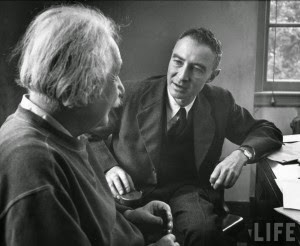
On September 1, 1939, the same day that Germany attacked Poland and started World War 2, a remarkable paper appeared in the pages of the journal Physical Review. In it J. Robert Oppenheimer and his student Hartland Snyder laid out the essential characteristics of what we today call the black hole. Building on work done by Subrahmanyan Chandrasekhar, Fritz Zwicky and Lev Landau, Oppenheimer and Snyder described how an infalling observer on the surface of an object whose mass exceeded a critical mass would appear to be in a state of perpetual free fall to an outsider. The paper was the culmination of two years of work and followed two other articles in the same journal.
Then Oppenheimer forgot all about it and never said anything about black holes for the rest of his life.
What happened? Oppenheimer’s lack of interest wasn’t just because he became the director of the Manhattan Project a few years later and got busy with building the atomic bomb. It also wasn’t because he despised the free-thinking and eccentric Zwicky who had laid the foundations for the field through the discovery of black holes’ parents – neutron stars.
Thus for Oppenheimer, black holes, which were particular solutions of general relativity, were mundane; the general theory itself was the real deal. In addition they were anomalies, ugly exceptions which were best ignored rather than studied. As Dyson mentions, unfortunately Oppenheimer was not the only one affected by this condition. Einstein, who spent his last few years in a futile search for a grand unified theory, was another. Like Oppenheimer he was uninterested in black holes, but he also went a step further by not believing in quantum mechanics. Einstein’s fundamentalitis was quite pathological indeed.
History proved that both Oppenheimer and Einstein were deeply mistaken about black holes and fundamental laws. The greatest irony is not that black holes are very interesting, it is that in the last few decades the study of black holes has shed light on the very same fundamental laws that Einstein and Oppenheimer believed to be the only thing worth studying. The disowned children have come back to haunt the ghosts of their parents.
"If the radiance of a thousand suns were to burst forth at once in the sky,
It would be like the splendor of the Mighty One.[I am Mighty, world-destroying Time.]
Now I am become death, the destroyer of worlds."
The Bhagavad Gita, the last sentence quoted by Oppenheimer reflecting on scientists' reactions when the atomic bomb was successfully tested.
Scientific American:
Oppenheimer's Folly: On black holes, fundamental laws and pure and applied science, Ashutosh Jogalekar
![]() |
| Credit: Technology Review |
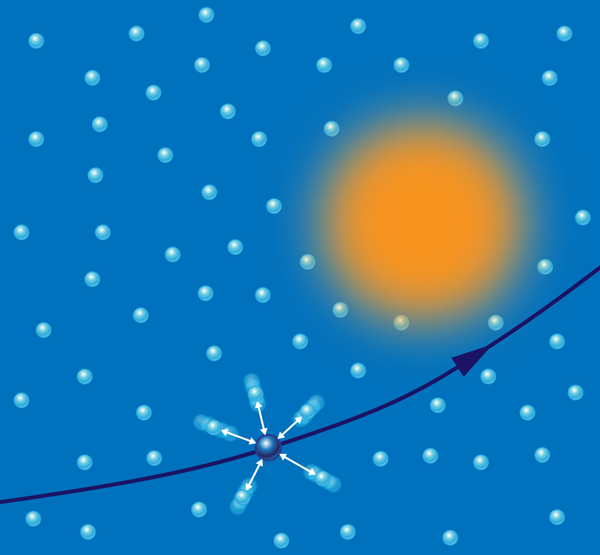
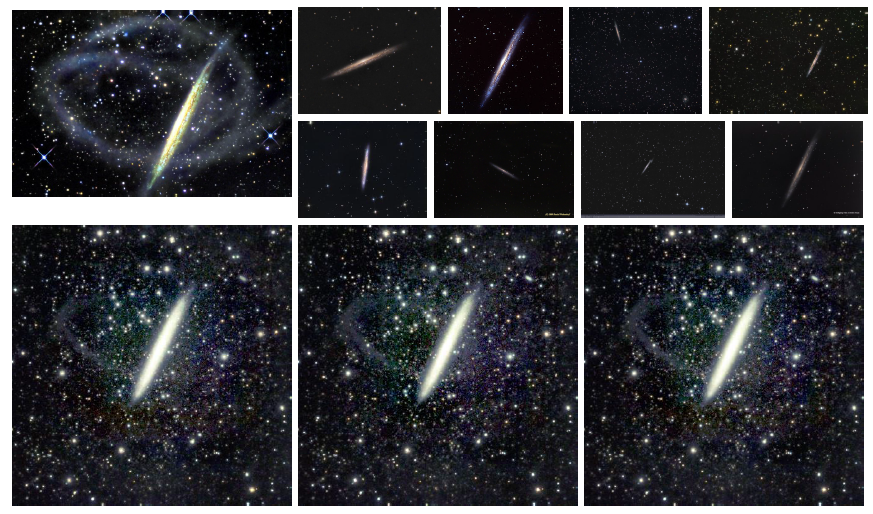
TECHNOLOGY REVIEW: Astrophotography is currently undergoing a revolution thanks to the increased availability of high quality digital cameras and the software available to process the pictures after they have been taken.
Since photographs of the night sky are almost always better with long exposures that capture more light, this processing usually involves combining several images of the same part of the sky to produce one with a much longer effective exposure.
That’s all straightforward if you’ve taken the pictures yourself with the same gear under the same circumstances. But astronomers want to do better.
“The astrophotography group on Flickr alone has over 68,000 images,” say Dustin Lang at Carnegie Mellon University in Pittsburgh and a couple of pals. These and other images represent a vast source of untapped data for astronomers.
Physics arXiv: Towards building a Crowd-Sourced Sky Map
Dustin Lang, David W. Hogg, Bernhard Scholkopf
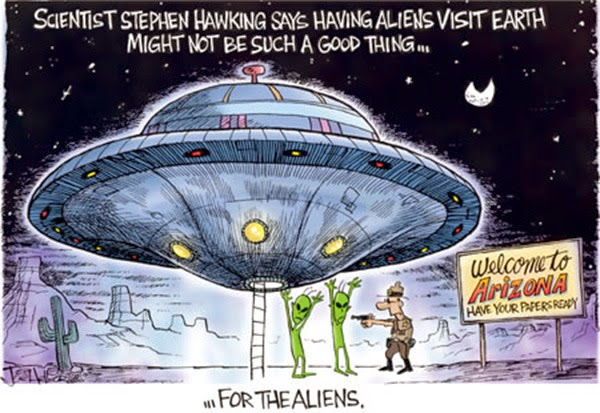
Enrico Fermi, when asked about intelligent life on other planets, famously replied, “Where are they?” Any civilization advanced enough to undertake interstellar travel would, he argued, in a brief period of cosmic time, populate its entire galaxy. Yet, we haven’t made any contact with such life. This has become the famous "Fermi Paradox”.
Various explanations for why we don’t see aliens have been proposed – perhaps interstellar travel is impossible or maybe civilizations are always self-destructive. But with every new discovery of a potentially habitable planet, the Fermi Paradox becomes increasingly mysterious. There could be hundreds of millions of potentially habitable worlds in the Milky Way alone.
So why don’t we see advanced civilizations swarming across the universe? One problem may be climate change. It is not that advanced civilizations always destroy themselves by over-heating their biospheres (although that is a possibility). Instead, because stars become brighter as they age, most planets with an initially life-friendly climate will become uninhabitably hot long before intelligent life emerges.
The Earth has had 4 billion years of good weather despite our sun burning a lot more fuel than when Earth was formed. We can estimate the amount of warming this should have produced thanks to the scientific effort to predict the consequences of man-made greenhouse-gas emissions.
These models predict that our planet should warm by a few degrees centigrade for each percentage increase in heating at Earth’s surface. This is roughly the increased heating produced by carbon dioxide at the levels expected for the end of the 21st century. (Incidentally, that is where the IPCC prediction of global warming of around 3°C centigrade comes from.)
Space.com:
Why Haven't We Encountered Aliens Yet? The Answer Could be Climate Change, David Waltham
A UNSW Australia-led team of researchers has discovered how algae that survive in very low levels of light are able to switch on and off a weird quantum phenomenon that occurs during photosynthesis.
The function in the algae of this quantum effect, known as coherence, remains a mystery, but it is thought it could help them harvest energy from the sun much more efficiently. Working out its role in a living organism could lead to technological advances, such as better organic solar cells and quantum-based electronic devices.
The research is published in the journal Proceedings of the National Academy of Sciences.
It is part of an emerging field called quantum biology, in which evidence is growing that quantum phenomena are operating in nature, not just the laboratory, and may even account for how birds can navigate using the earth's magnetic field.
Phys.org:
Quantum biology: Algae evolved to switch quantum coherence on and off
![]() |
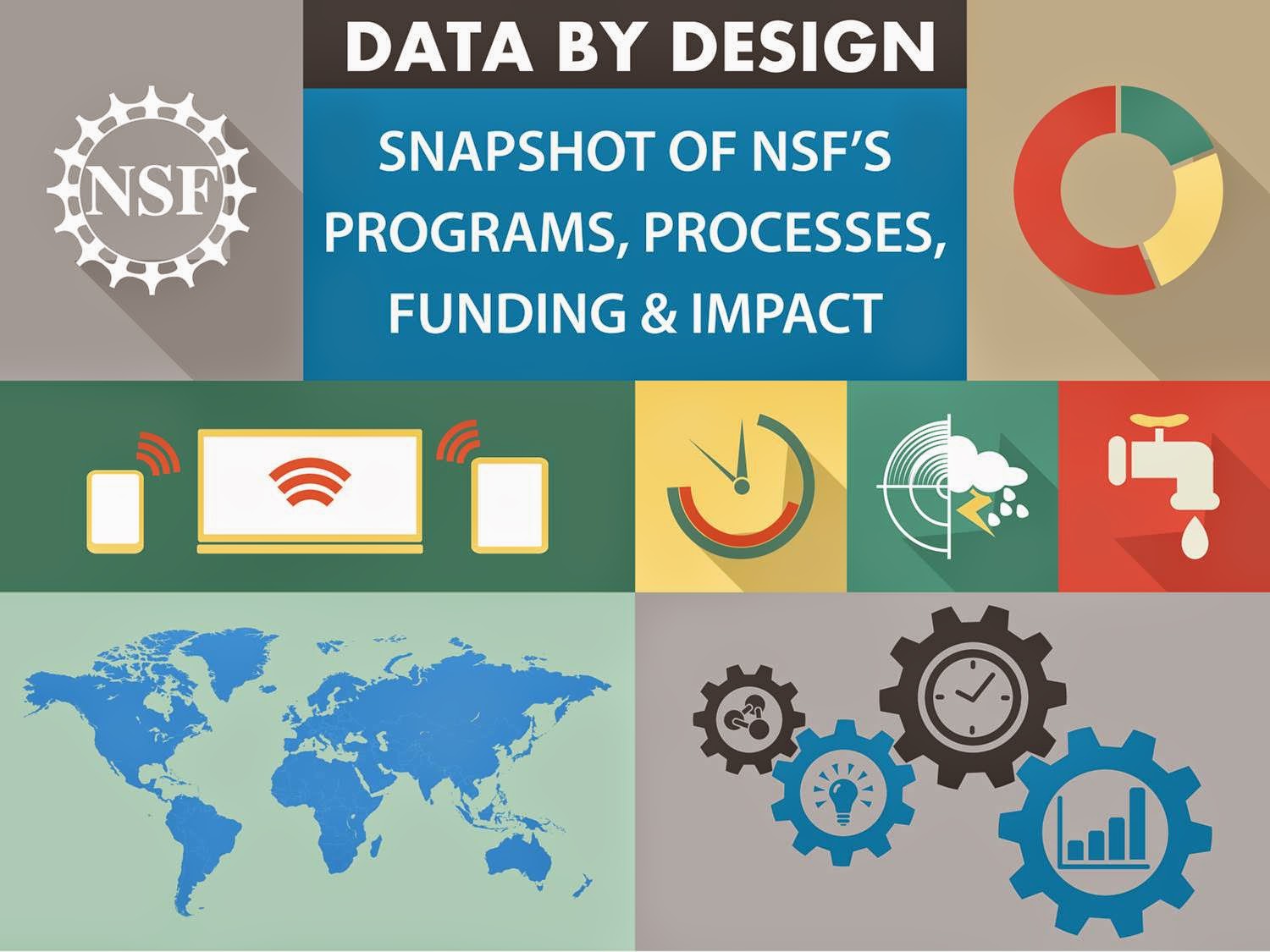
| NSF's Data By Design infographics are a snapshot of NSF's programs, processes, funding and impact. Credit: NSF |
June 20, 2014
Today the National Science Foundation (NSF) released a robust toolkit that includes new videos, infographics, fact sheets and brochures that describe NSF investments in fundamental research and how they contribute to the nation's science and engineering enterprise.
"NSF's toolkit offers a range of information about the vital work of the Foundation in a compelling way using modern communications methods," said NSF's Office of Legislative and Public Affairs Director Judith Gan. "We encourage the NSF community and the general public to explore the materials we're releasing today to learn more about how the agency helps our nation remain at the competitive forefront of discovery and innovation."
Part of the toolkit package is an animated, NSF-produced video describing the agency's rigorous merit review process. The agency also developed infographics called, "Data by Design: Snapshot of NSF's Programs, Processes, Funding & Impact." These colorful charts showcase the Foundation's role in building tomorrow's workforce, driving innovation, influencing national and international discoveries, and facilitating interdisciplinary collaborations.
National Science Foundation:
National Science Foundation toolkit highlights impact of NSF investments
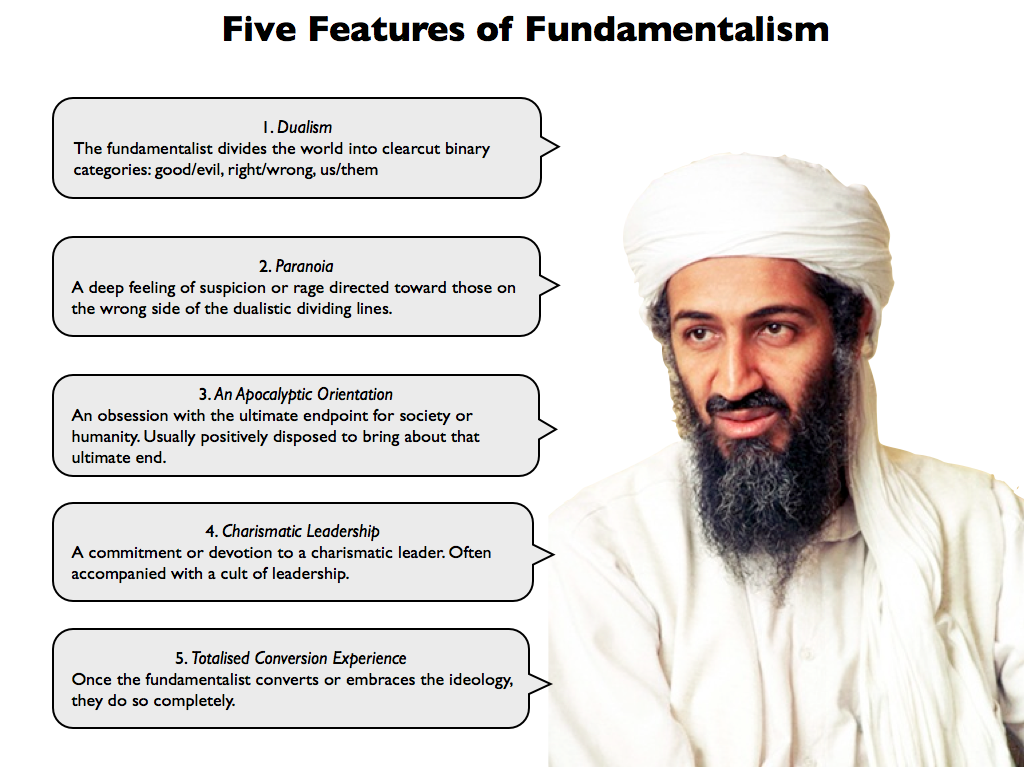
Fundamentalism: 1. movement with strict view of doctrine: a religious or political movement based on a literal interpretation of and strict adherence to doctrine, especially as a return to former principles; 2. support for literal explanation: the belief that religious or political doctrine should be implemented literally, not interpreted or adapted
We've confused opinion with fact-based inquiry and reporting of the same; we've confused sensationalism with journalism. The arcane 50's barometer Nielsen ratings - not informing the citizenry - is the all-important arbiter of broadcast decisions; what news outlets put out on the web. Talk radio becomes the model of how we disseminate information. Seeing a television interview of The National Inquirer years ago - they admitted to making up stories after "a few joints and beers," yet they managed to sober up and discover John Edward's dalliances with Rielle Hunter scooping all other conventional outlets. I assume it was the same muse at the now defunct Weekly World News, hence the occasional "bat-boy" alien pieces.
Quoting historian Jarret Ruminski, PhD:
In her essential study of the modern right-wing Tea Party movement, historian Jill Lepore explains that “historical fundamentalism is marked by the belief that a particular and quite narrowly defined past — ‘the Founding’ — is ageless and sacred and to be worshipped; that certain historical texts — ‘the founding documents’ — are to be read in the same spirit with which religious fundamentalists read, for instance, the Ten Commandments,” and that “the Founding Fathers were divinely inspired.” A belief in historical fundamentalism, Lepore notes, means that “political arguments grounded in appeals to the founding documents, as sacred texts, and to the Founding Fathers, as prophets, are therefore incontrovertible.”* In other words, the Far Right, from the Tea Partiers to the militia and sovereign citizens all believe that the Founding past must be restored to reclaim the present from the tyrannical powers of big government and the globalized world order. [1]
It is the same market fundamentalism that fuels the "stock exchange as deity" worship; it is the same fundamentalism that fuels science and climate change denial to our existential peril; it is the same fundamentalism that needs the Earth and the rest of the universe to be only 6,000 years old despite the evidence contrary to that assertion and fuels ill-labeled "creation science/intelligent design"; it is the same fundamentalism that against the changes technology fosters in social interactions, minority rights, women's rights, LGBT rights that publishes digital mountainous screeds of a "return to traditional values" (using the technology responsible for that change) at sovereign, white supremacists, right-wing sites on the Internet...let that irony sink in for a moment as you look for Ozzie and Harriet's URL.
It is why there's common cause between sovereign citizens movements, The Tea Neanderthals, Answers in Genesis (vs. COSMOS); White Supremacists, States Rights Advocates, and Conspiracy Theorists: the changing demographics in America spells [for some] a social and genetic holocaust, yet not a peep about dark money in politics and how that is not democratic nor republic. These are those who think they are at the top of the pecking order by virtue of magical thinking/manifest destiny: more like a set-up unfair structure based solely (or mostly) on a lack of Melanin, and a lot lately on financial clout. That "once-upon-a-time," a particular side of town had all the good books and libraries; everyone else had hand-me-downs and rags; "separate but equal" was the boondoggle that assured a place at the apex of the polyhedron and crush of the weight of its base on the 99%. Information back then intentionally wasn't democratized, and it sure couldn't be downloaded on a Smart Phone. When one didn't have to think about competing with global workers for the same job; that if one wasn't "college material," you could get a job at the local plant and make a decent living for yourself and any dependents, even promote over college-prepared women and minorities. Unions only could benefit the group that you belonged to, and not strive for some egalitarian utopia. That was how some thought it was, until some nefarious "other": African Americans; black-guy-in-the-White House; black helicopters; Beelzebub; coming-to-take-your-guns; Hispanics; Illuminati; immigrants; jack-booted-thugs; Latinos; LGBT; Martians; New World Order Conspiracy and Women's Rights all conspired and decided to ship this "American dream" and its goods, services and jobs overseas.
It's always something mysterious without an address (ghosts after all, are easy to typecast and harder to fight), yet NAFTA "was signed by President George H.W. Bush, Mexican President Salinas, and Canadian Prime Minister Brian Mulroney in 1992" and "signed into law by President Bill Clinton on December 8, 1993." [2] These are easily researched points, and involve participation in the governance of a democratic republic by informing oneself; engaging in public debate and voting. In two italic emphases, I showed both parties are equally at fault. Missing from the discussion of the humanitarian crisis at the US-Mexican border is how this trade agreement contributed to the demise of Central America's middle class; the rise of the drug cartels; how it, Citizen's United and the McCutcheon decision are contributing to the demise of this country's.
democratic republic: (n) a form of government embodying democratic principles and where a monarch is not the head of state; democracy: (n) free and equal representation of people: the free and equal right of every person to participate in a system of government, often practiced by electing representatives of the people by the majority of the people; republic: (n) political system with elected representatives: a political system or form of government in which people elect representatives to exercise power for them
Politicians are more than happy to fuel this willful ignorance of basic civics as long as it benefits their serial terms in office and plush retirement benefits. Local governors are more than willing to disenfranchise a part of the electorate not likely to vote for their policies anyway, and call it "protecting the integrity of the voting process" for a chimera made up whole cloth resurrecting Jim Crow 2.0. They will memorize the talking points and manage a speech into a three-point sermon with a call-and-response whooping conclusion, thumping a holy writ covered in dust and lint neglected on their own coffee tables. They will play up the fear of "blaming the other-than-your-group" and do nothing, absolutely NOTHING substantive legislatively, other than annual pay raises and continued tax cuts for themselves.
I fear an authoritarian fundamentalism, no different than the "Creation Science" Charlatans, the Tea Party and Open Carry Neanderthals here, and the political party that plays footsies with these groups, lighting a tinderbox that will eventually ignite us into a pyre of quick global irrelevance; the Taliban in Afghanistan and Al-Qaeda stemming from the Arabian Peninsula are kindred spirits. A reaction to a changing globe and technology doubling capacity as it follows Moore's Law [3, 4]: the unanticipated consequence of scientific efficiency, fought vigorously by dogma, pseudoscience and superstition. "Knowledge IS power": the ability to reason, question and hold accountable the powerful, the feared Achilles heel of all authoritarian fundamentalists the world over. It reduces their potency to flaccid impotence. They need the mob, the bewildered herd, for power and relevance.
My fear is founded on the observed, steady, evidence-based erosion of our faculties at critical thinking, reasoning and problem-solving. My fear is the embracing of demagogues in high places that will legislate our futures into a new dark ages. The Dystopian novels from Margaret Atwood [5] and Octavia Butler [6] are instructive. As I said yesterday, I'd rather "life [not imitate] art."
1. That Devil History: "Gun Nuts, Militias, and American Extremism in a Globalized World."
2. About.com: "History of NAFTA."
3. Intel: Excerpts from A Conversation With Gordon Moore - Moore's Law (PDF)
4. MIT News - Topic: Moore's Law
5. "The Handmaid's Tale," Margaret Atwood
6. "Parable of the Sower"; "Parable of the Talents," Octavia Butler

I listened to this on audio and this story wasted no time getting to it. A teenaged boy seeks to retrieve his younger sister after his grandfather is murdered. I'd been wanting to read a Lansdale book for a while after reading one of his short stories a year ago and The Thicket just leapt out at me.
The Good
The writing is awesome. Every character is rich with his own history and you feel like you're behind each characters' eyes. I only knew Lansdale as a horror author, but he is extremely adept at a period piece thriller (I guess that's what you'd call it). And there are several parts that are laugh-out-loud funny. Like Shorty describing the man who came into his story who kept threatening to dress him up in doll's clothes.
The Bad
Nothing. Honestly, I loved every bit of this story. If anything, I'd like to see another story with some of these characters.
And How Did I Feel About That…
I'm a new Joe R Lansdale fan. Now I'm going to find as much of his stuff as I can and begin reading. Michael C Hall stars in the movie adaptation of his novel Cold In July. I'm going to pick that one up as soon as it comes available.
I write stuff too! Download a copy of my short Where the Monsters Are. Only $0.99.
![]() |
| Star Trek official site |
Star Trek:
Star Trek: "Federation," Judith Reeves-Stevens
Admittedly, there is a suspension of belief for Trekkie fans: Warp Drive (NASA is researching it currently); transporters; phase weapons; Vulcan and Klingon humanoid species, and a heavy dose of Deux ex machina (after all, what would the story have been if the Klingons discovered us first?). Gene Roddenberry, by his own admission, was a hopeless optimist.
The above novels allude to the fictional fact that the ascension of the Federation did not come with a witty techno-babble resolution in less than sixty minutes. Especially this gem in the timeline:
Rising from the ashes of the Eugenics Wars of the mid-1990s, the era of World War III was a period of global conflict on Earth that eventually escalated into a nuclear cataclysm and genocidal war over issues including genetic manipulation and Human genome enhancement. World War III itself ultimately lasted from 2026 through 2053, and resulted in the death of some 600 million Humans. By that time, many of the planet's major cities and governments had been destroyed. The rest of the info at the source link is about as cheery, see: Memory Alpha.
They get some things surprisingly (frighteningly) right: nuclear winter (man made, and the antithesis of similarly global warming - irony); radiation in the atmosphere and sickness; the breakdown of social order giving space to the rise of authoritarian demagogues like the fictional Colonel Green (previous paragraph link). We somehow get over that and the genetic mutations associated with most likely plutonium poisoning and a half-life that would make life on a nuclear-devastated planet tenuous for 480 centuries (~24,000 years to get rid of half of it). Transporters...Vulcans...Deux ex machina...
Greg Cox converted the Eugenics Wars into a clandestine conflict between Khan and his super-intelligent, super-strong, megalomaniac genetic sisters and brothers. I guess Caesars just can't get along. In TOS, the Eugenics Wars was the third world war. Either way, losing a tenth of humanity is a lot of people.
"Federation" blended TOS, TNG and Zephram Cochrane with no mention of ENT or "First Contact" (who would have benefited directly from his genius). They also spoke of an "Optimum Movement," a racist, neo-fascist organization that lit the tender box (and launched the nukes) for the conflagration.
This is where I really hope "life [does not] imitate art."
Tomorrow: Fearing Fundamentalism
![]() |
| Texas Power and Light |
Tesla would be proud...1600th post.
Serbian-American inventor Nikola Tesla was born in July of 1856, in what is now Croatia. He came to the United States in 1884, and briefly worked with Thomas Edison before the two parted ways. He sold several patent rights, including those to his alternating-current machinery, to George Westinghouse. His 1891 invention, the "Tesla coil," is still used in radio technology today.
Around 1900—nearly a decade later after inventing the "Tesla coil"—Tesla began working on his boldest project yet: Building a global communication system—through a large, electrical tower—for sharing information and providing free electricity throughout the world. The system, however, never came to fruition; it failed due to financial constraints, and Tesla had no choice but to abandon the Long Island, New York laboratory that housed his work on the tower project, Wardenclyffe. In 1917, the Wardenclyffe site was sold, and Tesla's tower was destroyed.
In addition to his AC system, coil and tower project, throughout his career, Tesla discovered, designed and developed ideas for a number of important inventions—most of which were officially patented by other inventors—including dynamos (electrical generators similar to batteries) and the induction motor. He was also a pioneer in the discovery of radar technology, X-ray technology and the rotating magnetic field—the basis of most AC machinery. Biography.com
The WiTricity® technology story begins late one night with MIT Professor Marin Soljačić (pronounced Soul-ya-cheech) standing in his pajamas, staring at his mobile phone on the kitchen counter. It was the sixth time that month that he was awakened by his phone beeping to let him know that he had forgotten to charge it. At that moment, it occurred to him: “There is electricity wired all through this house, all through my office—everywhere. This phone should take care of its own charging!” But to make this possible, one would have to find a way to transfer power from the existing wired infrastructure to the phone—without wires. Soljačić started thinking of physical phenomena that could make this dream a reality.
Company site: WiTricity.com
http://www.kylamcmullen.com/Articles/sexy-black-female-scientists.html#sthash.apgngONp.onhrOTaS.dpbs
![]() |
| Source: Facebook |
Poem by Robert Gibbons (with permission)
a short thought for the black inventor of baby buggy
(for WH Richardson)
I guess you remember him
if you ever had to carry a baby
a bundle of joy
wrapped in swallowing clothes
but he gave you a choice
to either carry or buggy
to hold or tug them along
through the whining streets
little feet lifted in air
like a prayer
if you have one
call his name
racing through the streets
with wheels and then
peel back the layers
of history, remember
his name
Juneteenth is the oldest nationally celebrated commemoration of the ending of slavery in the United States.
Today Juneteenth commemorates African American freedom and emphasizes education and achievement. It is a day, a week, and in some areas a month marked with celebrations, guest speakers, picnics and family gatherings. It is a time for reflection and rejoicing. It is a time for assessment, self-improvement and for planning the future. Its growing popularity signifies a level of maturity and dignity in America long over due. In cities across the country, people of all races, nationalities and religions are joining hands to truthfully acknowledge a period in our history that shaped and continues to influence our society today. Sensitized to the conditions and experiences of others, only then can we make significant and lasting improvements in our society.
The baby buggy is an invention, an application of Newtonian mechanics for the greater common good. Since xenophobic, knuckle-dragging Neanderthals tend to sadly procreate, this information should cause some consternation and epic episodes of Cognitive Dissonance. Que trolls: 3...2...1...
It's also the birthdays of my favorite Civil Rights hero Mamie Goodwin-Douglas (sister), who put her life on the line many times for the world we take for granted, and my father Robert Harrison Goodwin (June 19, 1925 - August 26, 1999), a man who knew service (USN); boxing and hardship, facing indignities with dignity. One the fourth occasion his employer deemed him worthy of going to supervisory school only to (again) train his next Caucasian manager, he quietly retorted: "I expect I'll retire now." Since Pop had the time, they couldn't argue. He spent the remainder of his days before the lung cancer in reasonably good health working in his vegetable garden - doing exactly what he wanted to do. He is still missed.
Official site: Juneteenth.com
I will be attending Texas Comicon on June 21-22. You can find me in Artist Alley at Table A39 Limited Edition Sketchbooks, Prints, and Commissions. I still have copies of my limited edition sketchbooks available. Stop by my table to get your copy. $10 sketchbook, signed
![]() |
| Using the "magnetocaloric effect" to build a low-temperature magnetic refrigeration device. (Courtesy: Shutterstock/Spectral-Design) |
A large, rotational magnetocaloric effect – which could be used as the basis for a low-temperature magnetic refrigeration device – has been observed in crystals of the compound HoMn2O5, according to research carried out by scientists in Canada and Bulgaria. This finding expands our knowledge of magnetocaloric materials, adding to our progress towards a practical and environmentally friendly magnetic cooler that might be usable in a domestic setting.
In recent times, the potential of magnetic refrigeration techniques as an alternative to traditional, vapour-compression solutions has been attracting considerable attention. This is mainly thanks to the lower energy demands of the technique, and the fact that it is not reliant on hazardous fluids. Such devices take advantage of the magnetocaloric effect – a phenomenon in which certain materials change temperature in response to an externally applied magnetic field. Such fields cause the magnetic dipoles of the atoms within magnetocaloric compounds to align. To balance out this decrease in entropy – and thereby satisfy the second law of thermodynamics – the motion of the atoms also becomes more disordered, and the material heats up. In contrast, when the applied field is removed, the process reverses and the material cools. In magnetic refrigerators, these temperature changes can be harnessed, using a fluid or gas, to drive a heat pump.
This relates to the ozone layer and how we could use technology to reduce the size of the hole over the Antarctic. UV radiation is filtered by it to make our existence possible. Kind of an important thing, since Monday's post on warp drive technology - though inspiring - is still in the theory stage. The only spaceship we currently have is under our feet.
Physics World: Using magnetic cooling for 'green' refrigeration
#P4TC: "An Extremely Bold Op-Ed," November 19, 2010
The sun emits light waves with a range of frequencies. Some of these frequencies fall within the visible light spectrum and thus are detectable by the human eye. Since sunlight consists of light with the range of visible light frequencies, it appears white. This white light is incident towards Earth and illuminates both our outdoor world and the atmosphere that surrounds our planet.
The interaction of sunlight with matter can result in one of three wave behaviors: absorption, transmission, and reflection. The atmosphere is a gaseous sea that contains a variety of types of particles; the two most common types of matter present in the atmosphere are gaseous nitrogen and oxygen. These particles are most effective in scattering the higher frequency and shorter wavelength portions of the visible light spectrum. This scattering process involves the absorption of a light wave by an atom followed by reemission of a light wave in a variety of directions. The amount of multidirectional scattering that occurs is dependent upon the frequency of the light.
-ROYGBIV (huh?)
-Why are the skies blue?
-Why are sunsets red?
You could also just enjoy them (but, understanding them is such a conversation starter):
![]() |
| Photograph of Maui sunset by Becky Henderson |
Thrill your dates/science/physics teacher (and I pray those sets are "mutually exclusive"
) in the fall with the answers at:
Physics Classroom:
Blue Skies and Red Sunsets - The Electromagnetic and Visible Spectra
...whether or not we achieve it, it is fascinating that we're giving science discussions on it! Besides, this KILLS any previous designs of starships (without being too far off as well).
Instead of nacelles, it looks like we'd have two hoops enclosing the vessel. No "pivoting at Warp 2" recommended...see the video presentation below.
The dilemma can be summed in this humorous meme (not meant to insult anyone, but if you do a Google search, it's likely to come up):
![]() |
| Source: Motenes |
The science behind the humor: it took about as much fuel as the shuttle weighed to get it into orbit. Fuel would then be spent (emptied), and Newtonian mechanics - momentum and gravitational pull of planets mostly - would be the predominate force moving a craft forward.
The only interstellar vehicle that's left our solar system is Voyager 1 on August 25, 2012, launched in 1977 when I was decidedly (blessedly) in high school. With abs...and hair on my head...
35 years is a long time for a one-way trip. NASA is attempting to reduce such journeys to a human lifetime, and maybe make it a round trip. Even 1/10 c (the speed of light) would be a civilization-changing accomplishment.
Look at the picture above. Nope, it’s not a snapshot of a Star Wars scene, or any other sci-fi movie. It’s what you get if you combine a NASA physicist working on achieving faster-than-light travel with a 3D artist, and the result is freaking AWESOME. And yes, you heard correctly, there are scientists working on faster-than-light travel, and this is what the ship could look like in the future.
Read more at http://www.iflscience.com/space/nasa-reveals-latest-warp-drive-ship-designs#EPvMa3eRlv4Ekmb1.99
#P4TC links:
"As Dreams Are Made On," September 21, 2012
"Alcubierre Drive," October 28, 2012
"Warp Fields and Research Efficacy," July 26, 2013
According to Pew Research, we as an American Public are far more partisan/polarized than we've ever been. It affects who we live next to; where we shop and worship (or not); where our kids go to school; who we befriend/follow on social media. I think it affects how we take in knowledge, how we measure knowledge and what we count as knowledge.
Seen in some platforms as a link: