Reginald L. Goodwin's Posts (3123)

Sort by

Graphene Almost There...

Controlling magnetic clouds in graphene.
Condensed Matter Physics Group, University of Manchester, UK

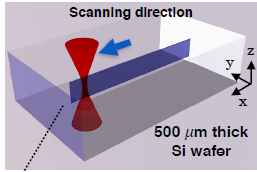
A new way to grow high-quality, wafer-scale graphene measuring between 100 and 300 mm across has been developed by researchers in the US and UK. The feat is a major advance since a size of 300 mm represents the silicon wafer-scale standard and means that the carbon material might now be easily integrated with silicon – a major goal for graphene research.


Graphene, a sheet of carbon just one atom thick, is a promising material for making molecular electronic devices of the future thanks to its unique electronic and mechanical properties, which include extremely high electrical conductivity and exceptional strength. The first real-world applications of graphene devices will most likely involve combining the carbon material with silicon complementary metal-oxide-semiconductor (CMOS) technology. However, integrating graphene with Si CMOS has proved to be more difficult than first imagined since there is no reliable process capable of producing large-area graphene films that have the same high performance as chip-scale ones.


Researchers have already tried out several methods for growing wafer-scale graphene, including epitaxially growing the material on SiC wafers, reducing graphene oxide, chemical vapour deposition (CVD) on metal thin films (such as copper) and recently CVD on hydrogen-terminated single-crystalline germanium surfaces. Among these techniques, CVD is probably the best in terms of compatibility with Si very large-scale integrated (VLSI) technology. However, there is a problem in that the graphene produced can be quite defective and so suffers from lower charge carrier mobilities.
The aixtron 300 mm growth system. Courtesy: K Teo


Now, a team of researchers led by Deji Akinwande of the University of Texas at Austin and Ken Teo of Aixtron Ltd in Cambridge, have grown CVD graphene films that measure between 100 and 300 mm across on polycrystalline copper films. The as-made polycrystalline graphene appears to have better charge carrier transport characteristics compared to previously synthesized poly- or single-crystalline wafers. What is more, the graphene covers over 96% of the substrates and has few defects – something that the researchers confirmed using a technique called Raman mapping.


Nano Tech Web: Graphene almost there for silicon wafer-scale standard
Belle Dumé, contributing editor at nanotechweb.org

Read more…

Manuel Corominas...

Manuel Corominas - see link below

El ingeniero Manuel Jalón Corominas, inventor de la fregona, ha fallecido esta madrugada en Zaragoza, a los 86 años, tras sufrir una parada cardiorrespiratoria.


Así lo ha confirmado uno de sus nietos, Alejandro, quien ha informado de que falleció en el hospital Miguel Servet de la capital aragonesa, de forma rápida y sin sufrir.


Manuel Jalón es el inventor de la fregona, pero en su currículum tiene además otras patentes muy importantes, como innovaciones en la jeringuilla desechable y otras de uso industrial.


Natural de Logroño (La Rioja), pasó la mayor parte de su vida en Zaragoza, ciudad de la que fue nombrado hijo adoptivo en 1992, aunque previamente vivió en Estados Unidos o en Finlandia, donde trabajó después de obtener el título de Ingeniería Aeronáutica -en Madrid- y de escribir su tesis doctoral sobre accidentes aeronáuticos.


*****


Manuel Jalon Corominas engineer, inventor of the mop, died this morning in Zaragoza, to 86 years , after suffering a cardiac arrest.


Manuel Jalon is the inventor of the mop on your resume but also has other important patents, such innovations in the disposable syringe and other industrial use.


Born in Logroño (La Rioja), spent most of his life in Zaragoza city that was named adoptive son in 1992, but previously lived in the United States or Finland, where he worked after earning the title of Aeronautical Engineering - in Madrid and writing his doctoral thesis on aviation accidents.


Spanish Inventor: Manuel Corominas

Read more…

How It Works...

Source: The Economist


I have four previous posts about BICEP2 and how the initial roll out (i.e. announcement) was heady for some; aggrandizement for others.


This next to the last paragraph at the bottom of The Economist sums it succinctly:


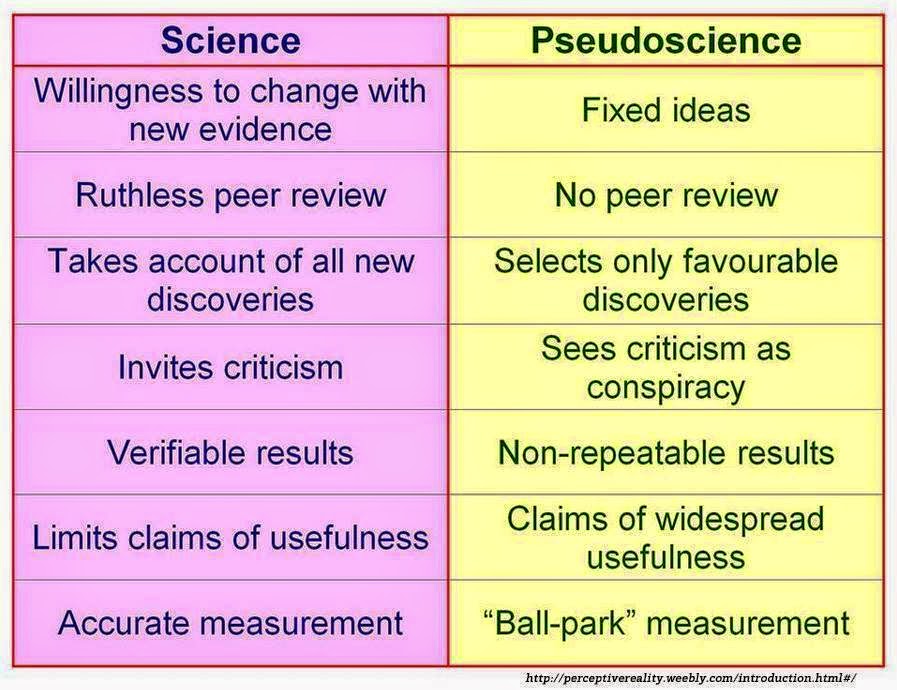
Rowing back on a triumphant announcement about the first instants of creation may be a little embarrassing, but the saga is a useful reminder of how science works. There is no suggestion that anyone has behaved dishonourably. Admittedly, the BICEP team’s original press conference looks, with hindsight, seriously overconfident. More information-sharing between the various gravitational wave-hunters, all of whom guard their data jealously, might have helped tone down the triumphalism. But science, ideally, proceeds by exactly this sort of good-faith argument and honourable squabbling—until the weight of evidence forces one side to admit defeat.


Now, the last paragraph points to a joint paper that's coming from the European Planck Telescope & BICEP2, (open adversaries to) the BICEP2 team. This seems confusing to those that would use this to point to scientific findings as "just theory," and if the scientists were so sure, they wouldn't change their minds on it. It atomizes the academy and politicizes reported results.


This however, is the nature of science and how it works.


There has to be an understood release to public scrutiny - not at all like (emphasis: unequal to) opinions trolled on Social Media - but peer review, which can be brutal for the uninitiated.


Whatever your findings are, become vetted by like-trained professionals who will first attempt to: 1. Read and understand your report and its results; 2. Using the conditions you've described in your paper, attempt to simulate and/or duplicate or get statistically close to your reported results within an acceptable percent error range.


The pseudosciences are not apt to subject themselves to this kind of scrutiny, often becoming openly hostile to any challenge to their veracity. The projected accusation is usually the scientific community is close-minded, reactionary and projecting a "religion of secular humanism."


All scientists are not humanists, that is a generalization. However, for a field to call itself a "science," it must be willing to allow this kind of public scrutiny, and if proven wrong: acquiescence to the prevailing evidence. Otherwise, it is mere notion and political canard for manipulation of a public that wishes to hear it for their own comfort at the sacrifice of their advancement and empowerment.


How Stuff Works:

How The Scientific Method Works
Scientific Method Steps
Scientific Method Videos
History of the Scientific Method

#P4TC: Ibn al-Haytham

Read more…

Michael E. Lopez-Alegria...

International Space Station Imagery

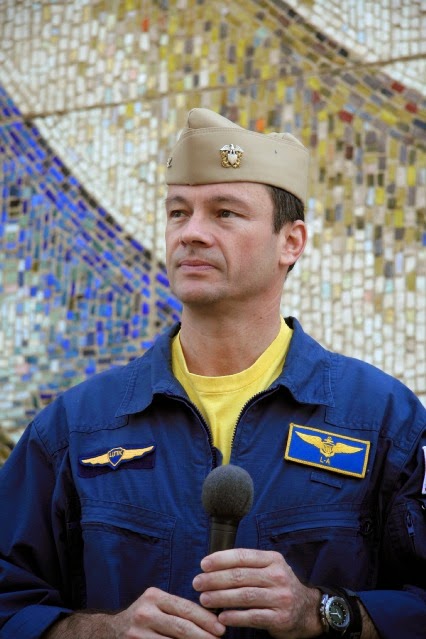
MICHAEL E. LOPEZ-ALEGRIA (CAPTAIN, USN, RET.)

NASA ASTRONAUT (FORMER)

PERSONAL DATA: Born May 30, 1958, in Madrid, Spain, and grew up in Mission Viejo, California. Lopez-Alegria enjoys sports, traveling and cooking and is interested in national and international political, economic and security affairs.


EDUCATION: Graduated from Mission Viejo High School, Mission Viejo, California, in 1976; received a bachelor of science degree in systems engineering from the U.S. Naval Academy in 1980 and a master of science degree in aeronautical engineering from the U.S. Naval Postgraduate School in 1988. Graduate of Harvard University’s Kennedy School of Government Program for Senior Executives in National and International Security. Speaks Spanish, French and Russian.


EXPERIENCE: Following flight training and designation as a Naval Aviator in 1981, Lopez-Alegria served as a flight instructor and then as a pilot and mission commander of EP-3E aircraft. In 1986, he was assigned to a 2-year cooperative program between the Naval Postgraduate School in Monterey, California, and the U.S. Naval Test Pilot School in Patuxent River, Maryland. His final tour before being assigned to NASA was at the Naval Air Test Center as an engineering test pilot and program manager. He has accumulated more than 5,700 pilot hours in over 30 different aircraft types.


NASA EXPERIENCE: Lopez-Alegria reported for training to the Johnson Space Center (JSC) in August 1992. Following a year of training and designation as an astronaut, he was first assigned to be the Astronaut Office technical point of contact to various space shuttle project elements. Lopez-Alegria was then assigned to Kennedy Space Center (KSC), where he provided crew representation on orbiter processing issues and support during launches and landings. Following his first spaceflight, he served as NASA Director of Operations at the Yuri Gagarin Cosmonaut Training Center in Star City, Russia. After his second mission, he led the International Space Station (ISS) Operations branch of the Astronaut Office. Following his third spaceflight, he was assigned as the technical liaison to JSC’s Extravehicular Activity (EVA) Office. A veteran of four space flights, Lopez-Alegria has logged more than 257 days in space and performed 10 spacewalks totaling 67 hours and 40 minutes of EVA. He retired from the Navy in June 2008 and left NASA in March 2012. Lopez-Alegria currently serves as President of the Commercial Spaceflight Federation in Washington, D.C.


NASA: Michael E. Lopez-Alegria, Captain, US Navy (retired, former astronaut)

Read more…

1st Quantum Logic Operation...

Technology Review

TECHNOLOGY REVIEW: The first teleportation of a photon inside a photonic chip illustrates both the potential for quantum computation and the significant challenges that lay ahead.


Back in 2001, an obscure group of theoretical physicists proved a remarkable result. They showed that it was possible to build a quantum computer out of ordinary optical components, such as mirrors, lenses, lasers and so on.


That was something of a surprise. Until then, physicists had thought that quantum computing would only be possible using non-linear crystals and other exotic components that are hard to control.


The prospect of using ordinary bits and pieces has an important consequence. It immediately suggests that more powerful devices can be built simply by adding extra components. This problem of scalability has always plagued other attempts to build quantum computers.


The reaction from the theoretical physics community was barely controlled excitement. But in practice, this approach has never lived up to its early promise. That’s because it is hard to build even ordinary optical components into chip-like devices that can be scaled like conventional silicon chips. It is just not possible to manufacture them with the required performance and tolerances.


Today, Benjamin Metcalf at the University of Oxford and a few pals show how they are tackling these problems while aiming for the ultimate goal of scalable quantum computation. These guys have built the first self-contained photonic chip capable of teleportation, one of the fundamental logic operations necessary for quantum computation. The device is a proof-of-principle demonstration that scalable quantum computers of this type are firmly in the crosshairs of experimental physicists. But it also reveals that significant challenges lay ahead.


Physics arXiv: Quantum teleportation on a photonic chip
Benjamin J. Metcalf, Justin B. Spring, Peter C. Humphreys, Nicholas Thomas-peter, Marco Barbieri, W. Steven Kolthammer, Xian-min Jin, Nathan K. Langford, Dmytro Kundys, James C. Gates, Brian J. Smith, Peter G. R. Smith, Ian A. Walmsley

Read more…

Arturo Pineda Alcaraz...


Geothermal power is the largest source of economically and technically feasible energy now available in our planet. It derives from the molten mass filling the inner core of the earth, over which the surface on which we live forms a relatively thin crust. Problems with geothermal energy are that technology for its use is new and little known, and it is accessible only in the earth's "hot spots." With these the Philippine archipelago is well endowed, located as it is on the "Pacific Ring of Fire." When accurately understood and wisely used this immense arc of tectonic and volcanic activity that girdles the Pacific Ocean, previously only feared for its earthquakes and eruptions, can become a major benefactor.


The use of geothermal heat is not new. Both Norse Vikings who settled Iceland more than 1,000 years ago and American Indians used geothermal geysers for cooking and baking. Maoris, who settled New Zealand some 600 years ago, grew their sweet potatoes in geothermally heated gardens.


The first industrial harnessing of steam from the earth began in northern Italy more than half a century ago, but the largest geothermal installation today is at The Geysers in California where dry steam readily lends itself to conventional generating, providing more than enough electric power for the city of San Francisco. However most of the geothermal energy available in the Philippines and elsewhere is wet steam—70 percent of production from a well may be hot water—and this demands a different and more difficult technology.


ARTURO PINEDA ALCARAZ was born in Manila in 1916 and grew up in Baguio where his father was city auditor during the gold mining boom. After studying a year at the University of the Philippines, ALCARAZ transferred to Mapua Institute of Technology when it offered the first degree in mining engineering. He earned a masters degree in geology at the University of Wisconsin and returned home in 1941 to be assigned by the Bureau of Mines to the island of Busuanga. Next posted to the Weather Bureau, its director, Maximo Lachica, introduced him to the science of seismology.


In 1952 the Philippine Congress responded to the destructive eruptions of Mount Hibok-Hibok on Camiguin Island by creating the Commission on Volcanology. Assigned as Chief Volcanologist, ALCARAZ began to pursue more fully the study of volcanos in order to improve eruption warning and assess possibilities for use of stored heat beneath them.


The first electric bulb in the Philippines lit by earth-heat energy was in Tiwi, Albay, on April 12, 1967. Three years later President Ferdinand Marcos set apart two geothermal reservations to be administered by the National Power Corporation (NPC), to which ALCARAZ transferred in 1974 as Chief of the Geothermal Division. The NPC, in cooperation with Philippine Geothermal, Inc., a subsidiary of Union Oil Company of California, has since brought on stream 550 megawatts of power at Tiwi and at Mac-Ban near Los Banos, making the Philippines the largest producer of geothermal electric energy from wet steam in the world. Meanwhile major geothermal energy fields in Leyte and Negros are under development by the Philippine National Oil Company Energy Development Corporation, with the cooperation of New Zealand and specialists from elsewhere. Present production is scheduled to be multiplied six times in the next seven years, thus further cutting down on oil imports.


Ramon Magsaysay Award Foundation: Alcaraz, Arturo Pineda

Read more…

Microfluidic Self-Assembly...

Technology Review

TECHNOLOGY REVIEW: When it comes to building microscopic devices, one of the most promising ideas is to exploit the process of self-assembly. In this way, complex structures can be created by combining building blocks under natural circumstances.


This kind of self-assembly mechanism dominates at the molecular scale, where it is responsible for the construction of most biomolecules. At the heart of this mechanism is Brownian motion which effectively mixes and jiggles molecules so that they rapidly find their place in incipient structures. This is a powerful process that can form hugely complex machines such as the ribosome, a molecular device for synthesizing proteins.


One recent idea is to use colloids rather than molecules as the building blocks for even more advanced structures. Colloids are insoluble, nanometre-scale particles mixed in water. These particles can be chemically engineered to bind together to form specific structures.


But as the building blocks become bigger, it takes longer for Brownian motion to jiggle the blocks into the appropriate locations. So self-assembly take significantly longer. In fact, it can take thousands of seconds to synthesise a single colloidal molecule. At that rate, a millimetre cube containing 1 billion colloidal molecules would take 30 years to form.


Clearly, that is far too slow for any kind of industrial process, so chemists have been looking for ways to speed up colloidal self-assembly. Today, Bingqing Shen at ESPCI (the Paris Institute of Technology) in France and a few buddies say they’ve found an entirely new way to assemble structures on this scale that should reduce manufacturing time by orders of magnitude.


Physics arXiv:
Self-Assembly Driven By Hydrodynamic Interactions In Microfluidic Devices
Bingqing Shen, Joshua Ricouvier, Mathilde Reyssat, Florent Malloggi, Patrick Tabeling

Read more…

Victor Celorio...

“The first time I saw a laser printer, I thought about making books with it.”

Born July 27, 1957 in Mexico City. Victor is an inventor who obtained patents for the technology popularly known as InstaBook or Book On Demand, as well as that of Distributed Printing technology in which an e-book is distributed among as many printing centers as required for immediate production and delivery, thereby creating a vast network of digital bookstores and libraries.


At a young age Celorio had a huge appreciation for the written word. Celorio loved to read and wanted to become a writer. Unfortunately there were not many bookstores in the area he lived in and always had a hunger for more books. This is where his idea to make books more accessible started, from his own battle in obtaining them. Celorio knew that books not only needed to be more accessible but affordable. The problem with publishing as Celorio saw it was actually found in the distribution system. Typically, a book retailer orders the number of books it thinks it can sell. But should the title prove to be popular, the store may not be able to order more if the publisher’s inventory is depleted. Alternately, small stores can’t afford to keep slow moving titles in stock. With these thoughts in mind, the idea for Print on Demand technology was born.


Amazing Mexicans: Victor Celorio, Inventor

Read more…

A Line in the Sand...

Please Do Not Spin the Moon

...rather than our heads. Although, I think this might be an Emu.


The National Academies - Science, Engineering, Medicine, Research - has a page called "America's Climate Choices." I feel our coy obfuscation for the moneyed has reduced our time necessary to respond. As a democratic republic, we should demand more of our elected officials and the sacred trust of representative government.


Especially in this country, there's obviously a litmus test on how much science one can deny. There was a People's Climate March in New York City last Sunday, and you wouldn't know it from most corporate-owned media. Google (the owners of Blogger) had to be embarrassed at a shareholder's meeting by climate activists to finally sever ties with ALEC - responsible for not only climate change denial and deniers, but the authors of "Stand Your Ground" legislation that has resulted in fostering a frontier climate in (at least on the calendar) a modern republic; a modern trail of tears and blood beyond Oklahoma's Native American history.


The Sociological Quarterly published a riveting study of the politicization and polarization of climate change in America in 2010 by Aaron C. McCright and Riley E. Dunlap. It's more than that: it's now whether we accept reality represented as data gathered and analyzed, or unicorns.


When someone asks me "do you believe in global warming"; "do you believe in the Big Bang"; "do you believe in Evolution" they are expressing articles of faith, which the Constitution freely allows. My response is usually: "Do you believe in the Pythagorean Theorem?" Blank stare...crickets..."of course I do!" Or the other one: "that's avoiding the question." I calmly state, no it's not. Not in any particular order:


A Belgian priest named Georges Lemaître first suggested the big bang theory in the 1920s when he theorized that the universe began from a single primordial atom. The idea subsequently received major boosts by Edwin Hubble's observations that galaxies are speeding away from us in all directions, and from the discovery of cosmic microwave radiation by Arno Penzias and Robert Wilson. National Geographic


Science never takes places in a void and evolutionary thought is no exception. Although Charles Darwin is considered to be by many the "father" of evolutionary thought, he was in fact aided and guided by the works of many scientists before him. The theories and ideas proposed by his predecessors were limited to the information available at the time. Darwin himself had no knowledge of genetics and therefore, his theory of natural selection as an explanation of evolution was based solely on what he observed and knew at the time. AAAS Science Net Links


Even though Pythagoras' name is on the theorem, several other people - the Babylonians (now Iran and Iraq), China and India - all had possibly discovered it well before his birth in Samos, Greece.


I present an embed (a link in some platforms) I fetched from the National Academy's site. Once opened, start with the formula bar, education for those open to it.

Read more…

Luis Ernesto Miramontes Cardenas...


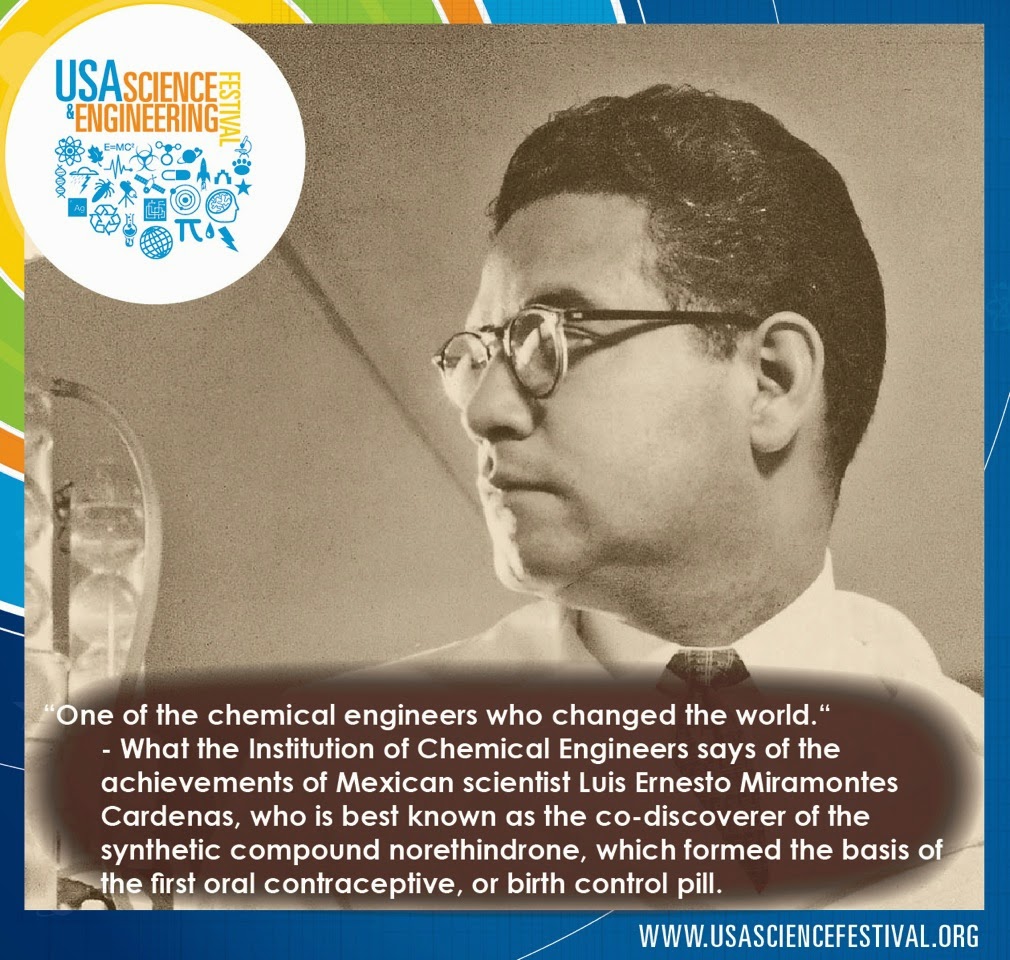
Luis Ernesto Miramontes Cardenas -- Mexican Chemical Engineer


At age 25, he co-discovered the synthetic compound norethindrone, which formed the chemical basis for the first oral contraceptive, or birth control pill.


Luis Ernesto Miramontes Cardenas was just a 25-year-old undergraduate chemistry student when he began at Syntex Corporation, a fledgling biochemical company in Mexico City, where he joined the research team of senior chemists Carl Djerassi of Austria, and Hungarian-born George Rosenkranz. Luis would later make science history with them.


Other Achievements: For his role in the development of the birth control pill, Luis (who as a chemical engineer also made his mark in other areas of his field -- from organic chemistry to petrochemistry and atmospheric chemistry) was bestowed with numerous awards and honors. Among them: Receiving the Mexican Prize in Chemistry; being elected as one the world's most influential chemical engineers of all time by the Institution of Chemical Engineers (IChemE), and named among the three most important Mexican chemists of all time.


Carl Djerassi, George Rosenkranz, and Luis Miramontes were granted US patent 2,744,122 for "oral contraceptives" on May 1, 1956. *

Education: He obtained his Degree in chemical engineering at the Universidad Nacional Autónoma de México (UNAM), and was a founding researcher of the Institute of Chemistry of at UNAM. In addition, Luis served as professor on the Faculty of Chemistry at UNAM, director and professor of the School of Chemistry at the Universidad Iberoamericana, and deputy Director of Research at the Mexican Institute of Petroleum.


USA Science Festival: Luis Ernesto Miramontes Cardenas

*About.com: Top List of Mexican Inventors, Mary Bellis

Read more…

Zero-Friction Quantum Engine...

Scientists have devised a way to run a quantum cycle based on the use of quantum shortcuts to adiabaticity, where friction-like effects are quenched. Shown are the four steps of a quantum Otto cycle, where heat enters (exits) the working medium and those where work is performed by (done onto).
Credit: A. del Campo, et al. ©2014 Nature Scientific Reports

(Phys.org) —In real physical processes, some energy is always lost any time work is produced. The lost energy almost always occurs due to friction, especially in processes that involve mechanical motion. But in a new study, physicists have designed an engine that operates with zero friction while still generating power by taking advantage of some quantum shortcuts.


The laws of thermodynamics successfully describe the concepts of work and heat in a wide variety of systems, ranging from refrigerators to black holes, as long as the systems are macroscopic. But for quantum technologies on the micro- and nano-scale, quantum fluctuations that are insignificant on large scales start to become prominent. As previous research as shown, the large quantum effects call for a complete reformulation of the thermodynamics laws.

What a quantum version of thermodynamics might look like is not yet known, and neither are the limitations or possible advantages of the quantum devices that would be described by such laws. However, one intriguing question is whether it may be possible to build a reversible quantum engine—one in which the engine's operation can be reversed without energy dissipation (an "adiabatic" process *).


In the new paper, the physicists have shown one example of a quantum engine that is "super-adiabatic." That is, the engine uses quantum shortcuts to achieve a state that is usually achieved only by slow adiabatic processes. This engine can achieve a state that is fully frictionless; in other words, the engine reaches its maximum efficiency, while still generating some power.


* See:

Hyper Physics: Adiabatic Processes
Princeton Wiki: Adiabatic process

Phys.org: Physicists design zero-friction quantum machine

Read more…

Dr. Angel Alcala...

Dr. Angel Alcala. See Famous Scientists link below

Angel Alcal has more than thirty years of experience in tropical marine resource conservationa. Angel Alcala is considered a world class authority in ecology and biogeography of amphibians and reptiles, and is behind the invention of artifical coral reefs to be used for fisheries in Southeast Asia. Angel Alcala is the Director of the Angelo King Center for Research and Environmental Management.


Angel Alcala - Degrees:


Undergraduate degree Silliman University

Ph.D. Stanford University [1]


Angel Alcala was born on the first of March in 1929. He and his family were from Cauayan, Negros Occidental. His mother Crescenciana Chua and his father Porfirio Alcala were residing in Caliling, a coastal village in Negros Occidental. Because of his exposure to a coastal setup, it is no wonder where Angel Alacala’s awareness and love for marine life came from. While they lived in a humble and rural setup, their simple living had always been supported by the bounty of the sea.


His early years in school had been indicative of his thirst for knowledge and desire to excel. He finished his high school years in Kabankalan Academy where he was one of the scholars. He had also been an active member of the academy’s debate team, and had taken part in their Boy Scout troop as well as other extra-curricular activities.


It was in 1948 when Angel Alcala took his pre-medicine course. He had his courses which made him earn his undergraduate degree in Silliman University, the oldest American building and institution in the Philippines, and the oldest university in Asia that was founded by the Americans. Because of his promising potential and evident intelligence, he was later on accepted to be a student of the University of the Philippines’s College of Medicine.


However, Alcala decided not to let the opportunity go due to the financial circumstances that his family faced. In 1951, he had finished the biological studies he started at the Silliman University and he graduated as the magna cum laude of his batch. Despite having given up the opportunity at the University of the Philippines, Angel Alcala was marked to make a change in history after his graduation from the Silliman University.


Walter C. Brown who happened to be one of the Fulbright professors of Stanford University arrived at Silliman University. He had then taken Alcala as one of his protégés and their partnership paved the way for numerous scientific researches concerning biology in the Philippines. They worked together on several publications and went on numerous field trips to come up with data for their researches and publications.


Through the support of Walter Brown, Alcala was granted a well-deserved Fulbright/Smith-Mundt Fellowship which was what had helped him earn his master’s degree. In 1964, Alacala went back to Stanford to finish his doctorate and two years later, he became one of the associate professors of Silliman University. [2]


1. Filipino inventors: Angel Alcala - Filipino Biologist, Mary Bellis
2. Famous Scientists: Angel Alcala, PhD

Read more…

Polonium-209...

Credit: Irvine/NIST

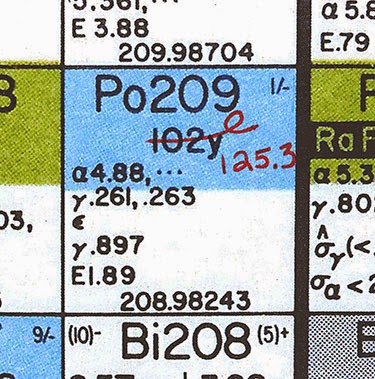
Scientists at the National Institute of Standards and Technology (NIST) have determined* that polonium-209, the longest-lived isotope of this radioactive heavy element, has a half-life about 25 percent longer than the previously determined value, which had been in use for decades.


The new NIST measurements could affect geophysical studies such as the dating of sediment samples from ocean and lake floors. They often employ Po-209 as a tracer. Because sediment cores are used for determining human impact on the environment over the past century, the new measurement could impact these studies as well as other environmental measurements and biological assays.


NIST: Polonium's Most Stable Isotope Gets Revised Half-Life Measurement, Chad Boutin

*R. Collé, R.P. Fitzgerald and L. Laureano-Perez. The half-life of 209Po: revisited. Journal of Physics G: Nuclear and Particle Physics 41 (2014) 105103, doi:10.1088/0954-3899/41/10/105103

Read more…

Dr. Ellen Ochoa...


1st Hispanic Female Astronaut: text source here

Originally September 26, 2013 with update embeds below...

Ellen Ochoa was born on May 10, 1958 in Los Angeles, CA. She received her bachelor of science degree in physics from San Diego State University, and a master of science degree and doctorate in electrical engineering from Stanford University.


Ellen Ochoa’s pre-doctoral work at Stanford University in electrical engineering led to the development of an optical system designed to detect imperfections in repeating patterns. This invention patented in 1987, can be used for quality control in the manufacturing of various intricate parts. Dr. Ellen Ochoa later patented an optical system which can be used to robotically manufacture goods or in robotic guiding systems. In all, Ellen Ochoa has received three patents most recently one in 1990.


In addition to being an inventor, Dr. Ellen Ochoa is also a research scientist and astronaut for NASA. Selected by NASA in January 1990, Dr. Ellen Ochoa is a veteran of three space flights. She has logged over 719 hours in space, her most recent mission was a 10 day mission aboard the space shuttle Discovery in May of 1999.


Read more…

Narciso Monturiol...

SellosMundo.com

Narciso Monturiol was a Catalonian physicist and inventor who researched underwater navigation and designed an early submarine. In 1856, Narciso Monturiol built a submarine called the "Ictineo".


Despite popular folklore, Narciso Monturiol did not build the very first submarine. (Our "Timeline of Submarine History" illustrates that submarines were being built as early as 1620.) However, Narciso Monturiol did build one of the most advanced submarines available at the time.


Narciso Monturiol was inspired to invent a device to aid the Spainish coral divers who fished off the coast of Cadaques. His submarine was intended to save the divers manual labor and reduce their exposure to diving risks. In 1859, Narciso Monturiol's Ictineo submarine was first launched from Barcelona and proved to be submergable for up to two hours. The Ictineo was manually powered by sixteen men turning the propeller. By 1864, Narciso Monturiol had redesigned the Ictineo adding a steam generator for power. The Ictineo could then reach depths of up to thirty meters, and stay submerged for up to seven hours.
Poster Lounge


One interesting fact about the Ictineo submarine is that Jules Verne, the famous writer of "20,000 Leagues Under The Sea" based his fictional Nautilus submarine after the Ictineo.


Hispanic Inventors: Narciso Monturiol

Read more…

Farpoint...


Every now and again, I watch "Encounter at Farpoint," the inaugural two-part episode of Star Trek: The Next Generation, and marvel at how well the story line was written, specifically the back story was fleshed-out; the acting mature and impeccable. I, like a lot of Trekkie fans at the time gave the series a broad brush of disappointment, especially at seeing a 137-year-old cranky Admiral Leonard "Bones" McCoy - we were lamenting our old Trek and not being fair to the then "new" one. It makes me miss good television.


The above somewhat "Nazi-like" banner hung in the kangaroo court the entity Q conjured Captain Picard and crew into. Q stood as judge, jury and presumably executioner, but also witness and soothsayer: who but the Q-continuum knew the Federation would eventually make contact with The Borg? Captain Picard's defense in a nutshell: yes humanity was once quite barbarous; we were guilty of discrimination and inequality, but we were in that fictional "then" as far from the depiction of a 21st century court post WWIII as he and his crew was far from Earth.


The Optimum Movement was a political movement that came about during the mid-21st century on Earth, and spread to a number of nations—including Great Britain and the United States of America. They are believed to be one of the instigators behind the Third World War, and the following post atomic horror. Memory Beta (please forgive the annoying embed commercials). The story was further "made flesh" in the novel Federation by Judith-Reeves Stevens, which I've read - an excellent Kindle read.


En route to Farpoint, Captain Picard and his crew first meet "Q." The mysterious and powerful being denounces the human race as barbarians and challenges the crew of the Enterprise to disprove his belief. If Picard and his crew are not persuasive in their arguments, they will be sentenced to death.


It's interesting in the 21st century, another author I've read - Naomi Klein - has written "This Changes Everything: Capitalism vs. The Climate." (I'd also recommend her book "The Shock Doctrine: The Rise of Disaster Capitalism.")


Star Trek in the mind of Gene Roddenberry was born on the back of the Cold War with the former Soviet Union possibly becoming a hot nuclear one, and on the heels of the Civil Rights Movement, thus projecting forward a positive, more accepting of science, less xenophobic, survivable future.


Nuclear war would be a fool's errand - whether as in Federation we established colonies on off worlds, the conflagration would leave swaths of Earth clearly uninhabitable for thousands of years. Corpses would have no care who actually "won" such an insane engagement. The Trek universe alludes to the discontinued existence of Washington, Moscow and other global capitals, hence the location of the fictional United Federation of Planets in San Francisco.


Ms. Klein's treatise seems to share a similar concern (book description):


In "This Changes Everything" Naomi Klein argues that climate change isn't just another issue to be neatly filed between taxes and health care. It’s an alarm that calls us to fix an economic system that is already failing us in many ways. Klein meticulously builds the case for how massively reducing our greenhouse emissions is our best chance to simultaneously reduce gaping inequalities, re-imagine our broken democracies, and rebuild our gutted local economies. She exposes the ideological desperation of the climate-change deniers, the messianic delusions of the would-be geoengineers, and the tragic defeatism of too many mainstream green initiatives. And she demonstrates precisely why the market has not—and cannot—fix the climate crisis but will instead make things worse, with ever more extreme and ecologically damaging extraction methods, accompanied by rampant disaster capitalism.


In Escape From Freedom, Eric Fromm makes an excellent case that the Renaissance and the Protestant Reformation cooperated in strange, significant ways: The Renaissance came after the fall of European hierarchies/caste systems, i.e. if your father was a carpenter, you were likely to be as well as your sons, etc. This gave rise to the individual and capitalism, but isolated the individual from the familiar; the safe. Luther and Calvin appealed to the poor and middle class respectively: the former for a better hereafter life, but disdain for opposing the status quo; the latter a fatalism of being born predestined to either going to heaven or hell - saved or condemned. The mental gymnastic escape is if you were "doing good work," you were probably going to heaven, and thus part of the "chosen." This mentality coupled with the rise of wealth in the hands of a moneyed few that ultimately primed the populace for rule by a single Fuhrer and totalitarian, authoritarian rule. He spoke of the rise of inequality, concentration of wealth with [that then] 1%; their influence on politics, religion, education - I could swear I was reading current headlines.


We may or may never, even with great research - achieve warp drive. Nor possibly not ever encounter omnipotent watcher beings like the Q-continuum. But we could - here - make mature decisions as a species, to reduce inequality - thus the crime and terrorism it inspires - and avoid our own failings without going through painful lessons and casualties - caused by, climate, inequality, nuclear or otherwise.


We don't have to go far from home to do that.

"Those who cannot remember the past are condemned to repeat it." George Santayana (16 December 1863 in Madrid, Spain – 26 September 1952 in Rome, Italy) was a philosopher, essayist, poet and novelist.

Read more…

Clatonia Joaquin Dorticus...


Cuban born, Clatonia Joaquin Dorticus of Newton, New Jersey invented an improved photographic print and negative wash machine (see patent drawing). During the process of developing a photographic print or negative, the product is soaked in several chemical baths. The print wash neutralizes the chemicals in each bath process, so that the time the chemicals effect a print can be exactly controlled. Clatonia Joaquin Dorticus believed his method would eliminate over washing that could soften the photograph too much.


Clatonia Joaquin Dorticus also invented an improved machine for embossing photographs (see patent drawing left). His machine was designed to both/either mount or emboss a photographic print. Embossing is a method or raising parts of a photograph for a relief or 3D look.


Clatonia Joaquin Dorticus's other inventions included an applicator for applying color liquid dyes to shoes and heels, and a hose leek stop.

List of patents:

#535,820, 3/19/1895, Device for applying coloring liquids to sides of soles or heels of shoes
#537,442, 4/16/1895, Machine for embossing photographs
#537,968, 4/23/1895, Photographic print washer
#629,315, 7/18/1899, Hose leak stop


Clatonia Joaquin Dorticus - invented an improved photographic print wash machine and method,
Mary Bellis

Read more…

Secession...

Know Your Meme

noun

the action of withdrawing formally from membership of a federation or body, especially a political state.

"the republics want secession from the union"


historical

the withdrawal of eleven southern states from the Union in 1860, leading to the Civil War.

singular proper noun: Secession; noun: the Secession


Scotland almost seceded from the UK. 1 in 4 Americans want to, or are at least open to seceding from the US. Kind of goes hand-in-hand with the paint job of the current Chief Executive in the "White House."

In Europe, particularly Scotland and Barcelona, the secession desire is born primarily from the recent economics of the Great Recession. There is a romanticism about secession without a clear appreciation of its history - at least in the US - and the logistics required to pull it off is daunting, if not quite simply impossible:


- The South developed their own currency;

- They had products to trade - agriculture, cotton, import/export, shipbuilding;

- They had slavery, i.e. free labor to leverage based on inhumane, brutish psychopathy longed for as "southern tradition."


Since the election and reelection of the country's 1st black president, I've heard wild Utopian fantasies about southern states forming "independent nations," yet asking them what their main product to trade on the global market, the answer amounts to...crickets. Scotland wanted "out" of the UK, yet wanted the luxury of continued usage of the British pound - see "bullet one" above.


"Some of the secessionists in these movements are charmingly idealistic do-it-yourselfers in a long American Utopian tradition. Others are disturbing-sounding provincials hostile to the diversity of large societies. Some are community-minded folks who think smaller polities do better at serving their own needs. Others are ornery individualists who don't want the community butting into their affairs at all. Under normal circumstances, these interesting assortments of free-thinkers don't attract much support." The Economist


Politicians have fostered a tribalism and partisanship that only functions to ensure they keep their seats. The British Prime Minister David Cameron is relieved he still has a job. Rick Perry really was pandering to his crowd as he suggested secession, coincided with running for president in a red state. It helps to dumb down the population - eliminating AP history; fostering creationism in science classes - so constituents are so confused, so bewildered they can't question what you're doing. Any real technological advances are funded - endowments and think tanks to make the rich richer still.


For the rest: scraps from the opulent table...for Lazarus.


Tomorrow: Farpoint

Read more…

Maven...

Source: NASA.gov, Image Credit: NASA/GSFC

NASA’s Mars Atmosphere and Volatile Evolution (MAVEN) spacecraft is nearing its scheduled Sept. 21 insertion (this Sunday) into Martian orbit after completing a 10-month interplanetary journey of 442 million miles.


Flight Controllers at Lockheed Martin Space Systems in Littleton, Colorado, will be responsible for the health and safety of the spacecraft throughout the process. The spacecraft’s mission timeline will place the spacecraft in orbit at approximately 9:50 p.m. EDT.


“So far, so good with the performance of the spacecraft and payloads on the cruise to Mars,” said David Mitchell, MAVEN project manager at NASA’s Goddard Space Flight Center in Greenbelt, Maryland. “The team, the flight system, and all ground assets are ready for Mars orbit insertion.”


The orbit-insertion maneuver will begin with the brief firing of six small thruster engines to steady the spacecraft. The engines will ignite and burn for 33 minutes to slow the craft, allowing it to be pulled into an elliptical orbit with a period of 35 hours.


Following orbit insertion, MAVEN will begin a six-week commissioning phase that includes maneuvering the spacecraft into its final orbit and testing its instruments and science-mapping commands. Thereafter, MAVEN will begin its one-Earth-year primary mission to take measurements of the composition, structure and escape of gases in Mars’ upper atmosphere and its interaction with the sun and solar wind.


NASA.gov: NASA Mars Spacecraft Ready for Sept. 21 Orbit Insertion
Dwayne Brown

Read more…