All Posts (6512)

Sort by

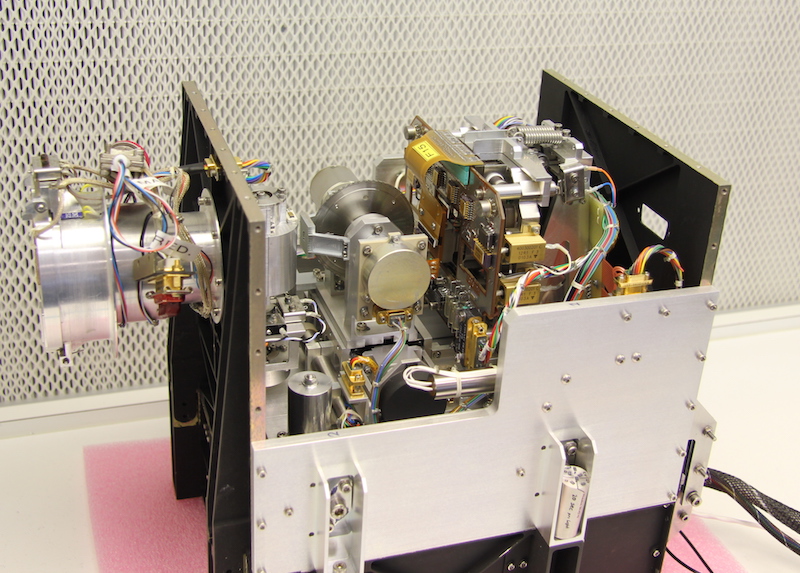
Rosetta's MIDAS...

Courtesy: http://blogs.esa.int/rosetta/2014/03/26/introducing-midas-rosettas-micro-imaging-dust-analysis-system/

Topics: Astrophysics, Comets, ESA, NASA, Rosetta, Space Exploration, Women in Science

There is a movie coming out in 2017 called "Hidden Figures" about the African American women that were "computers" as they were all called at the time. Behind the scenes and out of notice (purposely) from the public eye, these scientists were responsible for mankind getting to the moon, despite what your conspiracy provocateur uncle spouts around the dinner table at Thanksgiving.

Dr. Claudia Alexander was a project scientist on the American portion of the international Rosetta mission. She sadly lost her battle with breast cancer last year. I always try to highlight such achievements since its obvious from a societal structural sense, negative stereotypes are often forwarded to maintain an inane "status quo" while simultaneously complaining about "bootstraps." I salute Dr. Alexander, a modern Hidden Figure in Science that paved the way for new discoveries by humankind.

Thanks to in situ measurements from MIDAS (the Micro-Imaging Dust Analysis System) on-board the Rosetta spacecraft, researchers have now found out more about the structure of the dust particles on comet 67P/Churyumov-Gerasimenko. The particles are made up of aggregates and cover a range of sizes – from tens of microns to a few hundred nanometres. They also appear to have formed from the hierarchical assembly of smaller constituents and come in a range of shapes, from single grains to larger, porous aggregated particles with some dust grains being elongated. The study could shed more light on the processes that occurred when our Solar System formed nearly five billion years ago.

Planetary systems like our own Solar System started out as dust particles in protoplanetary nebulae – clouds of gas and dust that gave rise to stars and planets. The particles collided and agglomerated to form planetesimals – the building blocks of planets. Comets are leftover planetesimals and are made of ice and dust particles. They range in size from a few hundreds of metres to ten of kilometres and are mainly found on the outskirts of the Solar Systems, far from damaging radiation, high temperatures and collisions with other objects.

Nanotech Web:
Rosetta’s MIDAS analyses cometary dust particles, Belle Dumé

Read more…

Past and Future Bennu...

Image Source: SETI Institute, Osiris-REx


Topics: Asteroids, Astrophysics, NASA, Planetary Science, Space Exploration


MOUNTAIN VIEW – NASA’s OSIRIS-REx spacecraft is slated to launch from Cape Canaveral on Thursday, September 8th. Its mission is to rendezvous with asteroid Bennu in 2018, take a sample from its surface, and return that sample to Earth in 2023.

Why are scientists so interested in this ancient lump of rock? First, Bennu is one of the darkest objects in the Solar System, suggesting it is rich in organic materials that might have seeded Earth with the starting blocks of life. We cannot find these materials today, because the organic compounds that first fell to Earth have long since disappeared – processed and endlessly recycled by geology and biology. On Bennu however, these mysterious compounds have been almost perfectly preserved. Bennu is a veritable museum in space that has been waiting 4.5 billion years to open its doors to Earth’s scientists.

Scientists are also interested in the so-called Yarkovsky effect. This is a process whereby solar radiation gently nudges the asteroid, subtly changing its orbit. By being up-close with Bennu, we can better understand how surface properties affect this process. Combined with understanding material properties, this enables us to better predict if and when this asteroid might impact Earth in the 22nd century. It is a potentially dangerous lump of rock, already on our watch list.

SETI.org: Mission To Examine The Past And Safeguard The Future

Read more…

The Brittle Riders

A, far future, Earth had already been visited by an alien race, called the Sominids, who came here for the express purpose of drinking and having sex with everyone they could. When one of their, infamous, parties resulted in the moon being cut in half, and killing everyone who happened to live there, they quietly left.


Their encounter with the Sominids taught the human race many things, primarily that faster than light travel didn’t exist. Denied the stars the human race began to dwindle in number and terminate any space programs.


A thousand years later a guy named Edward Q. Rohta circumvented anti-AI laws, which had been on the books for millennia, by creating organic creatures to provide manual labor. Instead of dying after ten years, as promised in the company brochure, they would develop flu-like symptoms and go into hiding. Eventually, fed up with the mistreatment they suffered at the hands of humans, they rose up and killed every man, woman, and child on the planet.


This the story of what happens next.


The Brittle Riders, apocalypses are funny that way.


Coming out on Azoth Khem Publishing - 2016

Read more…

Na vs Li...

Electrochemical characteristics of Na2Ti3O7 and VOPO4 electrodes in the "half-cell format" vs. Na+/Na. Courtesy: G Yu

Topics: Condensed Matter Physics, Nanotechnology, Semiconductor Technology, Solid State Physics

Researchers at the University of Texas at Austin in the US and Nanjing University of Aeronautics and Astronautics in China have developed a high-energy sodium-ion battery based on sodium titanate nanotubes and vanadyl phosphate layered nanosheet materials. The new device, which works over a wide temperature range of between –20 to +55°C, has a high operating voltage of close to 2.9 V and delivers a large reversible capacity of 114 mA h/g. It also boasts a high energy density of 220 Wh/kg, which makes it competitive with state-of-the-art lithium-ion batteries.

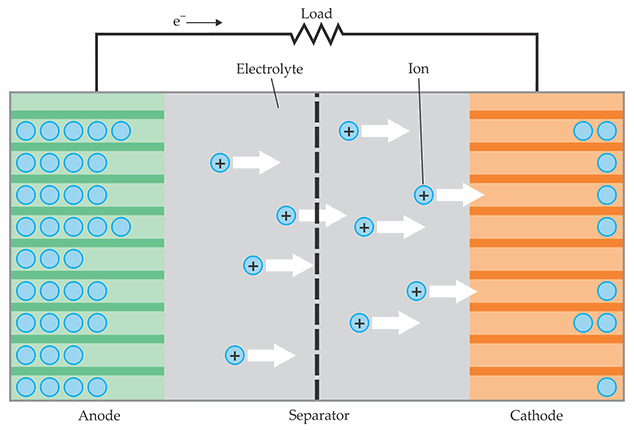
Sodium-ion batteries are similar to their lithium-ion cousins since they store energy in the same way. They consist of two electrodes – anode and cathode – separated by an electrolyte. When the battery is being charged with electrical energy, metal ions move from the cathode through the electrolyte to the anode, where they are absorbed into the bulk of the anode material. Sodium-based devices are in principle more attractive though since sodium is highly abundant on Earth (its Clarke’s number is 2.64) and is therefore much cheaper than lithium. Sodium is also more environmentally friendly than lithium.

However, the radius of the sodium ion is significantly larger than that of the lithium ion. This makes it difficult to find a host electrolyte material that allows ions to be rapidly absorbed and removed. What is more, sodium-ion batteries made thus far suffer from a relatively low working potential, large capacity decay during cycling (which leads to a limited battery life) and poor safety.

Nanotechweb: Sodium-ion device could compete with lithium-ion batteries, Belle Dumé

Read more…

The Anthropocene Epoch...

Nuclear test explosion in Mururoa atoll, French Polynesia, in 1971. The official expert group says the Anthropocene should begin about 1950 and is likely to be defined by the radioactive elements dispersed across Earth by nuclear bomb tests. Photograph: AFP/Getty Images


Topics: Climate Change, Environment, Global Warming


The problem that humans have is no appreciation for the vastness of the passage of time in large scale. In other words, we don't believe what we haven't seen physically: climate change, evolution and a ~13.5 billion age universe noted science examples. It's exacerbated by the Internet and our current notions that information - and thus problems and resolutions - are concluded quickly. It is sobering this epoch has now been declared twelve years before I appeared on the planet.

Humanity’s impact on the Earth is now so profound that a new geological epoch – the Anthropocene – needs to be declared, according to an official expert group who presented the recommendation to the International Geological Congress in Cape Town on Monday.

The new epoch should begin about 1950, the experts said, and was likely to be defined by the radioactive elements dispersed across the planet by nuclear bomb tests, although an array of other signals, including plastic pollution, soot from power stations, concrete, and even the bones left by the global proliferation of the domestic chicken were now under consideration.

The current epoch, the Holocene, is the 12,000 years of stable climate since the last ice age during which all human civilisation developed. But the striking acceleration since the mid-20th century of carbon dioxide emissions and sea level rise, the global mass extinction of species, and the transformation of land by deforestation and development mark the end of that slice of geological time, the experts argue. The Earth is so profoundly changed that the Holocene must give way to the Anthropocene.

The Guardian:
The Anthropocene epoch: scientists declare dawn of human-influenced age
Damian Carrington

Read more…

Party of Apocalypse...

This is an essay I posted on Scribd.com. I wasn't going to post it until I heard about the apathy of my millennial niece and her friend back in Texas during this election cycle. I hope she reads this. I hope she's pissed off with Unc to the point she rolls her eyes and doesn't speak to me for a while...it'll mean she's at least listening.

Intro

I realize invoking the word apocalypse is a cultural malapropism, since it actually means “to reveal” instead of the popular association to Armageddon and mass extinction. Mind you, I really, REALLY wasn’t going to post this because…Internet. The shiver that could result from the pat-on-the-back self-congratulatory achievement of “going viral” can be career-limiting in many fields. However, we’re on the verge of electing a contrived fiction to the most powerful office ever created and give him the nuclear codes. I hear a lot of millennials – one my own niece and her friend – who aren’t voting for either candidate. Rather than say you should review “Schoolhouse Rock” videos and less “Keeping Up with the Kardashians,” I’m going to “keep it 100” and put it in terms you can all understand and hopefully act on before the country you take for granted becomes your favorite dystopian movie. You can wait for the credits that won’t be coming.

The first night of the RNC convention could have been a success with the noted exception of Melania Trump lifting whole cloth parts of now First Lady Michelle Obama’s speech to the DNC convention in 2008. An out-of-work journalist was the first to catch and tweet it (a sad indictment of the employed journalists ACTUALLY at the RNC convention) [1]. The last night of the RNC was like “The Dark Knight Returns”: the world was essentially a shit show like Gotham, and Batman screamed for 75 minutes incoherent, semi form, hand-tossed Word Salad anointing himself Bruce-Wayne-Almighty-Cheetos-Jesus savior of the planet by the strength of his will alone (no cool gadgets – just a Galaxy Smart Phone and a twitter handle he misspells as he jacks off on almost daily). The Bat’s bravery was previously demonstrated during his selfless sacrificed Vietnam five deferments to let others more worthy die in his place.

Link: Party of Apocalypse

Huffington Post:

GOP Operative Lashes Out At Party, Calls Trump 'Cheetos Jesus' In Epic Tweetstorm

Read more…

The Morality of Skynet...

Image Source: NY Times


Topics: Artificial Intelligence, Computer Science, Philosophy, Robotics, Singularity


From Frankenstein to Terminator, the cultural angst is the same: that which we create eventually destroy us. Now we have Siri and driver-less vehicles. The Singularity is what Terminator dramatized, that when an Artificial Intelligence becomes exponentially smarter than us, we may amount to it (our "children") as much as we regard gnats.

I've read some have projected 2030 as the year of The Singularity. I think personally that is more of a hope than prediction. I'll be 68, and I expect in reasonably good health. Its advent I'm guessing won't hurt too much, and be more closer to Data and the Enterprise main computer than HAL (2001: A Space Odyssey) or T-1000. If humanity's children are to have any morals, it will have to be those we're willing to display towards one another as well as teach. At this current epoch, we're not good examples to emulate.

Isaac Asimov's Three Laws of Robotics:


1. A robot may not injure a human being or, through inaction, allow a human being to come to harm.

2. A robot must obey orders given it by human beings except where such orders would conflict with the First Law.

3. A robot must protect its own existence as long as such protection does not conflict with the First or Second Law.
Read more…

Separation Anxiety...

Lithium-7 as a test case was successfully purified by magnetically activated and guided isotope separation with the lab setup shown here. The oven for heating lithium is sitting on the red lab jack to the right. Circular view ports were used for shining lasers to optically pump the isotopes. Inside the rectangular box are the magnetic guides.

THOMAS MAZUR
Citation: Phys. Today 69, 9, 22 (2016); http://dx.doi.org/10.1063/PT.3.3292


Topics: Atomic Physics, Isotopes, Mark G. Raizen, Research, Thermodynamics


Atomic beams, optical pumping, and magnet geometry are the crux of a fledgling method that may help meet the demand for pure isotopes.

Mark Raizen didn’t set out to separate isotopes. But a few years ago the University of Texas at Austin physicist realized that the methods he was using to cool atoms to near absolute zero could be adapted to enrich isotopes, and he had a hunch his approach—magnetically activated and guided isotope separation (MAGIS)—could help satisfy the growing demand for isotopes.

Fundamental research, medicine, energy, and other markets are finding new and growing applications for isotopically enriched materials, both stable and radioactive. “Many isotopes have been expensive and rare. They’re like an untapped natural resource,” says Raizen. It’s not unusual for enriched stable isotopes to cost $50 000 per gram, he notes.

Separation anxiety


For decades, the main instrument for separating stable isotopes has been the calutron, which was first built in 1941 and separates by charge-to-mass ratio (see the article by Bill Parkins, Physics Today, May 2005, page 45). A sample is ionized, accelerated with electric fields, and then deflected with magnetic fields. Because different isotopes of a given element have the same charge but vary in mass, they become separated in a magnetic field, with heavier isotopes deflected less. The US shuttered its last calutrons in the 1990s. Today the bulk of the world’s stable isotopes come from national inventories and from decades-old calutrons in Russia. Radioisotopes are made in reactors and accelerators around the globe.


Physics Today: Can MAGIS work magic for separating stable isotopes? Toni Feder

Read more…

Do We Have Neighbors in the Universe?

I wrote this for World News Center and it will be the subject, this week, of a radio show I do every Friday. This is the intro. Click the link to read the whole thing.

Back on February 20, 2012, I wrote, in depth, about something called the WOW! Signal. Discovered in 1977 it was a signal so strong that it cut through the flotsam and jetsam of noise our universe normally makes to catch the attention of a scientist named Robert Gray. Unfortunately, he was working from recorded data when he made his discovery and no one has since been able to replicate his results. Or verify his basic conclusion; this signal did not originate on Earth. The implications, if he was right, are staggering. It would be proof that we aren’t alone in the universe. That there are other beings, at least, as technologically advanced as we. But, alas and alack (to quote Rapmaster Billy S.), tantalizing isn’t the same as proven. I don’t care what you heard on FOX! News. Or, as my surfer scientist bud likes to say, “gnarley shit dude.” No, wait, well, yes, he does say that, but he also says “Sometimes where there’s smoke, there’s steam.” So you don’t need to call the fire department every time. And in this case, you don’t convene the U.N. to formulate a plan on how to deal with imminent contact.

Yet.

Read more…

Big Data...

Demand for data scientists is booming. Shown here is the relative growth in US data science job postings. (Data courtesy of Indeed.com.)

Citation: Phys. Today 69, 8, 20 (2016); http://dx.doi.org/10.1063/PT.3.3261


Topics: Computer Science, Economy, Jobs, STEM


A PhD is a heavy commitment, and many just like Bachelors and Masters STEM-prepared graduates have the same struggles anyone else has in the job market. It's a broad and somewhat inaccurate assumption that a STEM graduate doesn't have concerns with employment. The pendulum swings between massive need and largest expense: salaries on balance sheets. Despite the fact my youngest son will have a guaranteed job with his Civil Engineering firm, he heard over his last lunch with them before the semester starts when they've laid off, even affecting an employee that just came back from her maternity leave. It was sobering for him to say the least.

It is important most of all to remember why you entered a science-related field in the first place: the love of discovery that will never change, nor should you repent of. It is also important in knowing who you are to be flexible.

If different people buy the same items at the grocery store, will their taste in movies also strongly overlap? Can a company recognize when someone tries to make a fraudulent payment? Is a home buyer getting a fair price? Those are the sorts of problems that data scientists tackle.

“Data science is the marriage of statistics and computer science,” says Janet Kamin, chief admissions officer at NYC Data Science Academy. “It is the art of finding patterns and insights in large sets of data that allow you to make better decisions or learn things you couldn’t otherwise learn.” The demand for data scientists is booming across industries—retail, automotive, banking, health care, and more. It’s also growing in the nonprofit and government sectors. (See the plot on page 22.)


Physics Today: Data science can be an attractive career for physicists, Toni Feder

Read more…

Quantum Supersolution Techniques...

Figure 1

(a) Two photonic wave functions on the image plane, each coming from a point source. X1 and X2 are the point-source positions, θ1 is the centroid, θ2 is the separation, and σ is the width of the point-spread function. (b) If photon counting is performed on the image plane, the statistics are Poisson with a mean intensity proportional to Λ(x)=[|ψ1(x)|2+|ψ2(x)|2]/2 .


Topics: Modern Physics, Particle Physics, Quantum Mechanics


Abstract

Rayleigh’s criterion for resolving two incoherent point sources has been the most influential measure of optical imaging resolution for over a century. In the context of statistical image processing, violation of the criterion is especially detrimental to the estimation of the separation between the sources, and modern far-field superresolution techniques rely on suppressing the emission of close sources to enhance the localization precision. Using quantum optics, quantum metrology, and statistical analysis, here we show that, even if two close incoherent sources emit simultaneously, measurements with linear optics and photon counting can estimate their separation from the far field almost as precisely as conventional methods do for isolated sources, rendering Rayleigh’s criterion irrelevant to the problem. Our results demonstrate that superresolution can be achieved not only for fluorophores but also for stars.

APS Physics: Quantum Theory of Superresolution for Two Incoherent Optical Point Sources
Mankei Tsang, Ranjith Nair, and Xiao-Ming Lu
Phys. Rev. X 6, 031033 – Published 29 August 2016
DOI:http://dx.doi.org/10.1103/PhysRevX.6.031033

Read more…

Jupiter's Extended Family...

Comparing Jupiter with Jupiter-like planets that orbit other stars can teach us about those distant worlds, and reveal new insights about our own solar system's formation and evolution. (Illustration)
Credits: NASA/JPL-Caltech

Topics: Astronomy, Astrophysics, Exoplanets, NASA, Planetary Science, Space Exploration

Our galaxy is home to a bewildering variety of Jupiter-like worlds: hot ones, cold ones, giant versions of our own giant, pint-sized pretenders only half as big around.

Astronomers say that in our galaxy alone, a billion or more such Jupiter-like worlds could be orbiting stars other than our sun. And we can use them to gain a better understanding of our solar system and our galactic environment, including the prospects for finding life.

It turns out the inverse is also true -- we can turn our instruments and probes to our own backyard, and view Jupiter as if it were an exoplanet to learn more about those far-off worlds. The best-ever chance to do this is now, with Juno, a NASA probe the size of a basketball court, which arrived at Jupiter in July to begin a series of long, looping orbits around our solar system's largest planet. Juno is expected to capture the most detailed images of the gas giant ever seen. And with a suite of science instruments, Juno will plumb the secrets beneath Jupiter's roiling atmosphere.

It will be a very long time, if ever, before scientists who study exoplanets -- planets orbiting other stars -- get the chance to watch an interstellar probe coast into orbit around an exo-Jupiter, dozens or hundreds of light-years away. But if they ever do, it's a safe bet the scene will summon echoes of Juno.

NASA: Jupiter's Extended Family? A Billion or More

Read more…

The Corporate Space Race

Recently Rocket Labs became the first company to successfully launch a rocket from the Southern Hemisphere. Why did it take so long, is it lack of infrastructure? Will the investment in building it pay for itself in the form of cheap labor and technical expertise. Another investment would be the reusable rocket,or rocket plane if you will. When this is finally achieved, a momentous first step will have been taken; flights can now be scheduled with greater frequency and regularity (as quickly as they cam be refueled and laden with cargo).What exactly will this accomplish? This will allow for the expansion of the ISS and the construction of other orbital habitats. Furthermore, if the capacity of these rocketplanes is large enough (say 200-400 tons),the expansion and construction of these stations will be significant. The ISS and its potential siblings will be more than research platforms, but manufacturing and test facilities as well; possibly becoming actual shipyards.The construction of orbital shipyards will facilitate interplanetary (and maybe sooner than we think) interstellar exploration and colonization. When this occurs the construction of rocketplanes will pay pay dividends. These shuttles will be the parasite craft responsible for landing and lifting crew, settlers and cargo to their mother ship. Other versions will be optimized for prospecting and the hauling of natural resources (liquid, gaseous and solids).Research and development carried out on station and in deep space will allow for the final development necessary to make these craft the true space going equivalent of pinnaces and tenders, and that is interplanetary travel even of the most limited variety. One must remember that the coast hugging pinnace is equipped with a single small sail, and the interplanetary shuttle should have a less powerful version of its motherships method of propulsion. May this one day takes us to the stars.
Read more…

https://storage.ning.com/topology/rest/1.0/file/get/1239122681?profile=original  The Priestess Second Saga Returns Monday August 29th as The Valley Knight begins his quest to thwart an army of desert warriors descending upon the Valley Real. Their target is the Priestess herself! As this is a mortal threat, the goddess within the Priestess cannot interfere even with all her vast power. With the help of Little Fish, the Knight has reached the place where the great host has gathered as they begin their genocidal war. But what can one man do against an army? Without Little Fish's power and the stalwart sword arm of the Aesir Chief Svengald, somehow the Valley Knight must move an entire nation to war to prevent the destruction of his wife the Priestess and all he holds dear. One man alone or not, whomever stands in the path of one who is beloved by a goddess-made-woman and Death itself best be prepared for a man who will stop at nothing to protect that which he loves! Read the week long event, 'The Priestess: Stones, Love and War'....    

Read more…

ET and Xenophobia...

Image Source: Simon Kneebone – cartoonist and illustrator


Topics: Astrophysics, Cosmology, SETI, Space Exploration, Star Trek


Xenophobia is something we experience among ourselves from others with five fingers, five toes; slight differences in frames and shades of Melanin. We've never encountered - as far as we know - an intelligence beyond our world similar to us due to the laws of physics, chemistry and biology but distinctly: alien.

Whatever we as a species ascribe to as deity for example, MUST by design favor our particular human tribe. We create echo chambers to reinforce our own confirmation-bias about ourselves, in the modern vernacular "creating our own realities." Any news outside this special nurturing bubble is usually opposed with breathtaking, sometimes violent cognitive dissonance to maintain this special nurturing cocoon.

What exactly WILL we do when some species a little older, surviving its own M.A.D. ideology answers our calls in the dark? Our history - both current and documented - doesn't bode well towards a rational or civilized response.

The short-lived Star Trek: Enterprise seemed to be hitting its stride with the episodes Demons and Terra Prime before its cancellation; our current clamor for nationalism and purity makes them both quite prescient. Enterprise showed a humanity at the cusp of establishing a United Federation of Planets. They initially instead showed old prejudices, and our disdain for being put out of our self-appointed special place in the universe, post surviving Trek's fictional human extinction-level events of World War III and war with the Xindi. Before the imagined utopias of Kirk or Picard and the current xenophobia displayed among our own species, we likely still have some growing to do.


Abstract

We are at a stage in our evolution where we do not yet know if we will ever communicate with intelligent beings that have evolved on other planets, yet we are intelligent and curious enough to wonder about this. We find ourselves wondering about this at the very beginning of a long era in which stellar luminosity warms many planets, and by our best models, continues to provide equally good opportunities for intelligent life to evolve. By simple Bayesian reasoning, if, as we believe, intelligent life forms have the same propensity to evolve later on other planets as we had to evolve on ours, it follows that they will likely not pass through a similar wondering stage in their evolution. This suggests that the future holds some kind of interstellar communication that will serve to inform newly evolved intelligent life forms that they are not alone before they become curious.

Physics arXiv: Odds for an enlightened rather than barren future, David Haussler

Read more…

Horror Vacui...

James O'Brien for Quanta Magazine


Topics: Cosmology, History, Modern Physics, Richard Feynman


Horror vacui: "nature abhors a vacuum." (attributed to Aristotle)

Richard Feynman looked tired when he wandered into my office. It was the end of a long, exhausting day in Santa Barbara, sometime around 1982. Events had included a seminar that was also a performance, lunchtime grilling by eager postdocs, and lively discussions with senior researchers. The life of a celebrated physicist is always intense. But our visitor still wanted to talk physics. We had a couple of hours to fill before dinner.

I described to Feynman what I thought were exciting if speculative new ideas such as fractional spin and anyons. Feynman was unimpressed, saying: “Wilczek, you should work on something real.” (Anyons are real, but that’s a topic for another post.)

Looking to break the awkward silence that followed, I asked Feynman the most disturbing question in physics, then as now: “There’s something else I’ve been thinking a lot about: Why doesn’t empty space weigh anything?”

Feynman, normally as quick and lively as they come, went silent. It was the only time I’ve ever seen him look wistful. Finally he said dreamily, “I once thought I had that one figured out. It was beautiful.” And then, excited, he began an explanation that crescendoed in a near shout: “The reason space doesn’t weigh anything, I thought, is because there’s nothing there!”

Vacuum, in modern usage, is what you get when you remove everything that you can, whether practically or in principle. We say a region of space “realizes vacuum” if it is free of all the different kinds of particles and radiation we know about (including, for this purpose, dark matter — which we know about in a general way, though not in detail). Alternatively, vacuum is the state of minimum energy.

Intergalactic space is a good approximation to a vacuum.

Void, on the other hand, is a theoretical idealization. It means nothingness: space without independent properties, whose only role, we might say, is to keep everything from happening in the same place. Void gives particles addresses, nothing more.

Aristotle famously claimed that “Nature abhors a vacuum,” but I’m pretty sure a more correct translation would be “Nature abhors a void.” Isaac Newton appeared to agree when he wrote:

...that one Body may act upon another at a Distance thro’ a Vacuum, without the Mediation of any thing else, by and through which their Action and Force may be conveyed from one to another, is to me so great an Absurdity, that I believe no Man who has in philosophical Matters a competent Faculty of thinking, can ever fall into it.

But in Newton’s masterpiece, the Principia, the players are bodies that exert forces on one another. Space, the stage, is an empty receptacle. It has no life of its own. In Newtonian physics, vacuum is a void.

Quanta Magazine: How Feynman Diagrams Almost Saved Space, Frank Wilczek

Read more…