Topics: Civics, Commentary, Existentialism, Research
It has finally happened. The inevitable was likely to come. As we've celebrated stupidity as a virtue (hell, we somehow let a foreign power put an imbecile with the attention span of a gnat, and has taken pathological lying to Olympic levels in charge of the nuclear codes), it was most assuredly going to be reflected in the data:
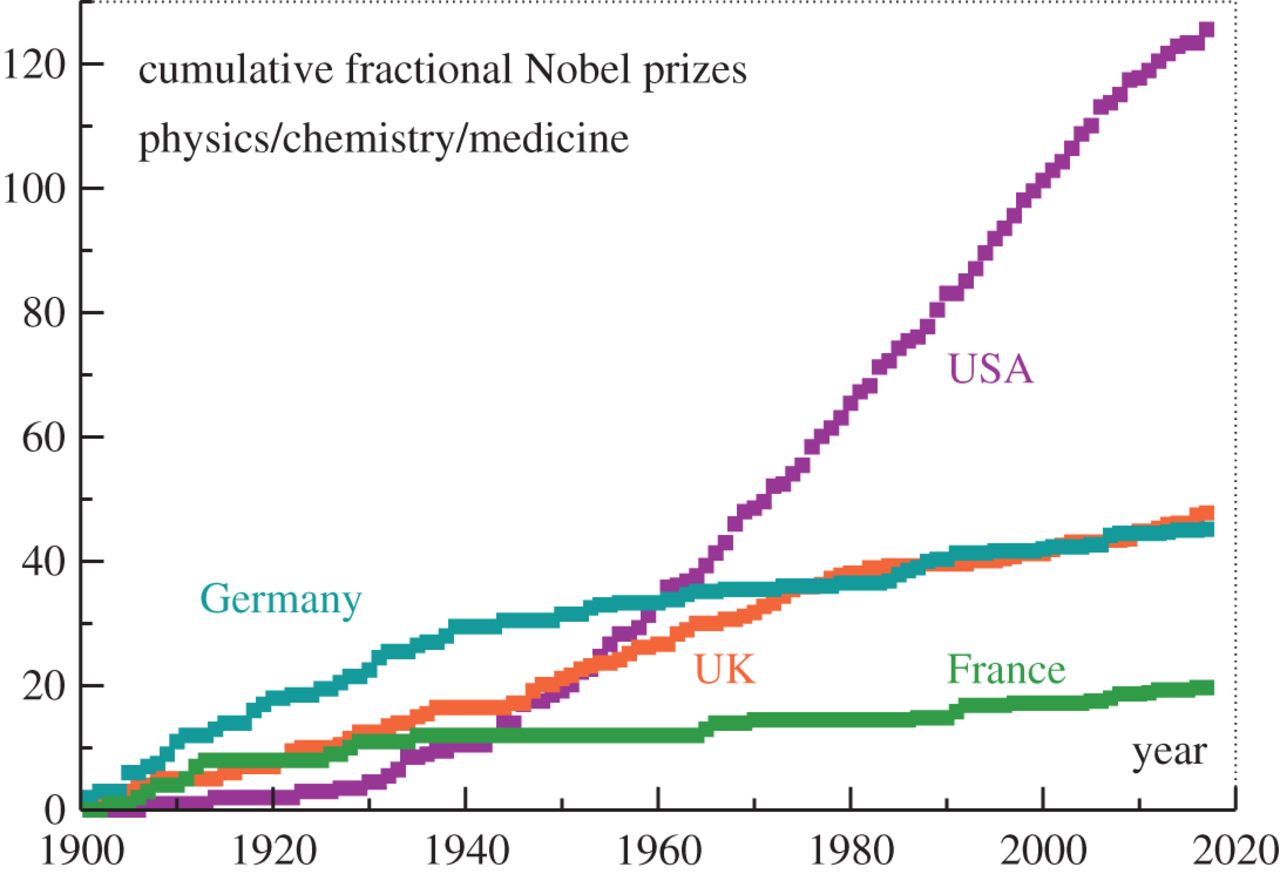
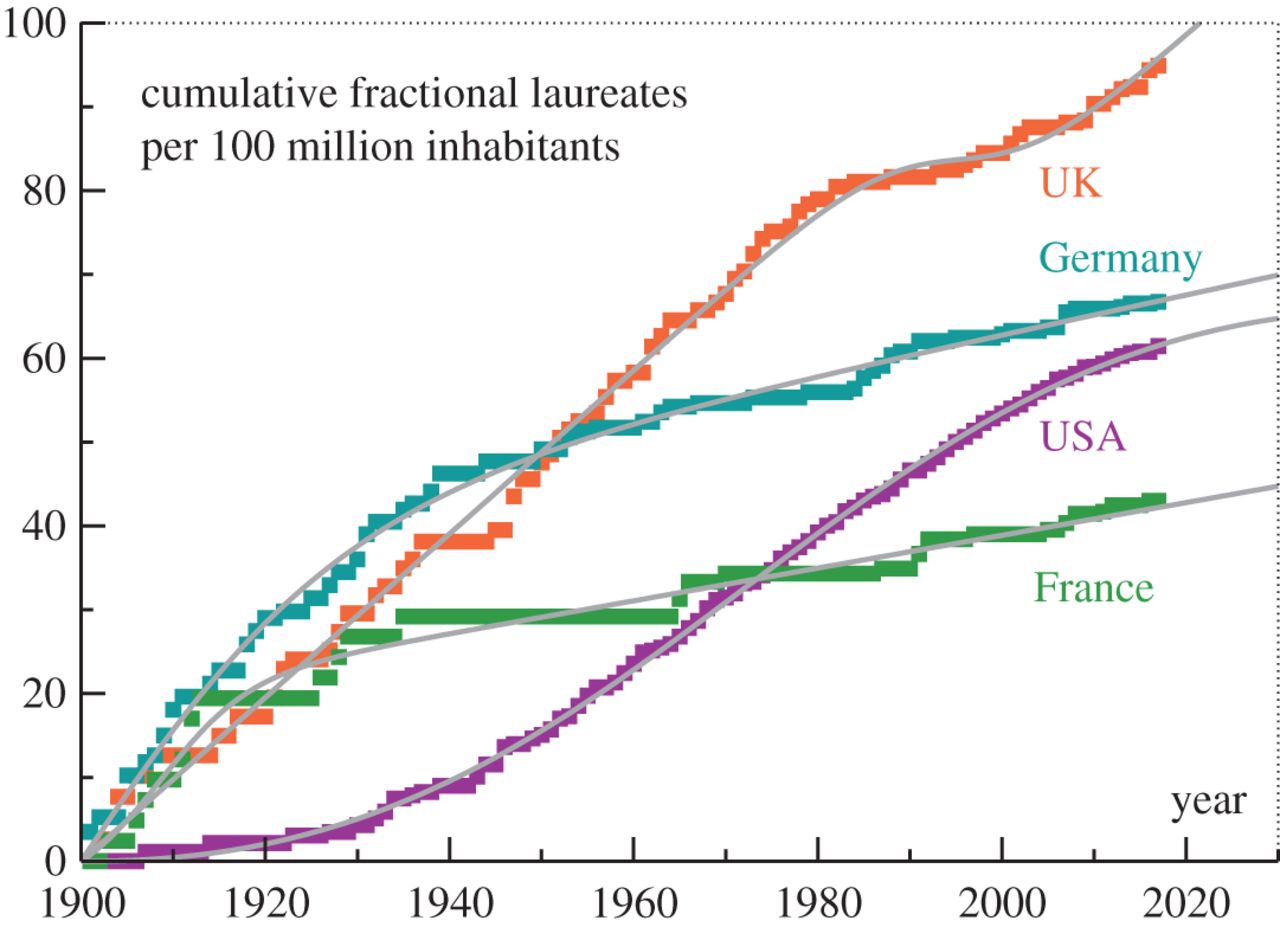
The US’s dominance in scooping Nobel prizes for work in the natural sciences could be nearing an end, according to a new analysis of previous winners. Carried out by physicist Claudius Gros from the Goethe University in Frankfurt, Germany, it also finds that the UK has won the most Nobel prizes per capita, with Germany coming second and the US a close third (R. Soc. Open Sci. 5 180167).
Since they were first awarded in 1901, scientists who are nationals of the US, the UK, Germany and France have won the most Nobel prizes in physics, chemistry, and physiology or medicine. Around 120 laureates have been American, 40 British, 40 German and 20 French. To determine Nobel-prize productivity, however, Gros factored out population size, particularly given that the US population has more than quadrupled from 76 million in 1901 to 327 million today.
Of course, the laborers will deny it, pious and humble in their efforts to denigrate science, scandalize research, question reality, facts, data: try to morally equivocate between evolution and (not) "intelligent design." We have been on this anti-intellectual Primrose Path since the Scopes Monkey trials. A select segment of the species here in America made denial of facts a staple of membership to the cult, and find they have a political voice in a bipolar tweeting, carnival-barking avatar. As Dr. Gros continues:
Gros found that the US’s productivity peaked in 1972 at 0.83 Nobel prizes per year and per 100 million inhabitants. He says that the most striking element of the US data is the continued downward trend. Since 1972 its success rate has fallen by 60% to 0.34 Nobel prizes per year and per 100 million inhabitants, and it is still dropping. “On a per capita basis, the US’s era is definitively coming to an end,” Gros told Physics World. “Within 12 years the US science Nobel prizes productivity should fall by another 50%.”
That will put us down to 0.17 per 100 million inhabitants by 2030, when the population should be: 327,000,000*e^(0.02*18) = 468,698,719 (from the Growth Formula: N = N_0*e^rt, r = growth/death rate of 0.02, t = time).
That's going to be a lot of mouths to feed and employ with fewer and fewer minds to generate new ideas, industries and thus, employment of the masses. Our slide from "exceptionalism" will inevitably follow.
This month sees the first International Day of Light. Wednesday 16 May was chosen because it is the anniversary of the first successful operation of the laser, as demonstrated by the American engineer and physicist Ted Maiman in 1960.
It’s a good choice, because the laser is a perfect example of how a scientific discovery can yield revolutionary benefits to society in all sorts of areas, including communications, healthcare and manufacturing. However, when I read the words “first successful operation of the laser” on the International Day of Light website (lightday.org), I had to look further, as it sounded like there might be more to the story.
I have spent most of my career working in photonics, optical communications and lighting, so I was already somewhat familiar with the laser’s history. However, the details still interested me. It turns out that although Maiman did indeed demonstrate the first working laser on 16 May 1960, he is not the only person with a reasonable claim to have “invented” the laser. The other is Gordon Gould, another US physicist who described “Some rough calculations on the feasibility of a LASER: Light Amplification by Stimulated Emission of Radiation” in his lab notebook in November 1957.
Each universe in a multiverse contains different levels of dark energy, according to the dominant theory. STOLK/GETTY IMAGES
Topics: Astrophysics, Cosmology, Dark Energy, Multiverses, Theoretical Physics
A hypothetical multiverse seems less likely after modeling by researchers in Australia and the UK threw one of its key assumptions into doubt.
The multiverse concept suggests that our universe is but one of many. It finds support among some of the world’s most accomplished physicists, including Brian Greene, Max Tegmark, Neil deGrasse Tyson and the late Stephen Hawking.
One of the prime attractions of the idea is that it potentially accounts for an anomaly in calculations for dark energy.
The mysterious force is thought to be responsible for the accelerating expansion of our own universe. Current theories, however, predict there should be rather more of it around than there appears to be. This throws up another set of problems: if the amount of dark energy around was as much as equations require – and that is many trillions of times the level that seems to exist – the universe would expand so rapidly that stars and planets would not form – and life, thus, would not be possible.
The multiverse idea to an extent accounts for and accommodates this oddly small – but life-permitting – dark energy quotient. Essentially it permits a curiously self-serving explanation: there are a vast number of universes all with differing amounts of dark energy. We exist in one that has an amount low enough to permit stars and so on to form, and thus life to exist. (And we find ourselves here, runs the logic, because we couldn’t find ourselves anywhere else.)
So far, so anthropic. But now a group of astronomers, including Luke Barnes from the University of Sydney in Australia and Jaime Salcido from Durham University in the UK, has published two papers in the journal Monthly Notices of the Royal Astronomical Society that show the dark energy and star formation balance isn’t quite as fine as previous estimates have suggested.
Mechanisms of induced seismicity Both wastewater injection and gas extraction can cause induced earthquakes. Detailed observations from the Midwestern United States and Groningen, Netherlands, show that in both cases, preexisting conditions in Earth's crust are of central importance
Topics: Alternative Energy, Earthquake, Geophysics, Green Energy
Since 2009, the Midwestern United States has seen a dramatic rise in earthquakes induced by human activities. Most of these events were caused by massive reinjection of wastewater produced during oil and gas extraction (1, 2). In February 2016, regulators in Oklahoma called for an injection rate reduction after several major events up to moment magnitude 5.8 (Mw 5.8) occurred. On the other side of the Atlantic, an unprecedented number of earthquakes has followed gas extraction from the Groningen field in the Netherlands (3). The Dutch government imposed production cuts after a Mw 3.6 event in August 2012 caused structural damage to houses. Intensive research of these two instances of induced seismicity points to contrasting mechanisms, but in both cases, the natural conditions prior to subsurface activities play a dominant part.
Fifty years ago, Healy et al. determined that fluid injection at depth causes the pore pressure to rise in a preexisting fault, reducing its strength and potentially leading to its failure (4). In contrast, fluid extraction at depth reduces the pore pressure, leading to compaction of the rock mass; the increased rock stress can drive a preexisting fault to failure. In both settings, the two factors that control induced earthquakes are operational parameters, such as the volume that is injected or produced, and natural conditions, such as the presence of preexisting faults and their ambient stress level. Operational parameters are often assumed to dominate, but that notion may reflect limited knowledge of the locations of preexisting faults and their ambient stress level. For regulatory measures to be effective in mitigating induced seismicity, it is crucial to understand the role of the natural conditions that existed before human activities.
Topics: Commentary, Existentialism, Politics, Star Trek
Star Trek (to me) is a societal metaphor for the perfection we at least see ourselves as a species eventually achieving in civics, equality and technology, an update to Winthrop's "city on a hill." A lot of the scripted claims aren't supported by any known science, the term "technobabble" is now a part of the lexicon. I gave up one night at Motorola trying to explain to a coworker the sound barrier is a lot different than a "light speed barrier" due to the fact we're all composed of matter, which has mass and thus, drag. Some things you just have to let go of.
I do often ask the question in casual Trek conversations: "In the fictional Star Trek universe, what is the most impacting technology?" If you're a Worf-type, it's phasers; if you're a Riker-type, it's warp drive (see my exasperation in the paragraph above).
But no, in this fantastical universe where I'm surprised they haven't yet pulled off a Star Trek/Star Wars crossover, I'd say the technology with the most impact has to be...replicators, those wretched violators of the Heisenberg Uncertainty Principle, right along with transporters that reassemble you just like you started, versus cloning ever-imperfect facsimiles as the physics should work. (See: Jeff Goldblum in The Fly)
The closest thing we have to replicators is 3D printing. Maybe combining that with a phone app would be a facsimile of the classic Picard line: tea, Earl Grey...hot! I know that sounds a lot like Panera Bread...
Wages have been stagnant since the seventies, exacerbating income inequality and leading to not just two Americas, but two societies: one rich, one poor and no middle class bridge in-between. It is a recipe for dystopia. Replicators would be a disturbing disruption to the hierarchical status quo. Suddenly, workers wouldn't have to "work" to feed themselves or their families. Industries would be short of workers that essentially stopped showing up for the Prussian economic model of capitalism. It would scare the piss out of the 1%! They might try to convince everyone of the "dangers" like Edison did AC current by electrocuting an elephant. However, someone's likely to leak the plans to the Internet, then all bets would be off. It would be a middle finger from the Proletariat. It's pure fantasy, but it would essentially eliminate the need for money, economy and thus hierarchies and control of societal "pariahs," which seems - among other things - a consistent critique from the right regarding the Trek franchise.
*****
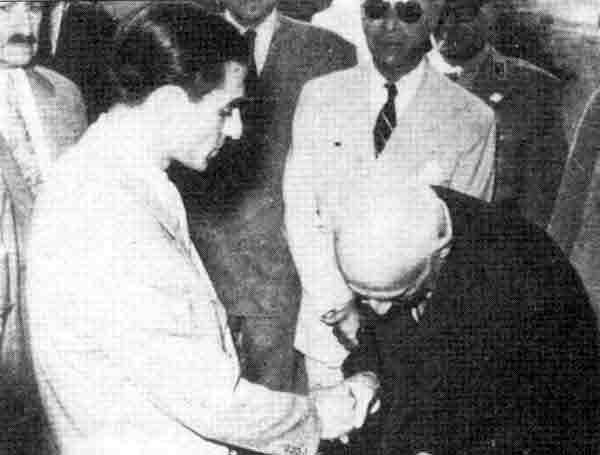
Mohammad Mosaddegh was the democratically elected leader of Iran. In 1953, oil interests in the United States and United Kingdom orchestrated a coup d'état primarily for the company now known as British Petroleum (BP). The operation was orchestrated by the Central Intelligence Agency (as new CIA Chief Gina Haspel would opine, "the good guys") and its manipulating British counterpart, MI-6. We then installed the Shah of Iran, by all accounts a brutal dictator that assassinated his enemies until the uprising that started my senior year in high school and solidified the rise of Ronald Reagan, who said to his admirers "our best days are behind us," almost in the same breath as announcing his presidential run blocks away from the site where three Civil Rights workers Michael Schwerner, James Chaney and Andrew Goodman were murdered in Philadelphia, Mississippi. That eventually had to morph into another slogan born of bigotry, birtherism, jealousy and xenophobia: "make America great again."
From Wikipedia: "An author, administrator, lawyer, and prominent parliamentarian, his administration introduced a range of progressive social and political reforms such as social security and land reforms, including taxation of the rent on land. His government's most notable policy, however, was the nationalization of the Iranian oil industry, which had been under British control since 1913 through the Anglo-Persian Oil Company (APOC/AIOC) (later British Petroleum and BP)." The CIA cryptonym was Operation Ajax.
Like AC current and replicators, Luddites oppose every single innovation that advances society and decreases inequality because it removes their places at the apogee of the hierarchy, and interferes with their addiction to every-increasing profits. I don't use that term loosely. Charles Ferguson, Academy Award winning director of "Inside Job" alludes to it in the film.
An addiction is defined as "1 : the quality or state of being addicted addiction to reading; 2 : compulsive need for and use of a habit-forming substance (such as heroin, nicotine, or alcohol) characterized by tolerance and by well-defined physiological symptoms upon withdrawal; broadly : persistent compulsive use of a substance known by the user to be harmful"Merriam-Webster
Addiction: What other definition could be so apropos as a small minority of humanity makes insane amounts of money while harming the environment, exacerbating income inequality, encouraging wars along with arms dealing for-profit within the US (NRA), abroad and skating along the precipice of negative climate outcomes, nuclear annihilation to pump up a portfolio, or a trust fund they may contribute to; purchase of a new yacht on a planet no longer able to sustain life...includingtheirs?
Replicators and Mosaddegh have several common threads: economies of scarcity or post-scarcity, energy exploitation and distribution; the intervention by moneyed elites in the evolution of societies, scientific research either supported or suppressed into alternatives to fossil fuels and hierarchical, unequal societies bordering on dysfunction...and demise. The most common thread is choice of direction: either one or the other will sustain the species. Replicators are fiction; Mosaddegh, history.
"For the love of money is a root of all kinds of evil. Some people, eager for money, have wandered from the faith and pierced themselves with many griefs." 1 Tim 6:10
And many feigned any "faith" from the beginning to manipulate a bewildered herd to its avarice bidding. When most rain forests burn to the ground, the higher, greener canopies go crashing down with them. It's physics, not fantasy.
A health worker walks at an Ebola quarantine unit on June 13, 2017 in Muma, Congo. Credit: John Wessels Getty Images
Topics: Biology, Ebola, Existentialism, Politics
The fact that the erstwhile resident of 1600 Pennsylvania Avenue, conman, racist, thug and crook has labeled any countries with shades of Melanin darker than his orange hue as "s-hole countries," don't expect any help from the US anytime soon. As a matter-of-fact, I expect we'll look at Puerto Rico as halcyon days of functionality.
The new Ebola outbreak on the western edge of the Democratic Republic of the Congo has ignited serious concern at the World Health Organization, with signs pointing to an epidemic that may have been underway for weeks or months.
Though there are only two confirmed cases at this point, preliminary investigations point to cases in several locations that may date back as far as early this year, Dr. Pierre Formenty, the WHO’s top Ebola expert told STAT. There is also fear that two health care workers may be among the infected, which happens often in Ebola outbreaks and can fuel the disease’s spread.
The country’s ministry of health, which declared the outbreak on Tuesday, said then that there are at least 21 people known to have symptoms consistent with Ebola, and 17 of whom have died.
While the outbreak is in a remote area where road travel is taxing and slow, one of the towns where cases may be occurring, Bikoro, is a port on a lake that connects to the Congo River. That opens up the disturbing specter of infected individuals traveling by boat to DRC’s densely populated capital, Kinshasa, or to Brazzaville, the capital of the neighboring Republic of the Congo.
“If it was only the roads, we know that the roads are very bad and that it’s difficult for people to travel. But if you reach Bikoro and you take a boat … everything could happen,” Formenty said in an interview on Wednesday.
“For us it’s a worrying situation in a bad context in terms of logistics. And we need to go fast.”
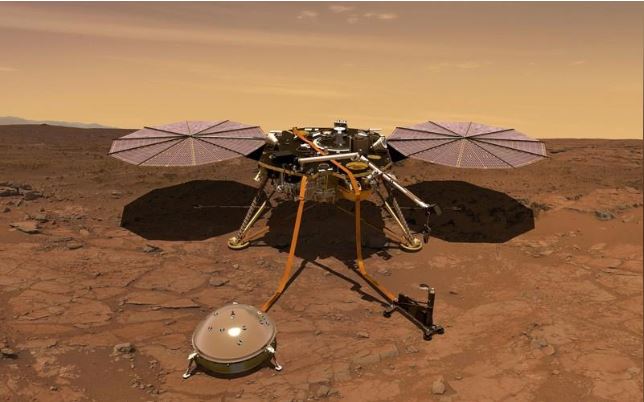
FILE PHOTO: The Mars InSight probe is shown in this artist's rendition operating on the surface of Mars, due to lift off from Vandenberg Air Force Base, California, U.S. on May 5, 2018 in this image obtained on May 3, 2018. NASA/ Handout via REUTERS/File Photo
Topics: Mars, NASA, Planetary Science, Space Exploration
LOS ANGELES (Reuters) - After decades exploring the surface of Mars, NASA is set for the weekend launch of its first robotic lander dedicated to studying the red planet’s deep interior, with instruments to detect planetary seismic rumblings never measured anywhere but Earth.
The Mars InSight probe is due for liftoff on Saturday before dawn from Vandenberg Air Force Base near the central California coast, treating early risers across a wide region to the luminous spectacle of the first interplanetary spacecraft to be launched from the U.S. West Coast.
The lander will be carried aloft for NASA and its Jet Propulsion Laboratory (JPL) atop a powerful, 19-story Atlas 5 rocket from the fleet of United Launch Alliance, a partnership of Lockheed Martin Corp and Boeing Co.
InSight will be released about 90 minutes after launch on a 301 million-mile (548 km) flight to Mars, and is due to reach its destination six months later, landing on a flat, smooth plain close to the planet’s equator called the Elysium Planitia.
The 800-pound (360 kg) spacecraft - its name is short for Interior Exploration Using Seismic Investigations, Geodesy and Heat Transport - marks the 21st U.S.-launched Martian exploration, dating back to the Mariner fly-by missions of the 1960s. Nearly two dozen other Mars missions have been launched by other nations.
Light-induced processes at the interface between silicon-based structures and biological ones can be used to remotely control a wide range of biological activities – from single cell calcium signalling to brain activity – without any genetic engineering of the biological systems involved. The new finding could help in the development of “electroceuticals”, in which bioelectric signals could be modulated to treat disease. As well as biomedical applications, the toolkits employed could also be used to study fundamental biophysical processes.
Silicon-based materials are widely used in biological applications. Two examples include silicon nanowire-based transistors for electrically monitoring the signals in cardiomyocytes and bioelectronics implants for the heart. They are rarely found in remotely controlled and interconnect-free device set ups, however. This is because researchers do not fully understand the complex physicochemical processes at play at the interfaces between silicon and biological materials.
Alan Turing, pictured in a slate sculpture by Stephen Kettle, is known as a computer scientist and code breaker, but also made forays into mathematical biology. Credit: Steve Meddle/REX/Shutterstock
Topics: Biology, Computer Science, Diversity in Science, Mathematical Models, Nanotechnology
Researchers in China have developed a filter that removes salt from water up to three times as fast as conventional filters. The membrane has a unique nanostructure of tubular strands, inspired by the mathematical-biology work of codebreaker Alan Turing.
The filter is the most finely constructed example of the mathematician’s ‘Turing structures’ yet, and their first practical application, say researchers. “These 3D structures are quite extraordinary,” says Patrick Müller, a systems biologist at the Friedrich Miescher Laboratory in Tübingen, Germany. The filter’s tubular strands, just tens of nanometers in diameter, would be impossible to produce by other methods, such as 3D printing, he says. The work is published on 3 May in Science.
British mathematician Alan Turing is best known for his code-breaking exploits for the UK government during the Second World War, and as the father of computer science and artificial intelligence. But he also produced a seminal work in the then-nascent field of mathematical biology in 1952, just two years before his death.
In it, he proposed a mathematical model for a process by which the cells of an embryo might begin to form structures — limbs, bones and organs. In this process, two substances continuously react with each other but diffuse through their container at very different rates. The quicker-diffusing reactant — called the inhibitor — pushes back against the slower one, called the activator, effectively corralling the resulting product into a pattern of spots or stripes. (The terminology was coined by biologists Hans Meinhardt and Alfred Gierer, who independently formulated an equivalent theory in 1972.)
Mind the gap: Around 13% of last authors in physics were women – a figure that is currently increasing at a rate of just 0.1% per year (courtesy: Jarmoluk on Pixabay)
Topics: Diversity in Science, Existentialism, Star Trek, STEM, Women in Science
Cultural reference in blog title: Waiting for Godot, by Samuel Beckett (Wikipedia)
Much has been seen recently in the #BlackLivesMatter, #MeToo, #TimesUp and subsequently, #MarchForOurLives movements. Things that are and have been systemic in our society are being questioned by those groups affected. Indignities and injustices aren't being tolerated anymore. Even the March for Science is a reaction to the adversarial relationship between science and power, as in many cases the answers research may yield not fitting well with the agreed dogma of political forces.
Many women and minorities were inspired into STEM careers due to the Roddenberry franchise, itself born of the often violent and lethal unrest in the sixties, and a hope we would resolve our differences both national and personal through rational actions and discourse, personified in the character of Spock played by the late Leonard Nimoy. Despite his alien origins, he was an outsider of two worlds: Earth and Vulcan; part of each and not fully accepted by either. What we saw was a possibility of acceptance based on merit, not blocked by gender, culture or preconceived biases.
Alas, science is not populated by dispassionate Data's devoid of emotion chips. Every single one of us comes into the field with our life experiences and conditioned prejudices of a person's worth in our particular fields. I have no doubt that part of the issue is how we're socializing our children into preassigned roles. For example, I remember my "toys" being G.I. Joe with the "Kung Fu" grip; a chemistry set, an erector sets, a microscope, a telescope and a junior construction tool kit. My female neighbor friends mostly had Barbies and teddy bears. I don't think much has changed.
We may be forcing the solution to society's most daunting problems in pigtails with dolls, rather than electronic snap kits and microscopes. The current estimate of gender parity puts us in the fictional Kirk era. That's assuming we survive as a species, daunted by current population growth, our projected population growth and a lack of starships.
Physics has one of the largest gender gaps in science, technology, engineering, mathematics and medicine (STEMM) according to an analysis of more than 36 million authors of academic papers over the last two decades (PLoS Biol 16(4) e2004956). The study, carried out by researchers at the University of Melbourne in Australia, says that at current rates it will be more than two centuries until there are equal numbers of senior male and female researchers in physics.
While the proportion of women in most STEMM fields is increasing, Luke Holman and his colleagues used computational methods to estimate the speed of change. They did this by estimating the gender of 36.6 million authors on 9.7 million papers the databases PubMed and arXiv. In the latter, for example, the researchers say they were able to estimate – with 95% confidence – the gender of 1.18 million authors from 538,688 preprint published since 1991.
If we want to see 50% of physicists being women sooner we need to implement new initiatives to do this – over and above any currently-running initiatives
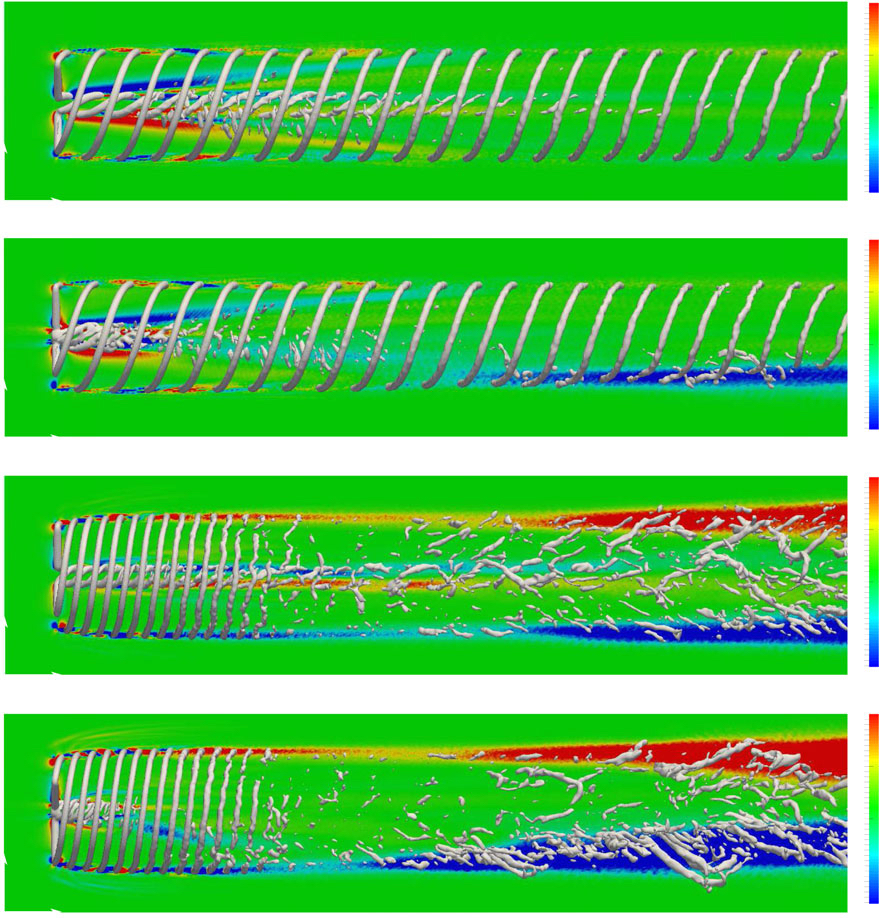
Color contours account for the creation of mean kinetic energy along the spanwise direction. Positive values (red) indicate a turbulent kinetic energy flux in the negative spanwise direction, while negative (blue) values denote a flux in the positive spanwise direction. For both set of simulations, by increasing the tip speed ratio, the entrainment of mean kinetic energy increases for a given streamwise distance from the rotor disk.
Topics: Alternative Energy, Computer Science, Economics, Economy, Green Tech, Jobs, Mathematical Models
A team of researchers from The University of Texas at Dallas (UT Dallas) has developed a new way to extract more power from the wind. This approach has the potential to increase wind power generation significantly with a consequent increase in revenue. Numerical simulations performed at the Texas Advanced Computing Center (TACC) indicate potential increases of up to six to seven percent.
According to the researchers, a one percent improvement applied to all wind farms in the nation would generate the equivalent of $100 million in value. This new method, therefore, has the potential to generate $600 million in added wind power nationwide.
In the branch of physics known as fluid dynamics, a common way to model turbulence is through large eddy simulations. Several years ago, Stefano Leonardi and his research team created models that can integrate physical behavior across a wide range of length scales — from turbine rotors 100 meters long, to centimeters-thick tips of a blades — and predict wind power with accuracy using supercomputers.
Illustration of the quartz plates used to measure heat transfer. The coloured regions are electrodes used to position the plates. Courtesy: M Ghashami et al/Phys. Rev. Lett.)
New insights into why heat transfer between objects is enhanced at very short separations have been gleaned by Keunhan Park and colleagues at the University of Utah and University of Pittsburgh in the US. The team made exquisitely precise measurements of how heat moves between two quartz plates that are positioned just 200 nm apart. They found that energy transfer is enhanced by about 45 times at tiny separations, which they ascribe to the coupling of surface photon polaritons across the gap between the plates.
Normally, the heat transfer between two objects at different temperatures can be approximated by assuming that the objects are “black bodies”. These are ideal entities that absorb all radiation falling on them and emit thermal radiation according to Planck’s law. Physicists have known for some time that this breaks down when objects get to within a few hundred nanometres of each other, where they exchange heat much faster than predicted by the black-body approximation. Indeed, this “near-field” enhancement has already been used in some technologies including heat extraction and thermophotovoltaic systems.
However, more widespread use of the enhancement has been hampered by a poor understanding of the effect – which is a result of significant experimental difficulties in measuring heat transfer between objects separated by just a few hundred nanometres. These challenges include controlling unwanted heat flow and achieving precise control over the orientation and separation of the two objects.
a) Schematic shows the band structure of the semiconducting HfS2/HfO2 when under strain, and the consequent charge funnelling. b) The strain is induced in the semiconductor by creating a region of oxide using intense laser light. c) A photocurrent map of the device; the photoresponse drastically increases when a region (dashed circle, bottom) is oxidized, compared with the same device before oxidation (top), a sign of the charge funnelling effect. Figure reproduced with permission from the authors and Nature Communications.
Topics: Green Energy, Green Tech, Laser, Nanotechnology, Semiconductor Technology, Solar Power
Note: Radiant solar energy = 1.1 x 10^18 kilowatt hours/year; 3.013 x 10^15 kilowatt hours/day. We're literally "leaving money on the table"... for fossil fuel greed.
Funnels are efficient tools for channelling liquids into containers with narrow openings. Now, researchers in Exeter have demonstrated the first funnel for electrical charges on a chip. The discovery builds on the ability to oxidize the atomically thin semiconductor, hafnium disulphide (HfS2), with a high-intensity UV laser. The non-uniform strain between oxidized and non-oxidized regions, and the subsequent band-gap modulation, generates electric fields, which effectively funnel the charges in the semiconductor flakes to areas where they can be more easily collected. This concept could enable a new generation of solar cells with 60% efficiency (currently around 21%), thanks to the increased efficiency in collecting photo-excited charges and the potential for hot-carrier extraction.
Intense laser light means oxidation, oxidation means strain
In general, bulk semiconductors can only sustain strains up to 0.4% before breaking. However, a layer of semiconductor that is only a few atoms thick can support strains of up to 25%. This amount of strain changes the band gap in the energy dispersion by up to 1 eV. In this work, Saverio Russo and his group at the University of Exeter, induce the strain in the HfS2 using a 375 nm laser to remove sulphur atoms, which are then replaced by oxygen atoms. According to calculations performed using density functional theory, the hafnium atoms have different separations in HfS2 and HfO2. This produces a 2.7% strain at the boundary between the oxidized and non-oxidized regions. Electrical contacts anchor the material to a substrate, so a strain gradient is present across the whole flake, shifting asymmetrically the conduction and valence bands to higher energies, and opening the band gap by 30 meV.
The 100th meridian west (solid line) coincides with the climate divide between the relatively moist eastern U.S. and the more arid West. Climate change may already be pushing the divide eastward (dotted line). Credit: Richard Seager Lamont-Doherty Earth Observatory
Topics: Climate Change, Greenhouse Gases, Weather
I used to live in Central Texas where an average summer temperature is 110 degrees Fahrenheit and a "cold front" is 90 degrees in comparison. I also suffered mightily from "Cedar Fever," a pollen from a popular local genus of tree. I also remember it being particularly lethal for senior and younger citizens as temperatures climbed. My wife has had her bouts with pine in New York and now North Carolina.
So CBS News reported in March that the intensity of allergy seasons may be extended by climate change as well as associated health risks from malaria to kidney stones and waterborne parasites. It makes it personal; denial hard to do when you're on an antibiotic more than you'd like to be.
The unfortunate part is, I think through denial and selfishness, we've waited beyond a window where we could do anything about it.
*****
To travel westward across the U.S. is to experience a striking landscape metamorphosis. Stately hardwood trees give way to squat shrubs, verdant cornfields to brown wheat and lush grasslands to cacti and creosote bush. The air dries out and the land is often parched. This rather abrupt shift from the humid east to arid west occurs along a border that slices neatly through the Canadian province of Manitoba, then the Dakotas, Nebraska, Kansas, Oklahoma, Texas and into eastern Mexico. The divide is so stark airline passengers can see it—a patchwork quilt of green farms on one side, a vast expanse of brown and gold on the other.
And now this boundary is on the move, creeping east as global temperatures rise, according to new research published last month in Earth Interactions. Given the line’s historical role in shaping U.S. westward expansion, its shift could alter the agriculture that plays a crucial role in the economy of the Great Plains states. [1]
Methane (CH4) is a potent greenhouse gas that is roughly 30 times more harmful to the climate than carbon dioxide (CO2). Both gases are produced in thawing permafrost as dead animal and plant remains are decomposed. However, methane is only formed if no oxygen is available. Until now, it was assumed that larger amounts of greenhouse gases are formed when the ground was dry and well aerated—when oxygen was available. Christian Knoblauch and his colleagues have now demonstrated that water-saturated permafrost soils without oxygen can be twice as harmful to the climate as dry soils—which means the role of methane has been greatly underestimated.
Knoblauch has, for the first time, measured and quantified in the laboratory the long-term production of methane in thawing permafrost. The team had to wait for three years before the approximately 40,000 year-old samples from the Siberian Arctic finally produced methane. The team observed the permafrost for a total of seven years, an unprecedented long-term study.
They found that without oxygen, equal amounts of methane and CO2 are produced. But since methane is a far more potent greenhouse gas, it is more significant. Because methane production couldn't be measured, it was assumed that in the absence of oxygen only very small amounts of it can be formed. "It takes an extremely long time until stable methane-producing microorganisms develop in thawing permafrost," explains Knoblauch. "That's why it was so difficult to demonstrate methane production until now." [2]
EPA Administrator Scott Pruitt yesterday unveiled a long-awaited plan to require that EPA studies used in future regulations must have open and transparent data. Pruitt said the proposed rule is part of his larger effort to dramatically reform the way science is used at the agency, which also included the removal of Science Advisory Board members who received EPA grants and were replaced with industry-friendly researchers.
“The science we use is going to be transparent, it’s going to be reproducible, it’s going to be able to be analyzed by those in the marketplace, and those that watch what we do can make informed decisions about whether we’ve drawn the proper conclusions or not,” Pruitt said yesterday at EPA headquarters.
But some of the biggest critics of Pruitt’s plans are scientists who say they’ve already been working to boost transparency for years.
Researchers have long grappled with how to make the peer-review process more accessible, how to make more research replicable and how to better share data, said Gretchen Goldman, research director for the Center for Science and Democracy at the Union of Concerned Scientists.
Scientists are always discussing ways to make their work more transparent, accessible and instructive for the community at large, Goldman added. The proposed EPA rule establishes a set of political hoops for researchers that will take more of their time, she said. And many won’t be able or willing to devote more effort to the additional red tape put up by Pruitt.
Blogger Marc Morano presented his book, “The Politically Incorrect Guide to Climate Change,” to Pruitt yesterday. Morano/Twitter
“This is not about all of the details that scientists need to scrutinize each other’s work. That information is already widely available, and scientists spend a tremendous amount of time disclosing all of their data and methods to get their work published,” she said. “This is adding additional burdens; it’s not the information that is required for appropriate peer review and reproducibility of studies. This is clearly just a political move.” [1]
*****
The prevailing mental condition is controlled insanity.
The rules of the Inner Party are held together by adherence to a common doctrine. In a Party member not even the smallest deviation of opinion on the most unimportant subject can be tolerated. But it is also necessary to remember that events happened in the desired manner. And if it is necessary to rearrange one's memories or to tamper with written records, then it is necessary to forget that one has done so. The trick of doing this can be learned like any other mental technique. It is learned by the majority of Party members, and certainly by all who are intelligent as well as orthodox. In Oldspeak it is called, quite frankly, "reality control." In Newspeak, it is called doublethink, though doublethink comprises much else as well.
Doublethink means the power of holding two contradictory beliefs in one's mind simultaneously, and accepting both of them. The Party intellectual knows in which direction his memories must be altered; he therefore knows that he is playing tricks with reality; but by the exercise of doublethink he also satisfies himself that reality is not violated. The process has to be conscious, or it would not be carried out with sufficient precision, but it also has to be unconscious, or it would bring with it a feeling of falsity and hence of guilt.
Doublethink lies at the very heart of Ingsoc, since the essential act of the Party is to use conscious deception while retaining the firmness of purpose that goes with complete honesty. To tell deliberate lies while genuinely believing them and to forget any fact that has become inconvenient, and then, when it becomes necessary again, to draw it back from oblivion for just so long as it is needed, to deny the existence of objective reality and all the while to take account of the reality which one denies - all this is indispensably necessary. Even in using the word doublethink it is necessary to exercise doublethink. For by using the word one admits that one is tampering with reality; by a fresh act of doublethink one erases this knowledge; and so on indefinitely, with the lie always one leap ahead of the truth. Ultimately it is by means of doublethink that the Party has been able - and may, for all we know, continue to be able for thousands of years - to arrest the course of history... [2]
Map of unusual cold temperatures in Europe during the summer of 1816 Credit: Creative Commons, authored by Giorgiogp2
Topics: Climate Change, Existentialism, Global Warming
The summer of 1816 was not like any summer people could remember. Snow fell in New England. Gloomy, cold rains fell throughout Europe. It was cold and stormy and dark - not at all like typical summer weather. Consequently, 1816 became known in Europe and North America as "The Year Without a Summer."
Why was the summer of 1816 so different? Why was there so little warmth and sunshine in Europe and North America? The answer could be found on the other side of the planet - at Indonesia’s Mount Tambora.
On April 5, 1815, Mount Tambora, a volcano, started to rumble with activity. Over the following four months the volcano exploded - the largest volcanic explosion in recorded history. Many people close to the volcano lost their lives in the event. Mount Tambora ejected so much ash and aerosols into the atmosphere that the sky darkened and the Sun was blocked from view. The large particles spewed by the volcano fell to the ground nearby, covering towns with enough ash to collapse homes. There are reports that several feet of ash was floating on the ocean surface in the region. Ships had to plow through it to get from place to place.
Fun facts: this was the year Mary Shelley wrote the first science fiction (and admittedly dystopian novel) Frankenstein; poet Lord Byron wrote "Darkness," inspired by all the gloominess. Mary's husband Percy was apparently a poet too. When writers get cooped up by dismal weather, they tend to go stir crazy!
This was and is climate change.
The less-sexy, mouthful term is anthropogenic climate disruption. You can't soundbite it and make it into a riff, either for or against. I guess technically, this was "volcanic climate disruption." Global weirding - then, and now - is probably more apropos:
I prefer the term 'global weirding,' coined by Hunter Lovins, co-founder of the Rocky Mountain Institute, because the rise in average global temperature is going to lead to all sorts of crazy things — from hotter heat spells and droughts in some places, to colder cold spells and more violent storms, more intense flooding, forest fires and species loss in other places. Source: Wiktionary
One wonders...instead of prose or poetry, what would have been inspired if Twitter had existed?
A single molecule has been created by combining individual atoms of sodium and caesium, using optical tweezers to guide them into place. The technique, devised by Lee Liu and colleagues at Harvard University and Harvard-MIT Health Sciences and Technology, could help chemists to study chemical reactions far more precisely by giving them control over the individual atomic and molecular collisions. The team hopes that their method will be used in a variety of fields to create diverse, complex molecules, allowing for discoveries of previously unforeseen molecular properties.
Conventional studies of chemical reactions involve observing the macroscopic results of large numbers of collisions of atoms and molecules – rather than studying individual collisions. Currently, chemists need to compare experimental reaction rates with theoretical models to calculate the probabilities of individual collisions taking place – a process that is fundamental to the understanding of chemistry. An alternative, and more precise, technique is to study interactions between individual atoms and molecules – something that requires great experimental dexterity.
To begin their interaction process, Liu and colleagues use magneto-optical traps to prepare reservoirs of stationary atoms of sodium and caesium at just a few hundred microkelvin. “Cooling and controlling atoms and molecules to temperatures where they are standing still allows for easier manipulations of their properties, interactions and reactions,” explains team leader Kang-Kuen Ni.
Flooding in Bangladesh could become more common as global temperatures rise.Credit: Mamunur Rashid/NurPhoto/Getty
Topics: Climate Change, Economics, Human Rights, Politics, Star Trek
A change of two words from a 2nd season Star Trek: The Next Generation episode "Up the Long Ladder" involving cloning and differences in cultures: clones versus agrarians, the sophisticated versus the barbaric. This plot is not too far from the mark, just without fantastic starship warp drives. It is peering down a long ladder from Asgard to Hades; from the Third Heaven to Purgatory. It is the aftermath of centuries of stratification of humanity. To invoke Jeanine Hill Fletcher from Friday's post (quoting Perkinson), it is: "a great grinding witch tooth, sucking blood and tearing flesh... without apology."
Nations such as Bangladesh and Egypt have long known that they will suffer more from climate change than will richer countries, but now researchers have devised a stark way to quantify the inequalities of future threats.
A map of "equivalent impacts", revealed at the annual meeting of the European Geosciences Union (EGU) this month in Vienna, shows that global temperatures would have to rise by a whopping 3 °C before most people in wealthy nations would feel departures from familiar climate conditions equal to those that residents of poorer nations will suffer under moderate warming.
The Paris climate agreement, adopted by 195 countries in 2015, aims to limit the rise in global mean temperature to 1.5–2 °C above pre-industrial levels. The world has already warmed by one degree or so — and since 1900, the mean number of record-dry and record-wet months each year has also increased.
But the effects of global warming are uneven, and poor regions in the tropics and subtropics are thought to be most vulnerable, for several reasons. They have limited financial resources with which to prepare for shifts in temperature and precipitation, and they are expected to face bigger changes in climate than countries in the mid-latitudes. Researchers have had difficulty quantifying those inequalities because the impacts of climate change depend on many factors, such as future economic growth and technological progress, which are hard to forecast.
Topics: Quantum Computer, Richard Feynman, Nanotechnology, Nobel Prize, Quantum Mechanics
The theme of this year’s April Meeting of the American Physical Society is the “Feynman Century” because the iconoclastic, Nobel-prize-winning physicist was born in 1918. This morning at a special session devoted to Feynman, quantum computing expert Christopher Monroe of the University of Maryland spoke about early contributions to quantum computing that were made by Feynman before his untimely death in 1988.
That theme continued in an afternoon session at the conference where nuclear and particle physicists discussed how quantum computers could be applied to their work. A huge challenge to those studying the physics of quarks (quantum chromodynamics or QCD) is that it takes vast amounts of computing power just to calculate the properties of relatively simple systems.
Low barrier to entry
Quantum computers, which (at least in principle), can solve certain problems much more efficiently than conventional computers could offer a way forward. Earlier this year we reported what is probably the first-ever nuclear physics calculation done using quantum computers – the binding energy of the deuteron. Thomas Papenbrock of the University of Tennessee and Oak Ridge National Lab explained how commercial cloud quantum-computing services from IBM and Rigetti had made this calculation possible, pointing out that the barrier to entry to quantum computing is very low thanks to these services.
The tornado that struck Greensboro Sunday was categorized as an EF2, but the damage it inflicted reached biblical proportions. Power was out at the Joint School of Nanoscience and Nanoengineering from that day until late Tuesday evening. Classes were canceled and arrangements to make them up emailed to students. The irony of the storm is the neighborhood that surrounds JSNN is predominately African American and/or people of color. In comparison to the rest of the city - power lines above ground vs. buried - it would be one of the latter locations to come back online first. Where my apartment is, power lines are buried and lights merely flickered. It was Katrina in miniature, as natural disasters likely or not likely inspired by climate change tends to pull the mask off the disparities inherit in our society we typically think egalitarian.
During a very stressful time at work during the 2016 electoral campaign, I wrote a cathartic essay about my foreboding at what was soon to become our country's 45th president*. He didn't just "happen." The GOP and Barry Goldwater made a Faustian compromise with their traditional principles after the passage of the '64 Civil Rights Act, the '65 Voting Rights Act and the '68 Fair Housing Act as disaffected Dixiecrats would use the refrain the former FBI director Jim Comey now uses to refer to his former membership with the Republican Party: "I didn't leave the Democratic Party (re: Dixiecrats) - the Democratic Party left me." Starbucks didn't just "happen" and "the talk" didn't just happen.
Systemic (Merriam-Webster):
: of, relating to, or common to a system: such as
a : affecting the body generally
b : supplying those parts of the body that receive blood through the aorta rather than through the pulmonary artery
c : of, relating to, or being a pesticide that as used is harmless to the plant or higher animal but when absorbed into its sap or bloodstream makes the entire organism toxic to pests (such as an insect or fungus)
Bowling for Columbine took a humorous look at the love affair this country has always had with violence: first the slaughter of Native Americans, then the kidnap and systematic debasement of the African Diaspora, soon reluctantly referred to as African Americans as would be established in our founding documents, which took courage to craft and break away from being a colony to becoming a nation. This is fear.
It's the fear that makes a neighborhood watch cop-wanna-be kill a child guilty of getting the munchies for ice tea and skittles. It's the fear that causes NYC cops to choke a man to death for selling loose cigarettes: "I can't breathe." It's the fear that slaughtered Trayvon Martin, Jordan Davis, Renisha McBride, Sandra Bland and a growing list of recent ancestors that would fill this post. It is a body count born of fear.
In The Chronicle of Higher Education, Donald Yacovone writes:
After reviewing my first 50 or so textbooks, one morning I realized precisely what I was seeing, what instruction, and what priorities were leaping from the pages into the brains of the students compelled to read them: white supremacy. One text even began with the capitalized title: "The White Man’s History." Across time and with precious few exceptions, African-Americans appeared only as "ignorant Negroes," as slaves, and as anonymous abstractions that only posed "problems" for the supposed real subjects of history: white people of European descent.
The assumptions of white priority, white domination, and white importance underlie every chapter and every theme of the thousands of textbooks that blanketed the country. This is the vast tectonic plate that underlies American culture. And while the worst features of our textbook legacy may have ended, the themes, facts, and attitudes of supremacist ideologies are deeply embedded in what we teach and how we teach it.
Scholars often bemoan their lack of influence: embarrassing book sales figures and the like. Yet my review of American textbooks revealed that historians of the 20th century exerted an enormous impact on the way Americans have come to understand their history. The results are painfully evident. Their work either filtered down into schools, as interpreted by educators, administrators, and popular authors, or appeared directly: Ph.D.-trained scholars wrote many of the textbooks I read. To appreciate why white supremacy remains such an integral part of American society, we need to appreciate how much it suffused our teaching from the outset.
Very soon in the founding of a new nation, however, White Christians began to establish their well-being by using the resources, bodies, and lives of others. Through their own "witchcraft," European Christians employed a mysterious and threatening potency that was the practice of using the other for their own gain. In [James W.] Perkinson's description, through the projects of modern Christian empire "a witchery" of heretofore unimaginable potency ravaged African and aboriginal cultures...For Perkinson, the witchcraft of White supremacy was conjured through racial discourse as an ideological and practical frame that he identifies as the 'quintessential witchery of modernity.'... In Perkinson's chilling words, "Whiteness, under the veneer of its 'heavenly' pallor, is a great grinding witch tooth, sucking blood and tearing flesh without apology."
On the Stephen Colbert Show, actor Will Smith made the poignant observation "racism is not getting worse, it's getting filmed." This mirror into our collective cultural psyche must be jolting to those that could depend on "the system" reinforcing and replicating itself; giving both intellectual and spiritual justifications to a hierarchy and status quo that requires a pariah, an underclass: an "other." It makes eight years being governed by an "other" fraught with peril. A fear of retribution if the former slugs of society suddenly found themselves empowered. A fear that has never been realized.
"We hold these truths to be self-evident, that all men are created equal, that they are endowed by their Creator with certain unalienable Rights, that among these are Life, Liberty and the pursuit of Happiness." US History: The Declaration of Independence
These words from the Declaration of Independence are among the most influential ever put on paper. The countless pleas for liberty and equality that have used the Declaration as a model are proof of its lasting power. The original Declaration challenged the authority of the British crown. Just within the United States, subsequent declarations have targeted capitalism, land owners, white supremacy, and the patriarchy. Time and again, those unhappy with the status quo have invoked the Declaration. Tyranny has meant different things to different people since 1776, but the search for liberty, however defined, goes on.
There is history for every current event; every modern crisis. There is a scaffolding we've built a facade over, and whitewashed. We've made ourselves Winthrop's mythological "city upon a hill," because we admire the poetry of the statement, but fail to live up to the ideals. Painting over a dung heap only makes it a less ugly, less acrid dung heap. It would be better to plow the feces beneath a compost pile, and let the stench fertilize something anew, a better republic without its current revealed blemishes, lies, and scars. We will never heal or have true equality, invoking Dr. Fletcher, until we do two things respecting our history demands: repentance and reparations. Any other empty apologies would be symbolic cowardice to a real, brutally savage system.
Dr. King said: "The choice is not between violence and nonviolence but between nonviolence and nonexistence." Paraphrased, we could evolve or devolve as a nation; we could be boldly courageous, or paralyzingly afraid. We can all march forward to a more hopeful future, or crawl backwards to a hierarchical, segregated and bigoted past.
What if...we had never had slavery?
What if...we actually lived up to our loftier ideals?
What if...we treated our fellow women and men as equals?