The sculpture above is Salvador Dali’s “Dance of Time II” displayed in front of the ArtScience Museum at Marina Bay Sands in Singapore. (Inside Science)
(ISNS) -- Almost nothing is more obvious than the fact that time flows from the past, which we remember, toward the future, which we don’t. Scientists and philosophers call this the psychological arrow of time. Hot coffee left on your desk cools down, and never heats up on its own, which reflects the thermodynamic arrow of time.
The principles of thermodynamics show that large collections of particles, like the trillions upon trillions of liquid molecules in a coffee cup, always move toward more disorganized arrangements. For instance, hot water molecules clumped together in a cold room need a lot of organization, so warm drinks eventually cool to the surrounding temperature. Physicists say such disorganized arrangements have high entropy, whereas ordered arrangements have low entropy.
Good primer on the subject, and an attempt to bridge the philosophy with the physics. As I've stated to someone that's asked me about why backwards time travel isn't possible, my answer is it hasn't been observed in nature. We would see teacups or chandeliers "un-break" or waterfalls flow backwards. It would be quite visible and noticeable from the norm, I would think. If it were possible, we could have visitors from the future creating paradoxes that would wreck havoc to the timeline - someone would notice that as well.
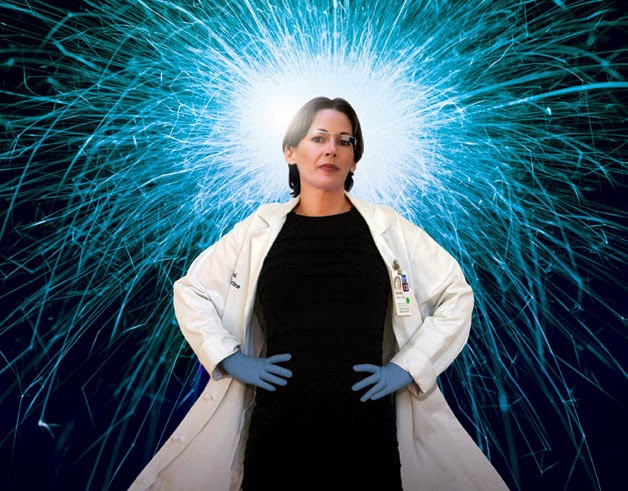
From the image source at Nature: "Science remains institutionally sexist. Despite some progress, women scientists are still paid less, promoted less frequently, win fewer grants and are more likely to leave research than similarly qualified men. This special issue of Nature takes a hard look at the gender gap — from bench to boardroom — and at what is being done to close it."
Unfortunately, the world is not like Star Trek, populated with fictional Captains like Kathryn Janeway of this inspiring description:
"This subject's penchant for the scientific method and clear-cut choices has given her a healthy dose of skepticism, which usually provides a command asset in dealing with new situations. Her preference for difficult studies is self-traced back to childhood, when she would prefer that to outdoor play. Since then, she has indicated no pleasure in outdoor camping, hiking, or cooking."StarTrek.com
I follow a blog: Female Science Professor. The author describes herself as a full professor, and other than staying anonymous (probably important around review time) she's very frank about the biases encountered both from colleagues and students: her most resent post, a student in class evaluation said "You should improve your teaching methods." The prof made lemons into lemonade and blogged about it. The genders of her students - like her own identity - were left nebulous.
Diversity: an ideal we all agree sounds good on paper, but are reluctant to do the heavy lift to achieve it (see Nature excerpt). Even in politics: our current president as probability represents 2.3% of the general population of Chief Executives from George Washington to himself. However, disrespect of the office and obstruction of his agenda approaches Guinness World Record levels as he's being sued for using Executive Orders - the least of any president according to official archives and math - essentially the pre-pubescent, sidewalk-flailing public tantrum of a desperate orange man being any Executive Order above zero. Women and minorities are not only underrepresented in the sciences, they are openly discouraged from pursuing STEM careers at the university level and at early life stages. I was personally insulted by my middle school science teacher - "No, you big dummy!" - after asking a question about calculating the coefficient of linear expansion on a metal wire. I had stifled the immediate urgent need at that moment to deck him, confident of the outcome with the authorities if I had. My parents were not amused, and scheduled a visit with the principal. That was followed by a sweaty, self-preserving "apology" from the science teacher. I passed his class with a descent grade, and moved on from the twerp. The fact both groups are so low means discouragement is remarkably efficient to maintain the status quo of the "usual suspects" in the sciences, and a concentration of wealth and opportunities along gender and cultural lines. Suffice to say, to resist the "haters": you have to want it! Albert Einstein was so fond of answering the fan mail of children interested in science, author Alice Calaprice wrote a book on it. In an exchange with a young science fan from South Africa named Tiffany:
September 19, 1946: "I forgot to tell you, in my last letter, that I was a girl. I mean I am a girl. I have always regretted this a great deal, but by now I have become more or less resigned to the fact. Anyway, I hate dresses and dances and all the kind of rot girls usually like. I much prefer horses and riding. Long ago, before I wanted to become a scientist, I wanted to b e a jockey and ride horses in races. But that was ages ago, now. I hope you will not think any the less of me for being a girl!"
To which, Einstein's reply was classic, and classy (circa October 1946):
"I do not mind that you are a girl, but the main thing is that you yourself do not mind. There is no reason for it."
Carl Sagan pointed out there is an excellent correlation between poverty for women and high birthrates, whether the country is defined by religion - Christian, Hindu, Irreligious, Muslim, etc. That would suggest access to birth control increases the wealth of women and nations, unless you're a Corporation-Person that can presumably give obeisance from bricks to deity. Or, you're five male, activist Catholic Supreme Court Justices intent on cramming their Neanderthal viewpoints down everyone's throats. The caveat emptor is in dismantling the legal fiction and protections forming corporations give. Someone is going to sue a business in the future siting this so-called ruling, coming after the owner or owner's personal wealth also. Slippery slopes forge unintended pathways. Minorities (an ironic label for the majority of the Earth's population) at least numerically in this country are hampered by generations of specifically-designed social engineering; castigated for not competing in rigged "rights" of citizenship (like voting); when the value of property plummets at their presence; the neurological harmful effects of leaded plumbing in East Austin and other areas not addressed until gentrification (and now I see climate effects); globalization and technology eliminating previous decent-paying jobs, doubled unemployment rates and the obvious differences dependent on which side of the tracks you were born (still) in education since Brown vs. Board. It's also interesting to see screeds on the Internet against the LGBT community, unbeknownst to the screed producer of the Turing Test for artificial intelligence, or that he's the reason we have in the lexicon "algorithm"; "computation"; "cryptography" (the essence of McAfee, Norton or any antivirus software), or as the father of Computer Science that we're typing on laptops at all. Not to mention the ugly, breathtaking displays of xenophobia at the border of California to children by the great-great-grandchildren of immigrants that have yet to recompense the Native Americans for the sins of Columbus.
We can have myriad months of celebrations that target specific groups and their contributions. It all disappears into the social, attention-deficit ether. Our discourse, our academia, our music, our self-governance; our sense of right-and-wrong (who goes to prison and who goes to rehab) will not change nor will we survive as a species until we see one another...as humans. Related link: Go-Girl - Gaining Options-Girls Investigate Real Life
The Very Large Array, one of the world's premier astronomical radio observatories, consists of 27 radio antennas in a Y-shaped configuration on the Plains of San Agustin fifty miles west of Socorro, New Mexico. Each antenna is 25 meters (82 feet) in diameter. The data from the antennas is combined electronically to give the resolution of an antenna 36km (22 miles) across, with the sensitivity of a dish 130 meters (422 feet) in diameter.
My youngest has an internship with a Civil Engineering firm in Arlington. That fact fills me with pride, and some financial relief as he pays his own rent this summer. However, the following both filled me with parental puff, and gave me pause: STEM learning is critical to a 21st century education, but there remains a serious mismatch of skills for entering the workforce. According to data from the Ray Marshall Center’s Student Futures Project, in 2012 only 21 percent of students in Central Texas graduated with an interest in an Engineering, Computer & Information Services, or Natural Sciences & Mathematics post-secondary program. Further, research suggests that students indicating a preference for a STEM career by the eighth grade are two to three times more likely to earn STEM degrees than their peers.
By the ninth grade, he entered and matriculated through something called an "Architectural Passport" program until he graduated. He initially wanted to be an architect or go into architectural engineering. Civil engineering was the closest at UT Arlington, and the firm he works for works in structural engineering, which is essentially what AE's would do. He's having a lot of fun. This statistic from the STEM council troubles me as employers are starting to hire Central Texans again in STEM fields. To feed this pipeline, it would behoove them to increase this percentage. If you're in Civil Engineering, the ASCE site probably is your best bet. For all us physics nerds, here's a little help below. Note: For SPS - Society of Physics Students - internships, applications due February 14.
(Valentine's Day massacre? Couldn't resist). Stipend: $4,500.
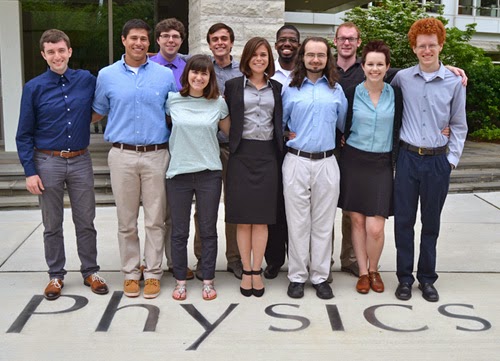
Also covers: commuting allowance, coverage of transportation to/from Washington, DC, and support to attend and present at a national physics meeting in the year following the internship. Meet the 2014 SPS National Interns, who are in the Washington, DC, area for 9.5-week science, policy and outreach internships with organizations including SPS, AIP, AAPT, APS, NASA, NIST, and the U.S. House of Representatives, May 28 - August 1, 2014.
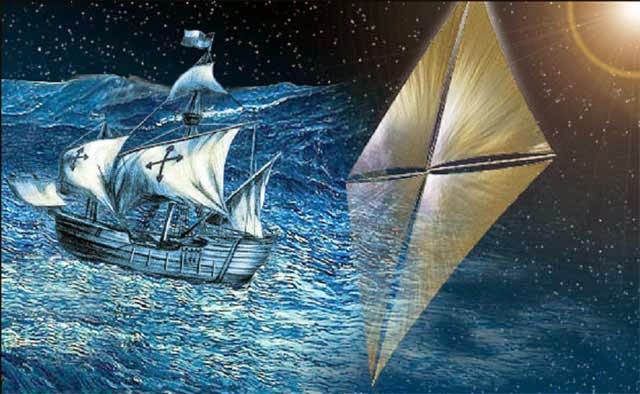
"Provide ships or sails adopted to the heavenly breezes, and there will be some who will brave even that void..." Johannes Kepler in a letter to his friend Galileo, 1610
Related to the topic (and mentioned in the live stream - see the Space.com link below):
Unlike chemical and rocket systems, which must expell a propellant to create thrust, an electrodynamic tether generates thrust through Lorentz-force interactions with a planetary magnetic field. By using the space environment to create thrust, electrodynamic tether systems can dramatically reduce the cost of many space missions by eliminating the need to launch large quantities of propellant into orbit.
An electrodynamic tether is essentially a long conducting wire extended from a spacecraft. The gravity gradient field (also known as the "tidal force") pulls the tether taut and tends to orient the tether along the vertical direction. As the tether orbits around the Earth, it crosses the Earth's magnetic field lines at orbital velocity (7-8 km/s!). The motion of the conductor across the magnetic field induces a voltage along the length of the tether. This voltage, which is called the "motional EMF", can be up to several hundred volts per kilometer.
Ok so it seems like a good time to update the lecture section. Here we have a full course on quantum field theory. Ed Witten, when asked about quantum field theory, described it as the hardest theory in modern physics by far. However my friends, don’t be discouraged, there are plenty of great resources online that can help you out in taming this hard theory. One of the best resources is this course delivered by David Tong. The course contains 14 lectures focusing on the basics of QFT. The only obvious drawback is, as you might have noticed, the quality of these videos. Luckily, the videos can be downloaded in various formats (including the slides showing the blackboard) on the Perimeter Institute website. For more lectures visit the links below.
Source: Science Magazine; US Army Corp of Engineers
When ground water saturates a river basin, the risk for flooding goes up. So does the strength of Earth’s gravity in that region, ever so slightly, because of the extra mass of the underground water. By using tiny variations in gravity detected from space, researchers report online today in Nature Geoscience that they can identify basins that are primed for flooding if additional rains come—sometimes with several months' warning. As a test case, the scientists looked at the gravity signals leading up to catastrophic floods in 2011 on the Missouri River (pictured above). They used data from NASA’s Gravity Recovery and Climate Experiment (GRACE), a pair of orbiting satellites that get tugged around the Earth faster in places where gravity is slightly stronger.
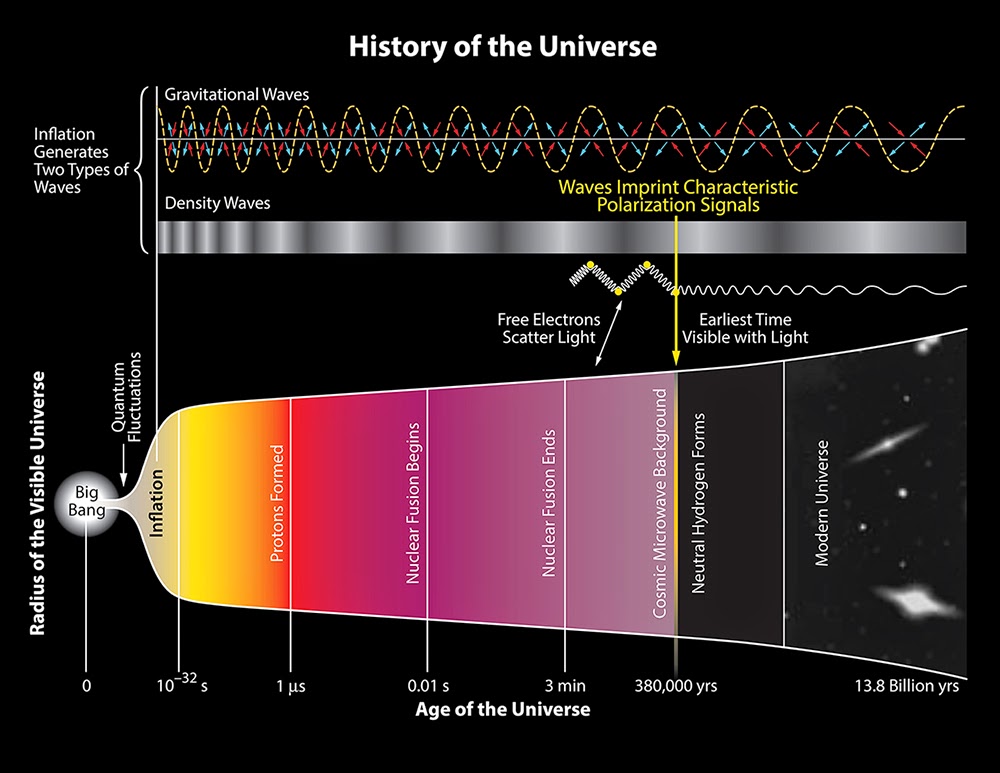
On March 17, a panel of four astrophysicists held a press conference at the Harvard-Smithsonian Center for Astrophysics in Cambridge, Mass., to announce that they had discovered features in the cosmic microwave background (CMB) that are consistent with gravitational waves from the universe’s first moments. The results agreed with predictions from the decades-old theory of inflation, said panelist Chao-Lin Kuo of Stanford University, providing the first direct evidence that for an infinitesimal instant after the Big Bang, our universe expanded faster than the speed of light.
Kuo had designed the sensitive photon detectors in the telescope responsible for the breakthrough. For three years in the cold, dry atmosphere of the South Pole, the Background Imaging of Cosmic Extragalactic Polarization (BICEP2) telescope collected photons from the CMB, the 13.8-billion-year-old residue of the Big Bang. Information describing the intensity and polarization of the captured photons was transmitted by satellite to an international collaboration of 47 researchers working at various institutes. Gradually, a pattern of polarized light emerged. The researchers were initially reluctant to interpret the data as evidence for primordial gravitational waves. They labored to rule out alternative explanations for the signal, including the possibility that the pattern had been generated not by gravitational waves but by dust in the Milky Way.
The con...
In mid-March, a panel of four astrophysicists working on an experiment to probe the first moments of time held an extraordinary press conference at the Harvard-Smithsonian Center for Astrophysics (CfA) in Cambridge, Mass. The scientists announced that a radio telescope located at the South Pole had discovered gravitational waves generated by the Big Bang. They posted a non-peer-reviewed paper on the Internet that proclaimed the beginning of a “new era” in cosmology.
Sharing the spotlight at the press conference were Andrei Linde and Alan Guth, two theoretical physicists who have developed seminal theories of how our universe rapidly inflated at its birth. The new results validated those theories — or so it seemed.
Stanford University and the CfA both distributed press releases calling the discovery a “smoking gun” showing that the theory of inflation is true, a phrase that appeared in international headlines about the findings. A short video of Stanford researcher Chao-Lin Kuo walking up Linde’s driveway to share the news of the discovery was viewed by millions. Smiling physicists and cosmologists nearly danced with excitement in media interviews.
Refugees - whether from climate disaster, or social/political unrest - are fleeing violence and the possibility of personal extinction. That cause ultimately stems from the allocation of resources among the population. See yesterday's Malthusian Musings post.
The approximately 10 million households that have achieved the status of millionaires by net worth is 3.125% of the general population in the US. That estimate is a rebound with respect to the stock market crash of 2008 that affected the many households - not theirs - and propelled some previously in the middle class into poverty.
The crisis at the US border met by protesters at the same in California: there is no "middle class society" in Central America; no leg up as yet from poverty or bridge from that to higher classes, though it has improved. If nature abhors a vacuum, in nations with no official middle class, it is usually filled by crime. The children being callously turned away are going back to a meat grinder that will only ultimately result in their deaths. If you're born poor in such a state, you're likely to remain as such and exposed to the violence of resource allocation. Typical of this irony, it's not well known that the former richest man in the world - Carlos Slim Helú - resides there in Mexico (the crown has been recaptured by Bill Gates - U-S-A!). Trade agreements that suppress wages for the sake of corporate profits are likely to make the Carlos' of the world happy, but not many of the 99% others.
Millionaire - Billionaire - Monarchy: all a recognition of hierarchy and the need to validate it. It's usually validated by the allocation of resources at the apogee of the social pyramid construct. Like good oligarchs, it helps to control the political process and news agencies of the countries you dwell in to reinforce the mantra. Unlike Germany, that's boosted its minimum wage to 8.50 Euros ($11.50 US dollars), there is no incentive in this nation to essentially change this paradigm. Instead there are the Horatio Alger - Ayn Rand myths upon which so many have given oblation and obeisance to. Along with those myths of "pluck" and "spunk" there is the need for self-preservation at the apogee. Thus, those at the top of the pyramid have no incentive to change the structure of how they got there. It would de-legitimize the construct they've worked so hard to preserve/conserve that has passed down from forebears to inheritors.
The other myths that must be fostered are "a constitutional crisis"; "government overreach"; a "need to return to principles" (whatever they are). Along with it, helps to insert in the public narrative pseudoscience like "climate change denial"; "intelligent design" to obfuscate and eliminate the tools a populace can use to question those in authority.
Refugees - whether from climate disaster, or social/political unrest - are fleeing violence and the possibility of personal extinction, may just be for many a cynical Calculus, the cost of doing business; the "noise" in the signal of ever-increasing profitability. Noise ignored, only increases in intensity and ultimately dampens the signal desired: a zero-sum deconstruction. PBS: Life Beyond Earth: Drake Equation Calculator
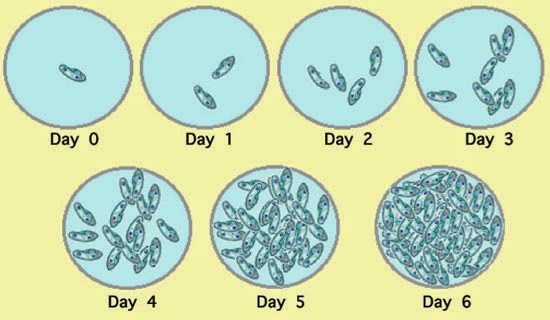
Figure 1: Changes in a population of Paramecium over a six day period Each individual in the population divides once per day. Source: Nature link below.
The link to Wolfram leads to the differential equation for population growth.
N(t) = N0ert
N0 = initial number.
r = Malthusian parameter, meaning population growth rate.
More humans; dwindling resources (bees, food, water, fossil fuel); diminished ozone protection; greenhouse gases; political unrest and conflicts; congressional obfuscation; "blame-the-other," homophobia, racism, sexism, xenophobia; "open carry"; doomsday preppers; tactical nukes in theater; pseudoscience; socially-engineered stupidity in science; same volume of planet under our feet as it was when there was literally "cattle on a thousand hills" (and, way before agribusiness or GMOs): What could possibly go wrong?
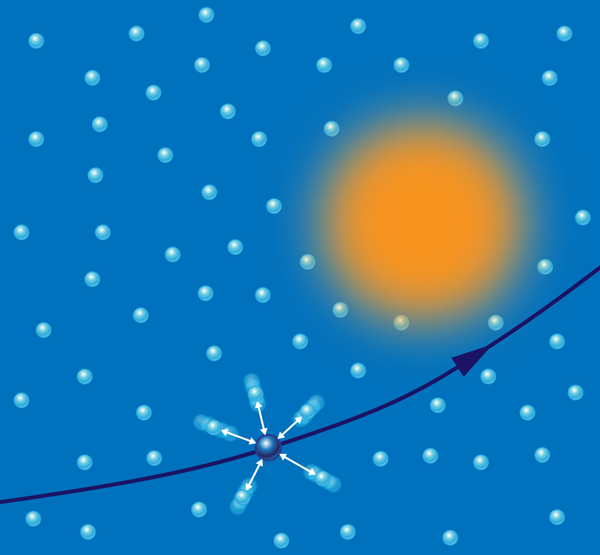
Figure 1: As an electron (dark blue) in a metal is deflected by an impurity atom (orange), further scattering of the electron is caused by its fluctuating interactions with the surrounding electrons (light blue). These fluctuations add an intrinsically dynamical contribution to the resistivity of the metal. Credit: see [+] below
A new model shows that quantum fluctuations make a significant contribution to a metal’s low-temperature resistance.
Electrical resistance in metals like copper and silver mainly comes from the scattering of electrons by vibrations in the crystal lattice (phonons). These vibrations die away at low temperatures, which explains why metals become less resistive when you cool them. But a small “residual resistivity” persists at low temperatures because electrons also scatter from impurities, such as a vacancy or an atom of a different species, which are always present in any real metal. So far, the residual resistivity was thought to only depend on the interaction between each electron and the impurities, but a new theory from Vladimir Nazarov and Yia-Chung Chang at the Academia Sinica, Taiwan, and Giovanni Vignale at the University of Missouri in Columbia shows that dynamical interactions between electrons—a many-body effect—also make a distinct contribution in the presence of impurities [1]. Their theory provides the first quantitative description, from first principles, of the resistivity of simple metals at low temperatures. As an example, they show that many-electron effects can explain the measured value of the residual resistivity of aluminum.
One of the oldest theories in condensed-matter physics is that of the conduction of an electrical current through a metal. In Paul Drude’s 1900 classical perspective [2], electrons in a metal are constantly moving in all directions, rather like molecules in a gas, but since their net momentum is zero, so is the current. Applying a voltage between the ends of the conductor creates an electric field that causes the electrons to veer slightly towards the positive end, producing a net current. From time to time, collisions once again randomize the electrons’ directions of motion. The frequency of such collisions determines the metal’s resistance. [+]
In a high-resolution photoemission study of a Mo(110) surface state various contributions to the measured width and energy of the quasiparticle peak are investigated. Electron-phonon coupling, electron-electron interactions and scattering from defects are all identified mechanisms responsible for the finite lifetime of a valence photo-hole. The electron-phonon induced mass enhancement and rapid change of the photo-hole lifetime near the Fermi level are observed for the first time. [~]
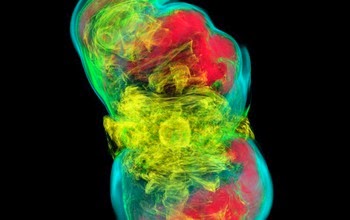
Volume rendering of the entropy of a differentially rotating and highly magnetized progenitor to a supernova in a full 3-D. Red colors indicate high entropy (hot) material while blue represents low entropy (cold) material. Strongly magnetized material is continuously launched from the surface of the proto-neutron star in the center but gets severely distorted such that, instead of a clean jet observed in the ultra-strong magnetic field case, two giant polar lobes are formed. The box size for the visualization is 2000km cubed.
Credit: Philipp Moesta, TAPIR, California Institute of Technology
[The following is Part eight in a series of stories that highlight recent discoveries enabled by the Stampede supercomputer. In parts one, two, three, four, five, six and seven, learn how the system is helping to advance research throughout science and engineering.]
Using the National Science Foundation-supported Stampede supercomputer, Philipp Moesta and Christian D. Ott from the California Institute of Technology succeeded in performing the first 3-D simulations of a collapsing star that takes into account the influence of general relativity and magnetohydrodynamics--the interplay of electrically conducting fluids like plasmas and powerful magnetic fields. The death of these collapsing stars leads to energetic, jet-driven supernova explosions.
Their findings show that the simulations behave very differently in full, unconstrained 3-D compared to the same model simulated with the assumption that stars are sperically symmetrical.
The universally accepted method of expressing physical measurements for world commerce, industry, and science is about to get a facelift, thanks to our improved knowledge of fundamental constants.
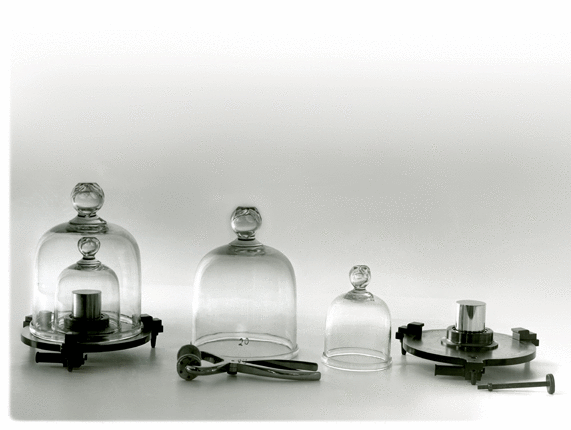
Although the present International System of Units (SI, from the French Système International d’Unités) was officially established in 1960, its origin goes back to the creation of the metric system during the French Revolution. Following an idea proposed a century earlier by John Wilkins, 1 the new system of weights and measures took as its starting point a single universal measure—the meter—and used it to define length, volume, and mass. The meter came from a perceived constant of nature: one ten-millionth of the distance along Earth’s meridian through Paris from the North Pole to the equator. 2 Definitions for the units of volume and mass followed, with the liter being 0.001 m 3 and the kilogram the mass of 1 liter of distilled water at 4 °C. Subsequently, in 1799, two platinum artifact standards for length and mass based on those definitions were deposited in the Archives de la République in Paris. In the words of the Marquis de Condorcet, a new system of measurement “for all time, for all people” was born.
The SI is a living, evolving system, changing as new knowledge and measurement needs arise, albeit sometimes slowly when measured against the rapid pace of scientific progress.
The new SI will also have seven base quantities: frequency, velocity, action, electric charge, heat capacity, amount of substance, and luminous intensity. The specific reference quantities will be the exact values of a set of defining constants: the ground-state hyperfine splitting of the cesium-133 atom Δ ν( 133Cs) hfs, c, h, e, k, the Avogadro constant N A, and the luminous efficacy K cd. However, to provide continuity and ease of transition, their values will be expressed in terms of the present SI units instead of in potentially confusing new base units.
Caption: This is a still frame from an artist's animated rendering of the MAGIS Device (magnetically activated and guided isotope separation). To begin the MAGIS process, unpurified ore is vaporized and enters an optical pumping region where a one-watt laser (red beam) tuned to a specific wavelength magnetizes only the particles of the desired isotope so that they are repelled by a magnetic field. The magnetized and unmagnetized particles enter a curved tunnel lined with permanent magnets, called a wave guide. The particles must follow the curve to make it to the collector at the end, but can only do so if repelled by the magnetic field. Since only the particles of one isotope are magnetized (blue dots), only those particles make the trip and end up in the collector. The MAGIS method was developed by Mark Raizen, Tom Mazur and Bruce Klappauf. The full animation can be viewed at https://www.youtube.com/watch?v=zIRi-7AxFAM.
I don't know what's more exciting - the new discovery, or knowing one of the discoverers.
I guess it's both! MAGIS: Magnetically-activated and guided isotope separation:
AUSTIN, Texas — Researchers at The University of Texas at Austin have devised a new method for enriching a group of the world's most expensive chemical commodities, stable isotopes, which are vital to medical imaging and nuclear power, as reported this week in the journal Nature Physics. For many isotopes, the new method is cheaper than existing methods. For others, it is more environmentally friendly.
A less expensive, domestic source of stable isotopes could ensure continuation of current applications while opening up opportunities for new medical therapies and fundamental scientific research.
Chemical elements often exist in nature as a blend of different variants called isotopes. To be useful in most applications, a single isotope has to be enriched, or separated out from the rest.
A combination of factors has created a looming shortage of some of the world's most expensive but useful stable isotopes.
Last year, the Government Accountability Office released a report warning that there may soon be a shortage of lithium-7, a critical component of many nuclear power reactors. Production of lithium-7 was banned in the U.S. because of environmental concerns, and it's unclear whether the current sources, in China and Russia, will continue meeting global demand.
Nuclear medicine in particular could benefit from the new method, the researchers say. Many stable isotopes are precursors to the short-lived radioisotopes used in medical imaging, cancer therapies and nutritional diagnostics.
The new method also has the potential to enhance our national security. The researchers used the method to enrich lithium-7, crucial to the operation of most nuclear reactors. The U.S. depends on the supply of lithium-7 from Russia and China, and a disruption could cause the shutdown of reactors. Other isotopes can be used to detect dangerous nuclear materials arriving at U.S. ports.
Raizen's co-authors on the paper are Tom Mazur, a Ph.D. student at the university; and Bruce Klappauf, a software developer at Enthought and a former senior research scientist at UT Austin.
Now, Raizen's top goal is getting this technology out of the lab and into the world. The MAGIS invention has been issued a U.S. patent, which is owned by The University of Texas at Austin, with Raizen and Klappauf as inventors.
Raizen plans to create a nonprofit foundation to license the technology.
TECHNOLOGY REVIEW: Europe and China are gaining the upper hand in the race to bounce perfectly secure messages off satellites in low Earth orbit.
One of the great benefits of quantum communication is the ability to send messages from one point in space to another with perfect security. Not so great is the fact that so-called quantum cryptography is limited to distances of around 100 kilometers.
That’s because over longer distances, photons tend to be absorbed by the glass in fiber-optic cables and by the atmosphere when beamed from one location to another. That causes errors that are too great for perfect privacy.
But there is a potential way around this–to send photons to an orbiting spacecraft, which then retransmits the message securely when it is over another part of the planet. That’s possible because the photons traveling straight up only have to negotiate a few tens of kilometers of the atmosphere before reaching space.
So it’s not surprising that governments all over the world are keen on exploiting space-based quantum cryptography. Indeed, last year we reported on a Chinese team that had successfully reflected individual photons off an orbiting satellite, to simulate a satellite sending photons to the ground.
The above actually (or, a version of it) occurred 1st on the show:
Picard tries to explain to Ralph Offenhouse from the 20th century that there would be no need for his law firm any longer: "A lot has changed in three hundred years. People are no longer obsessed with the accumulation of 'things'. We have eliminated hunger, want, the need for possessions." (TNG: "The Neutral Zone")
Then, reiterated on the big screen:
When Lily Sloane asked how much the USS Enterprise-E cost to build, Picard tells her "The economics of the future is somewhat different. You see, money doesn't exist in the 24th century... The acquisition of wealth is no longer the driving force in our lives. We work to better ourselves and the rest of Humanity." (Star Trek: "First Contact"), see: Memory Alpha - Money
At these two lines - somewhat sappy sentiments, really - my conspiracy theorist fellow engineering coworker went into overdrive. It was Austin, Texas and he listened religiously to a certain overweight bloviating local talk show host was then [as he nauseatingly is now via the Internet mostly] on AM radio. I got a lot of rapid fire, staccato Communist-Socialist-New World Order ramblings that left me rather deer-in-the-headlights-dazed and amazed he bothered to memorize all the talking point non-techno-babble. I briefly thought about suggesting we go out to lunch, and maneuvering him towards a blood pressure machine. If you've seen his particular radio muse rant and rave, my friend was a pretty close clone, and closer to bursting a blood vessel on his forehead! I knew his systolic and diastolic readings had to be impressively BAD! It was really hard keeping a straight face.
First observation: Mr. Ralph Offenhouse was fashioned as a general prick in the spirit of a few contemporary billionaire bad examples that apparently instead of being content with swimming in their loot like Scrooge McDuck want to control everything about human choice and existence in the 21st century, especially over alternative energy options (they'd outlaw a Dyson Sphere if it were ever developed; in Star Trek: Federation, Warp Drive was initially opposed by the powerful - you can't rule those who choose to go off-world). Ralph went to great personal expense in the standard economy we all know intimately now to survive his own mortality, and like a good 1%-er, he wanted his lawyer's law firm (its descendant partners, really) to tell him what his returns would be 300 years hence! Can't say I'm sad he's disappointed. Then I found this term: post-scarcity economy. It means "an alternative form of economics or social engineering in which goods, services and information are universally accessible." [Wikipedia] Essentially, a give economy of non-anal retentive hominids that aren't comparing their bank accounts like boy scouts compare penis lengths at jamborees (not much difference, really). On the Kardashev Scale, that would mean control of some impressive energies and violation of significant physics concepts: mass-to-energy conversion at a whim (E=mc2); making the Heisenberg Uncertainty Principle "certain" to get (as I've joked many times): "tea, Earl Grey...hot!" It would also require cooperation politically and socially on a scale we've never seen before in our species, as everyone in their part of the planet thinks "their way" is the only way, and everyone else everywhere else are existentially Martians! Thereareprofound changes in the economy due to technology -robotics, for example has eliminated many jobs that used to require human intervention on an assembly line. Now it requires at least humans with the technical skills to repair them when they inevitably break down. As we advance, we will have to give some consideration to what "work" means and how to pursue it. In the 24th century, humanity would have some cultural memory of life before Warp, specifically their memories of WWIII and flirting with the apocalypse. Like most cultural groups that have gone through dreadful shared histories - the African Diaspora; the Holocaust - the group says collectively "never again." The group in this fictional case is the human species itself. With that near-miss on mass extinction, there would be motivation to do something radically different than previous economic formulations (sorry Ralph). Their life spans essentially doubling suggests universal healthcare (and low stress since the premise is people work because they want to, not because they have to - see replicator below); their comfort with technology points to an education system (like their health system) devoid of our current political machinations. So, after reading several theses on the subject (some of them mentioning it outright, see "Related Links" below), I settled on the only thing that made sense from a physics standpoint as a "Federation Credit" in a 24th century economy: a Joule, unlike Bitcoin, actually based on the following physics definition. Joule (pronounced like "jewel") is a measure of work, defined as force exerted over a defined distance, units: Newton-meter. Dividing by a unit of time (second) and you get a Joule/second = a Watt, or measure of power. For the electrical buffs out there: it's one ampere of current passed through a resistance of one ohm for one second. It makes sense in this regard: infants and toddlers probably wouldn't get much credit (other than being cute) since they can't do too much in the way of work. Dependent on your occupation and contribution to society, you'd get more Fed Joule creds in your account. It would increase proportionately if you say, discovered a new invention, won the Nobel Prize or solved a crisis on a distant planet. Your creds would then increase and due to the Deus ex machina transporter-replicator-thingy. You could trade it on replicated clothing, Earl Grey Tea, food, furniture or on worlds that still had a banking system - like the Ferengi. As you age - 120 years for the average 24th century human is kind of getting up there - your credits would diminish proportionately. It coincides with Leonard McCoy's complaint in the Star Trek reboot in '09:
"Taking the whole planet in the divorce" suggests a one-way exchange of currency (sounds like it was not in Bones' favor). So can we say the [now former] Mrs. McCoy "had him by the Joules"? Leonard was obviously "Fed-street-cred-deficient"; "broke" in a society supposedly without what we consider money. I hope my former coworker reads this, stops listening to AM talk radio; learns to laugh at life a little and calms down hopefully quite a bit...
“When you call yourself an Indian or a Muslim or a Christian or a European, or anything else, you are being violent. Do you see why it is violent? Because you are separating yourself from the rest of mankind. When you separate yourself by belief, by nationality, by tradition, it breeds violence. So a man who is seeking to understand violence does not belong to any country, to any religion, to any political party or partial system; he is concerned with the total understanding of mankind.”Jiddu Krishnamurti
"As avenues to foreign influence in innumerable ways, such attachments are particularly alarming to the truly enlightened and independent patriot. How many opportunities do they afford to tamper with domestic factions, to practice the arts of seduction, to mislead public opinion, to influence or awe the public councils. Such an attachment of a small or weak towards a great and powerful nation dooms the former to be the satellite of the latter." General George Washington, 1st President of the United States' Farewell Address. *****
Also here: Actor and comedian Richard Belzer tells “Say Anything!” host Joy Behar why he thinks President Barack Obama is headed for a “landslide” victory in November noting:
“The Republican Party is not a political party – it’s a mental condition. And I mean that seriously because if you are for crushing the poor, unprovoked wars, there is no climate change, immigrants. It’s like ‘who are we’?”
Who are we?...
The National Academy of Sciences was founded on March 3, 1863, at the height of the Civil War.
The immediate roots of the NAS can be traced back to the early 1850s and a group of scientists based largely in Cambridge, Massachusetts. The group enlisted the support of Massachusetts Senator Henry Wilson, who helped draft a bill for the incorporation of the National Academy of Sciences. Wilson brought the bill to the Senate on February 20, 1863, where it was passed on March 3. It was passed by the House of Representatives later that day, and was signed into law by President Lincoln before the day was over. The National Academy of Sciences had officially come into being with 50 charter members, who over the years would be joined by the election of the nation's most distinguished scientists.NAS History
We erroneously assume that the absolutely insane, the inane cannot possibly get elected to public office, then surprised when they do.
We assume that we are the grandchildren of Jefferson and his trinity of three greatest men; we assume our Civics and Social Studies is universal and understood by our political leaders.
“To err is human,” wrote Seneca. “To persist is diabolical.” Everyone makes incorrect predictions. But to be that consistently, grossly wrong takes special effort. So what’s this all about? Nobel Prize-Winning economist Paul Krugman opines in the New York Times on the ideological persistence of one party on the "sins" of the Affordable Care Act despite evidence to the contrary.
Who are we, and who do we want representing our views after any election?
1979:
150 corporations control television (ABC, CBS, NBC, PBS, UHF); radio and print media.
2014:
6 corporations control television (more stations than I can list), radio, print media and Internet and social media. That is a 25X reduction if you wanted the math.
Washington nor Jefferson had to contend with lobbyists or corporations, nor influence peddlers that use marketing firms to direct our thoughts online and convert us into sheep commodities for profit.
It is not just a denial of climate change or science: it's a denial of reality itself; allowing larger forces to manipulate that reality for gain or profit and purposely seed doubt on institutions designed to act in our best interests, getting us to vote or behave not in our best interests.
If one party denies reality, HOW can we extend to it the reigns of power governing the most significant country on the globe? Mutually Assured Destruction was never meant as a goal.
I want a resurgence of the party of science - the previous Republican Party before the current takeover by bigots, extremists, terrorists and apocalyptic zealots. That would be a "return to principles" I think everyone could support.
Einstein and Oppenheimer: Both men in their later years dismissed black holes as anomalies, unaware that they contained some of the deepest mysteries of physics (Image: Alfred Eisenstaedt, LIFE magazine)
For those of you whose Latin is crisper than mine: roughly "the folly of giants"... On September 1, 1939, the same day that Germany attacked Poland and started World War 2, a remarkable paper appeared in the pages of the journal Physical Review. In it J. Robert Oppenheimer and his student Hartland Snyder laid out the essential characteristics of what we today call the black hole. Building on work done by Subrahmanyan Chandrasekhar, Fritz Zwicky and Lev Landau, Oppenheimer and Snyder described how an infalling observer on the surface of an object whose mass exceeded a critical mass would appear to be in a state of perpetual free fall to an outsider. The paper was the culmination of two years of work and followed two other articles in the same journal.
What happened? Oppenheimer’s lack of interest wasn’t just because he became the director of the Manhattan Project a few years later and got busy with building the atomic bomb. It also wasn’t because he despised the free-thinking and eccentric Zwicky who had laid the foundations for the field through the discovery of black holes’ parents – neutron stars.
Thus for Oppenheimer, black holes, which were particular solutions of general relativity, were mundane; the general theory itself was the real deal. In addition they were anomalies, ugly exceptions which were best ignored rather than studied. As Dyson mentions, unfortunately Oppenheimer was not the only one affected by this condition. Einstein, who spent his last few years in a futile search for a grand unified theory, was another. Like Oppenheimer he was uninterested in black holes, but he also went a step further by not believing in quantum mechanics. Einstein’s fundamentalitis was quite pathological indeed.
History proved that both Oppenheimer and Einstein were deeply mistaken about black holes and fundamental laws. The greatest irony is not that black holes are very interesting, it is that in the last few decades the study of black holes has shed light on the very same fundamental laws that Einstein and Oppenheimer believed to be the only thing worth studying. The disowned children have come back to haunt the ghosts of their parents.
"If the radiance of a thousand suns were to burst forth at once in the sky,
It would be like the splendor of the Mighty One. [I am Mighty, world-destroying Time.] Now I am become death, the destroyer of worlds." The Bhagavad Gita, the last sentence quoted by Oppenheimer reflecting on scientists' reactions when the atomic bomb was successfully tested.
TECHNOLOGY REVIEW: Astrophotography is currently undergoing a revolution thanks to the increased availability of high quality digital cameras and the software available to process the pictures after they have been taken.
Since photographs of the night sky are almost always better with long exposures that capture more light, this processing usually involves combining several images of the same part of the sky to produce one with a much longer effective exposure.
That’s all straightforward if you’ve taken the pictures yourself with the same gear under the same circumstances. But astronomers want to do better.
“The astrophotography group on Flickr alone has over 68,000 images,” say Dustin Lang at Carnegie Mellon University in Pittsburgh and a couple of pals. These and other images represent a vast source of untapped data for astronomers.
Enrico Fermi, when asked about intelligent life on other planets, famously replied, “Where are they?” Any civilization advanced enough to undertake interstellar travel would, he argued, in a brief period of cosmic time, populate its entire galaxy. Yet, we haven’t made any contact with such life. This has become the famous "Fermi Paradox”.
Various explanations for why we don’t see aliens have been proposed – perhaps interstellar travel is impossible or maybe civilizations are always self-destructive. But with every new discovery of a potentially habitable planet, the Fermi Paradox becomes increasingly mysterious. There could be hundreds of millions of potentially habitable worlds in the Milky Way alone.
So why don’t we see advanced civilizations swarming across the universe? One problem may be climate change. It is not that advanced civilizations always destroy themselves by over-heating their biospheres (although that is a possibility). Instead, because stars become brighter as they age, most planets with an initially life-friendly climate will become uninhabitably hot long before intelligent life emerges.
The Earth has had 4 billion years of good weather despite our sun burning a lot more fuel than when Earth was formed. We can estimate the amount of warming this should have produced thanks to the scientific effort to predict the consequences of man-made greenhouse-gas emissions.
These models predict that our planet should warm by a few degrees centigrade for each percentage increase in heating at Earth’s surface. This is roughly the increased heating produced by carbon dioxide at the levels expected for the end of the 21st century. (Incidentally, that is where the IPCC prediction of global warming of around 3°C centigrade comes from.)