All Posts (6512)

Sort by

Space Seed...

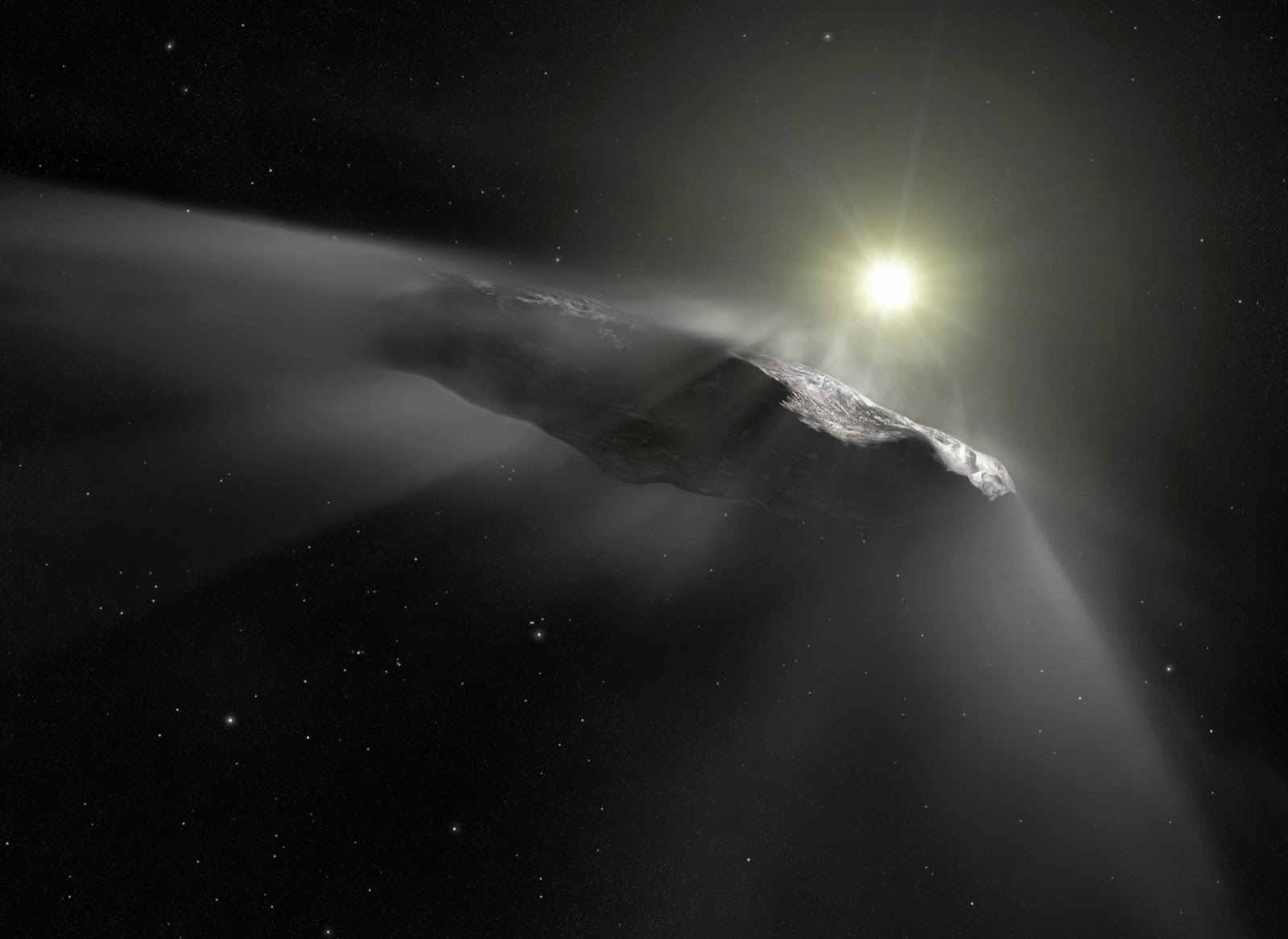
Interstellar objects like Oumuamua could be the source of life as we know it. ESA/Hubble, NASA, ESO, M. Kornme

Topics: Carl Sagan, Exoplanets, SETI, Space Exploration, Star Trek

Note: Star Trek had an episode titled "Space Seed" with Ricardo Montalbán and his portrayal of Khan Noonien Singh. Also, since I've used Panspermia before, that was the rationale for the post title (with proper attribution, of course).

Are we truly earthlings? Is terra firma unequivocally the birthplace of humanity?

Maybe not. A new paper by a trio of Harvard University researchers argues that we all might be immigrants from deep space, brought to Earth via a mechanism called panspermia.

While the conventional wisdom from biologists has long been that life on Earth began on Earth, science fiction isn't so fuddy-duddy. “Prometheus,” Ridley Scott’s 2012 prequel to the blockbuster “Alien” franchise, is one of many films positing that our planet was seeded by extraterrestrial life.

In the movies, aliens use some sort of engineered transportation system to get here — rockets or wormholes, for example. Panspermia makes no such technical demands. Here’s the basic idea: A meteor slams into a planet where life exists, and the collision lofts into space a microbe-containing dirt clod. The clod eventually slams into another world and infects it with life.

Are germs from outer space the source of life on Earth?

Seth Shostak, Senior Astronomer, SETI Institute

Read more…

#VOTE...

"You want to be the pebble in the pond that creates the ripple for change." Tim Cook, CEO, Apple, Inc. Brainy Quote

Topics: Civics, Civil Rights, Diversity, Existentialism, Human Rights, LGBT Rights, Politics, Women's Rights

I've literally done all that I can do. I've blogged, I've called, I've text messaged, I've given money; I've reminded/nagged/begged. I've also early voted. It's now all up to you millennials tomorrow, and the futures you want for yourselves.

Trust me on this one: you will get older. You won't look as good as you do right now in the mirror. A car accident, a fall, a cancer diagnosis could change your world for the far worse than it is. I don't want you to find out the high cost of healthcare in this country (an oxymoron) and the high price of ignoring signs and "hoping it will go away on its own."

If you've decided not to have kids because of the terrible state of affairs in the world, that's fine too. I know a lot of couples that are childless by choice. Minus refugees fleeing the blow back from our country's debacles in Central America; climate change, minus clean water standards; minus standards of living: we're headed into 15 billion souls that will need food, clothing, healthcare and jobs with no ideas coming from the living fossils tied at the hip to the fossil fuels industry. They get to die before the impact of their blunders turn your golden years into a dystopian nightmare.

Think of it this way: if your "favorite" isn't on the ballot, if your candidate didn't move you to tears with their oratory; if you just think all this fuss is kind of dumb, what isn't is your futures. It's on the ballot tomorrow and every election after that.

It Can't Happen Here is a semi-satirical 1935 political novel by American author Sinclair Lewis,[1] and a 1936 play adapted from the novel by Lewis and John C. Moffitt.[2]

Published during the rise of fascism in Europe, the novel describes the rise of Berzelius "Buzz" Windrip, a demagogue who is elected President of the United States, after fomenting fear and promising drastic economic and social reforms while promoting a return to patriotism and "traditional" values. After his election, Windrip takes complete control of the government and imposes a plutocratic/totalitarian rule with the help of a ruthless paramilitary force, in the manner of Adolf Hitler and the SS. The novel's plot centers on journalist Doremus Jessup's opposition to the new regime and his subsequent struggle against it as part of a liberal rebellion. Wikipedia

I'm surprised I've not heard any parallels drawn from the plot of this novel and current events.

Like the Neanderthal nincompoop politicians lining their pockets from their 1% paymasters, I'll likely be ashes in a cemetery giving life to a maple tree (or, at least that will be my request).

I would just really appreciate a planet to supply oxygen for and clean water for my roots to drink. I tend to think you would too.

Read more…

Nasty Tricks and Tasty Treats

"LaShaun, you better not be on the roof again."

"Mom, we're just up here playing Spider and Prey. We want it to look realistic."

"Hurry up and get dressed for Halloween."

"I am dressed. I am wrapped in spider-silk and Frank's going to dangle me from the roof at just the right moment."

"Did you put the lights up?"

"Yes, mom. Remote's in the kitchen."

"What's my part?"

"You don't have a part. You're the Mom handing out candy to innocent children. That is your part. You also get to be technical support. Turn on the lights after I twitch convincingly and then surprise moan."

"Frank makes his menacing hiss and the kids run off screaming into the night."

"No they won't."

"Yeah, Mom, they will. Remember when he jumped down and ran off with the Davis kid dressed as Superman?"

"All I remember is having to chase him down the street telling him not to eat that kid."

"Yeah. That's what all the kids remember too...They don't know he lives in the backyard."

"Frank says there are kids coming down the street. He's on the back side of the house."

"The camera is recording from the corner of the house and in the car."

"Great, Mom. I'm going to the roof to get ready. Stall 'em for a minute."

"Okay, Caesar Romero."

"Trust me, Mom. It's gonna be great."

"FRANK, no running off with the kids!"

"He knows, Mom. He knows."

"He knew last year, too."

"After we're done here, you have to finish packing. We'll need to be on the road by tomorrow."

"Okay, Mom. See you soon."

"Trick or Treat!"

"Hello children. What do we have here. A vampire. A princess. Captain America. What about you little girl? What are you?"

"A serial killer. They look just like everyone else."

"That's so sweet... Everyone gets some candy."

"What's that noise?"

"What noise?"

"Help me!"

Children and parents scream as LaShaun dangles from the porch awning skillfully wrapped in webs. Mom hits the lights and they see Frank, waving his arms in a menacing but completely over-acted fashion. LaShaun twitches artfully while spinning above the heads of the fleeing children.

The terrified families flee down the street, followed by smaller dog sized things swarming from around the house. Each is grabbed, webbed, scooped up and flung skyward to land with an awkward thump in the backyard of LaShaun's house.

The spiderlings too small to carry away prey, pick up every drop of candy and debris before disappearing into the darkness. It was as if no one had ever been there.

The next group of children were just a block away, everything had to be perfect.

Frank reels LaShaun in and the two high-five.

"Yes, Frank, it's going to be an all you can eat night."

Nasty Tricks and Tasty Treats © Thaddeus Howze, 2018

Read more…

Leadership of Ghouls...

Topics: Civics, Civil Rights, Human Rights, Politics, Women's Rights

Ghoul (n):

1 : a legendary evil being that robs graves and feeds on corpses

2 : one suggestive of a ghoul

especially : one who shows morbid interest in things considered shocking or repulsive Merriam-Webster

Nihilism (n):

1

a : a viewpoint that traditional values and beliefs are unfounded and that existence is senseless and useless

Nihilism is a condition in which all ultimate values lose their value.

— Ronald H. Nash

b : a doctrine that denies any objective ground of truth and especially of moral truths

2

a : a doctrine or belief that conditions in the social organization are so bad as to make destruction desirable for its own sake independent of any constructive program or possibility

b capitalized : the program of a 19th century Russian party advocating revolutionary reform and using terrorism and assassination Merriam-Webster

MOSCOW (AP) — A security aide to Yevgeny Prigozhin, a Russian businessman who has been indicted by American investigators for allegedly trying to interfere with the 2016 U.S. election, says the mogul has been involved in attacks on several people and at least one killing, an independent Russian newspaper reported Monday.

Prigozhin has been dubbed “Putin’s chef” for organizing catering events for Russian President Vladimir Putin and even personally serving him and his guests on some occasions.

The Novaya Gazeta article Monday by reporter Denis Korotkov came out several days after unknown people sent a funeral wreath to the journalist’s home and left a basket with a severed goat’s head at the newspaper’s office.

Korotkov’s article relies on several interviews with Valery Alemchenko, a former convict who worked for Prigozhin. Alemchenko said he orchestrated attacks on Prigozhin’s opponents as well as the killing of an opposition blogger in northwest Russia, all at the mogul’s behalf.

According to the Crime Museum's web site, the third early sign of a serial killer is the mutilation of animals. Apparently in Moscow, it's a key job description.

We cherish, as well as take our freedoms for granted. If the death of Jamal Khashoggi is not investigated by the UN; if the extra judicial killings in and by Russia is not backed up with stiffer sanctions, it is a matter of time before it's tried on these shores. If the suspicious deaths of low-level bloggers or reporters are met with collective shrugs, the First Amendment will at that point in history have been fed through a shredder. It matters not which Amendment is your "favorite," for those of our citizenry that cannot count beyond the 2nd: The Constitution for all intents and purposes is at that point worthless toilet paper for the dung hill America will have become.

Amendment I

Congress shall make no law respecting an establishment of religion, or prohibiting the free exercise thereof; or abridging the freedom of speech, or of the press; or the right of the people peaceably to assemble, and to petition the government for a redress of grievances. Cornell Law

*****

'I told you, Winston,' he said, 'that metaphysics is not your strong point. The word you are trying to think of is solipsism. But you are mistaken. This is not solipsism. Collective solipsism, if you like. But that is a different thing: in fact, the opposite thing. All this is a digression,' he added in a different tone. 'The real power, the power we have to fight for night and day, is not power over things, but over men.' He paused, and for a moment assumed again his air of a schoolmaster questioning a promising pupil: 'How does one man assert his power over another, Winston?'

Winston thought. 'By making him suffer,' he said.

'Exactly. By making him suffer. Obedience is not enough. Unless he is suffering, how can you be sure that he is obeying your will and not his own? Power is in inflicting pain and humiliation. Power is in tearing human minds to pieces and putting them together again in new shapes of your own choosing. Do you begin to see, then, what kind of world we are creating? It is the exact opposite of the stupid hedonistic Utopias that the old reformers imagined. A world of fear and treachery is torment, a world of trampling and being trampled upon, a world which will grow not less but more merciless as it refines itself. Progress in our world will be progress towards more pain. The old civilizations claimed that they were founded on love or justice. Ours is founded upon hatred. In our world there will be no emotions except fear, rage, triumph, and self-abasement. Everything else we shall destroy everything. Already we are breaking down the habits of thought which have survived from before the Revolution. We have cut the links between child and parent, and between man and man, and between man and woman. No one dares trust a wife or a child or a friend any longer. But in the future there will be no wives and no friends. Children will be taken from their mothers at birth, as one takes eggs from a hen. The sex instinct will be eradicated. Procreation will be an annual formality like the renewal of a ration card. We shall abolish the orgasm. Our neurologists are at work upon it now. There will be ...no loyalty, except loyalty towards the Party. There will be no love, except the love of Big Brother. There will be no laughter, except the laugh of triumph over a defeated enemy. There will be no art, no literature, no science. When we are omnipotent we shall have no more ..need of science. There will be no distinction between beauty and ugliness. There will be no curiosity, no enjoyment of the process of life. All competing pleasures will be destroyed. But always -- do not forget this, Winston -- always there will be the intoxication of power, constantly increasing and constantly growing subtler. Always, at every moment, there will be the thrill of victory, the sensation of trampling on an enemy who is helpless. If you want a picture of the future, imagine a boot stamping on a human face -- for ever.'

George Orwell, '1984,' Part 3, Chapter 3

*****

An obvious fan of the illegitimate president* sent pipe bombs to a specific enemies list: Joe and Jill Biden, John Brennan, Bill and Hillary Clinton, Robert De Niro, Eric Holder, Barack and Michelle Obama, Debbie Wasserman Schultz, Maxine Waters and the staple of conspiracy theorists, George Soros. They apparently threw in Governor Andrew Cuomo and CNN where his little brother works to round out the list. This is how they look mind you, when they WIN (by hook, or Russian crook). It might have something to do with vitriolic rhetoric of the media as "the enemy of the people," chants of "lock her up," praising Neo Nazis at Charlottesville and a congressman for body slamming a reporter. Just saying...

(Dishonorable mention of inciting murderous mayhem: Mama Grizzly Sarah "don't retreat, instead: RELOAD!" Palin, and Mr. Loofah Bill "Tiller the Baby Killer" O'Reilly.)

The blueprint of the dystopian by Eric Blair (George Orwell was his pen name) seems daily revealed, slowly with increasing frequency. The author hinted at any totalitarian regime that was in vogue at the time of his brief life (he died after the publication in 1949). It could be Nazis, it could be the Soviets; it could be George Lincoln Rockwell (Richard Spencer looks like he purposely cloned himself after him) in a Philip K. Dick dystopia - "The Man in the High Castle," currently in its third season on Amazon Prime. The date 1984 was merely a nod to the future. There are many theories on the origin of the novel's name. It targets no specific epoch for when a society essentially experiences entropy: it merely darkly illustrates what such a society might look like. So does "The Handmaid's Tale" by Margaret Atwood (on Hulu); "The Parable of the Sower" and "The Parable of the Talents" by Octavia Butler (that SHOULD be made into movies, or a series). Though their endings are grim, the relief for the reader is it is a complete fantasy. S/he is comforted that such an event can never happen in modern times and understanding of democratic republics, and promptly orders a soothing latte. Before the anarchy of authoritarianism, it must be fueled by apathy.

Yesterday and today [ominously, the date of the article is November 9, 2012] mark the 74th anniversary of Nazi Germany's state-instigated pogroms known as Kristallnacht (Night of Broken Glass), a turning point in Hitler's anti-Jewish policy. For most scholars, it marks the beginning of the period we now define as the Holocaust.

Nazi militants destroyed thousands of stores and Jewish homes, desecrated cemeteries and burned down hundreds of synagogues. German Jewish citizens were arrested, systematically humiliated and abused in public in every city, town and village of Germany and in the recently annexed Austria. The majority of German citizens were bystanders to the pogrom and did not try to prevent the vandalism and destruction.

The events of Kristallnacht teach a valuable lesson. They show that a modern society can become numbed to the fate of its minorities. Since Hitler's rise to power in March 1933, Jews had been classified and categorized as "others." They were demonized, legally discriminated against and spatially segregated. Non-Jewish Germans were increasingly convinced that the treatment of Jews was justified and did not concern them. Remembering Kristallnacht: It starts with apathy, Alejandro Baer, Star Tribune

I will make this my last post before November 5 and 6, 2018 (literally: Judgment Day). Our country will either be a referendum against creeping fascism, or an endorsement of it. Putin has boldly proclaimed our better days are behind us, mocking the United States and orange shit stain to John Bolton's face. The KGB master spy's ideal is likely a return to serfdom on a global scale, with figurehead potentates reporting into him as kingpin crime boss, the "strongmen" maintaining control with fear, division and xenophobia. William Shakespeare said "what's past is prologue," and since the future is ours to shape, it doesn't have to be an inevitable slide to tyranny. This is a time to early vote, then canvas; then call until the last minute - until the last breath. This is the election of not just our lifetimes, but the lifetimes of our posterity yet born, for a world they'll inherit that will be habitable, or not; a world that will be fairer to people of color, our daughters, our LGBT relatives, immigrants... or, not. We've all lived through the low turnouts of the 1994 and 2014 midterms, near and distant history that have shaped this current crisis now. This is NOT a time for the indifferent, haughty bench warmers or the "too woke" to vote. The apathetic need to get out of the way of The Indivisible. If we lose this one, we all lose a nation and our place as the world's last, best hope.

Those remaining in that dark aftermath of a dangerous, unsure world are usually ordered about the remainder of their short days by zombies, Nazis...or, ghouls.

"Unless someone like you cares a whole awful lot,

Nothing is going to get better. It's not."

― Dr. Seuss, The Lorax

#VOTE
Read more…

Shrink Ray...

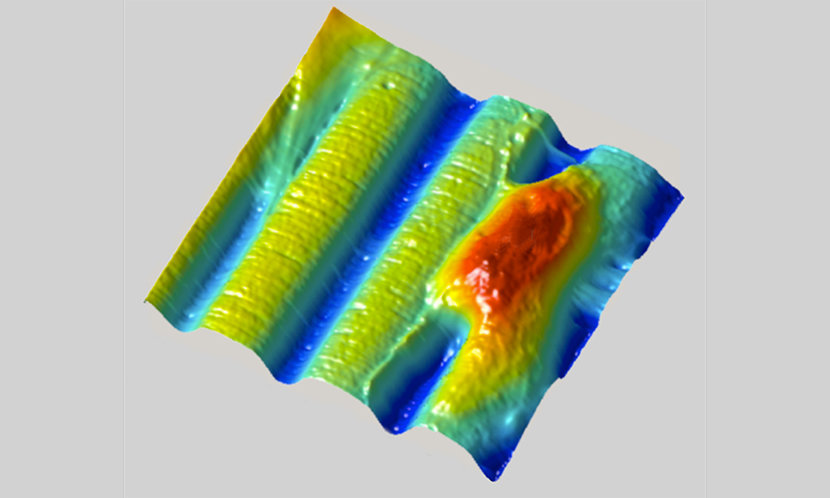
Using a new kind of "shrink ray", UT Austin scientists can alter the surface of a hydrogel pad in real time, creating grooves (blue) and other patterns without disturbing living cells, such as this fibroblast cell (red) that models the behavior of human skin cells. Rapid appearance of such surface features during cell growth can mimic the dynamic conditions experienced during development and repair of tissue (e.g., in wound healing and nerve regrowth). Credit: Jason Shear/University of Texas at Austin.

Topics: Biology, Chemistry, Laser, Research, Science Fiction

From "Fantastic Voyage" to "Despicable Me," shrink rays have been a science-fiction staple on screen. Now chemists at The University of Texas at Austin have developed a real shrink ray that can change the size and shape of a block of gel-like material while human or bacterial cells grow on it. This new tool holds promise for biomedical researchers, including those seeking to shed light on how to grow replacement tissues and organs for implants.

"To understand, and in the future engineer, the way that cells respond to the physical properties of their environment, you want to have materials that are dynamically re-shapeable," said Jason B. Shear, professor of chemistry and co-inventor of the new tool.

The work was published online today in the Journal of the American Chemical Society.

The real power of shrinking the material used to grow cells—called the substrate—isn't so much in making it smaller as it is in selectively changing the shape and texture of the surface. By controlling precisely which parts of the interior of the material shrink, the researchers can create specific 3-D features on the surface including bumps, grooves and rings. It's like pinching a rug from below to form peaks and valleys on the surface.

The researchers can also change the location and shapes of surface features as time goes by, for example turning a mountain into a molehill or even a sinkhole, mimicking the dynamic nature of the environment in which cells typically live, grow and move.

The shrink ray is a near-infrared laser that can be focused onto tiny points inside the substrate. The substrate looks and behaves a bit like a block of Jell-O. On the microscopic level, it's made of proteins jumbled and intertwined like a pile of yarn. When the laser strikes a point within the substrate, new chemical bonds are formed between the proteins, drawing them in more tightly, a change that also alters the surface shape as it's tugged on from below. Researchers scan the laser through a series of points within the substrate to create any desired surface contour at any place in relation to targeted cells.

Unlike other methods for altering the substrate under living cells, the UT Austin shrink ray doesn't heat or chemically alter the surface, damage living cells or cause cells to unstick from the surface. And it allows the formation of any 3-D pattern on demand while viewing the growing cells through a microscope.

Honey, I shrunk the cell culture, University of Texas at Austin

Read more…

Post Mole Day...

Credit: Design: N. Hanacek/NIST

Topics: Chemistry, Education, NIST, Periodic Table, STEM

In suburban Maryland, on the third floor of the Advanced Chemical Sciences Laboratory at the National Institute of Standards and Technology (NIST), Bob Vocke and Savelas Rabb are explaining how they are helping to redefine the mole, that mammoth concept we learned in high-school science class.

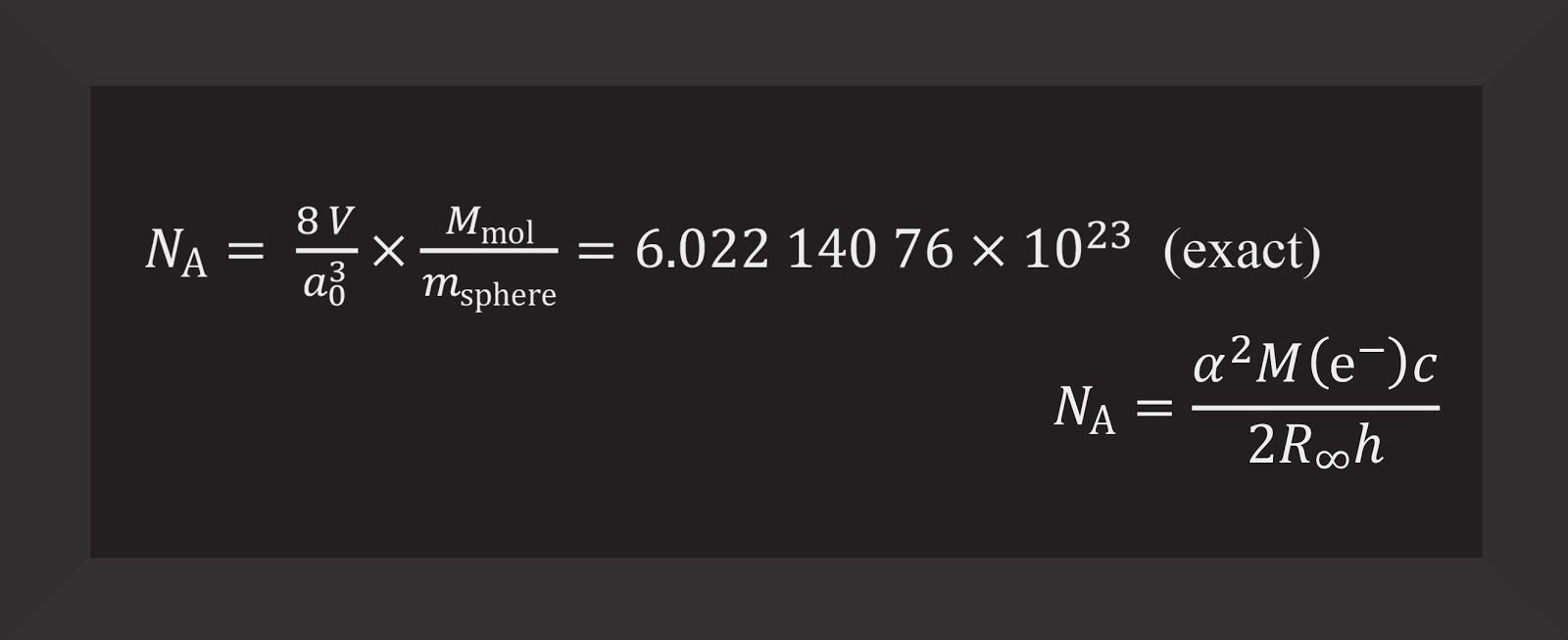
Mostly, this means using abstract symbols and numbers, dancing along in a long equation that Vocke obviously thinks is beautiful. You can tell because he enthusiastically writes each detail out on the white board for some lab visitors. Every so often, Rabb provides suggestions or tells a joke and sort of eggs Vocke on. It is clear they are having a good time and could do this kind of annotation and explanation all day.

After the mole equation, they add more:

Credit: Design: N. Hanacek/NIST

To fully grasp the new definition of the mole, you must embrace these long equations, which show how that measurement connects to fundamental constants of the universe—such as the speed of light in vacuum and the amount of charge in an electron. In turn, these fundamental constants will completely redefine the modern metric system, known as the International System of Units (SI). The mole is one of the seven base units of the SI.

For Vocke and Rabb, the equation work brings joy. The process is entertaining, and a little fun.

For most others, it seems impossibly cryptic.

On the surface, the mole’s basic definition will remain the same. It’s a measure of stuff—how many molecules or atoms you have of a particular substance such as water, or gold or a protein.

But the current definition is more complicated than it needs to be. In the present metric system, a mole is the amount of substance that contains as many elementary entities as there are atoms in 0.012 kilograms of the most common form of carbon, known as carbon-12. A further complication: the mole relies on another definition, the definition of the kilogram, which is currently specified by the mass of a platinum-iridium cylinder locked up in a special vault outside Paris, France.

*****

Mole Day is an unofficial holiday celebrated among chemists, chemistry students and chemistry enthusiasts on October 23, between 6:02 a.m. and 6:02 p.m.,[1][2] making the date 6:02 10/23 in the American style of writing dates. The time and date are derived from Avogadro's number, which is approximately 6.02 × 10²³, defining the number of particles (atoms or molecules) in one mole (mol) of substance, one of the seven base SI units.

Mole Day originated in an article in The Science Teacher in the early 1980s. Inspired by this article, Maurice Oehler, now a retired high school chemistry teacher from Prairie du Chien, Wisconsin, founded the National Mole Day Foundation (NMDF) on May 15, 1991. Wikipedia

Redefining the Mole, NIST

Spectrometers, Silicon Spheres and Statecraft Modernize Chemistry’s Mammoth Measurement Unit
Read more…

Nouveau Paradox...

Credit: Getty Images

Topics: Modern Physics, Quantum Mechanics, Schrödinger's Cat, Theoretical Physics

In the world’s most famous thought experiment, physicist Erwin Schrödinger described how a cat in a box could be in an uncertain predicament. The peculiar rules of quantum theory meant that it could be both dead and alive, until the box was opened and the cat’s state measured. Now, two physicists have devised a modern version of the paradox by replacing the cat with a physicist doing experiments—with shocking implications.

Quantum theory has a long history of thought experiments, and in most cases these are used to point to weaknesses in various interpretations of quantum mechanics. But the latest version, which involves multiple players, is unusual: it shows that if the standard interpretation of quantum mechanics is correct, then different experimenters can reach opposite conclusions about what the physicist in the box has measured. This means that quantum theory contradicts itself.

The conceptual experiment has been debated with gusto in physics circles for more than two years—and has left most researchers stumped, even in a field accustomed to weird concepts. “I think this is a whole new level of weirdness,” says Matthew Leifer, a theoretical physicist at Chapman University in Orange, California.

The authors, Daniela Frauchiger and Renato Renner of the Swiss Federal Institute of Technology (ETH) in Zurich, posted their first version of the argument online in April 2016. The final paper appears in Nature Communications on 18 September. (Frauchiger has now left academia.)

Reimagining of Schrödinger's Cat Breaks Quantum Mechanics—and Stumps Physicists, Davide Castelvecchi, Scientific American

Read more…

Tools Made of Light...

Topics: Diversity in Science, Optical Tweezers, Laser, Nobel Prize, Women in Science

I'm pretty sure I was in the throw of midterms. I did not miss it, just didn't have time to post about it.

Tools made of light

The inventions being honored this year have revolutionized laser physics. Extremely small objects and incredibly rapid processes are now being seen in a new light. Advanced precision instruments are opening up unexplored areas of research and a multitude of industrial and medical applications.

Arthur Ashkin invented optical tweezers that grab particles, atoms, viruses and other living cells with their laser beam fingers. This new tool allowed Ashkin to realise an old dream of science fiction – using the radiation pressure of light to move physical objects. He succeeded in getting laser light to push small particles towards the centre of the beam and to hold them there. Optical tweezers had been invented.

A major breakthrough came in 1987, when Ashkin used the tweezers to capture living bacteria without harming them. He immediately began studying biological systems and optical tweezers are now widely used to investigate the machinery of life.

Gérard Mourou and Donna Strickland paved the way towards the shortest and most intense laser pulses ever created by mankind. Their revolutionary article was published in 1985 and was the foundation of Strickland’s doctoral thesis.

Press release: The 2018 Nobel Prize in Physics. NobelPrize.org. Nobel Media AB 2018. Mon. 22 Oct 2018. < https://www.nobelprize.org/prizes/physics/2018/press-release/ >

Read more…

Belief in Oneness...

#NuffSaid

Topics: Civics, Civil Rights, Climate Change, Diversity, Existentialism, Human Rights, Politics

Dear Millennials,

New York Magazine (the home state of our current orange nightmare) couldn't be more stark: your futures are being determined by ossified, geriatric creatures that KNOW they will not live to see the impact of their disastrous decisions on the environment, stoking wars, cutting taxes for their wealthy benefactors and themselves (ballooning the federal deficit); packing the Supreme Court with right wing, misogynist and sexist ideologues that don't hold your views on fairness, equality and will influence your lives for at least two generations. Along with subverting our electoral process in 2016 with Russia, the cover up of the apparent murder and brutal dismemberment of Jamal Khashoggi (15 must be the "magic number" in Saudi Arabia). This may tie to Jared Kushner being in the Saudi prince's "pocket," usually meaning he owes him, likely for a business loan that salvaged his New York property, ominously addressed "666 Fifth Avenue." Whether agnostics, atheists or theists, that's a lot to digest. I list these concerns because you will only get older, and the world they're destroying you will inherit, in whatever condition it's left in, however long it lasts.

Notice the message is fear: I saw a commercial warning of socialism, open borders, MS-13 paid for by a conservative PAC. I saw a bus load of seniors in Georgia getting on a bus to vote being stopped for no crime other than voting. Native Americans in North Dakota are having their votes blocked by legal fiat. Note the distinct dichotomy in the definitions of democracy and fascism - they're obviously leaning towards the latter. Parkland shooting survivors and their activism terrifies them. Since 2015, it's been observed they are getting older and dying off. The heady days of Ronald Reagan taking 61 to 30 voters between 18 to 24 is well-past their better days and jump shots. A lot of things back then aligned with that popularity: nostalgia was "Laverne and Shirley"; "Happy Days" "Back to the Future" and "Family Ties" with Michael J. Fox as a young urban professional - conservatism was "cool" but it's overstayed its shelf life. Democracy only worked for them when they were in the numerical majority - the tables turn circa 2042, and by the blatantly demonstrable voter suppression activities WITHIN the United States, they're panicking early now. The ONLY way they can stay in power is to suppress the youth and minority vote, and maybe collude with a foreign power.

Speaking of the environment: we're losing insects around the world at an alarming rate due to climate change. The meddlesome critters are an important part of our food chain, which if you're capable of reading this post, you're squarely at the top of it. Destroy the foundation; it eventually drives up the price of food, then inhibits the access to it. That is a recipe for starvation, poverty, hyper income inequality, wars...and extinction.

*****

The capitalized term First Contact, in Human context, was used to specifically refer to the first official publicly and globally known contact between Humans and extraterrestrials. The First Contact took place on the evening of April 5, 2063, when a Vulcan survey ship, the T'Plana-Hath, having detected the warp signature of the Phoenix, touched down in Bozeman, central Montana, where they met with the Phoenix's designer and pilot, Zefram Cochrane. This event was generally referred to as the defining moment in Human history, eventually paving the way for a unified world government and, later, the United Federation of Planets. The event also became an annual holiday called First Contact Day. Memory Alpha - First Contact

I've always been dubious about this platitude in Trek mythology, that somehow knowing that we're "not alone" in the universe was some kind of unifying force multiplier to eternal (and secular) Kumbaya and Koinonia. The screaming at immigrant children at the border BEFORE the 2016 elections and kiddie concentration camps now leave my optimism in doubt. Roddenberry was playfully imaginative, but Pollyannish at best.

Star Trek was born in the 1960s as was the Civil Rights movement, which involved hoses, bricks, fire bombings and assassinations. It was during the Cold War with (ironically) Russia, and the notion that "duck and cover" drills wouldn't ultimately save us from extinction. So, it was a brief respite from the existentialism that gripped most in those days. Someone who looked like us might survive our own pride and hubris. There could be life after half-life.

*****

The belief that everything in the universe is part of the same fundamental whole exists throughout many cultures and philosophical, religious, spiritual, and scientific traditions, as captured by the phrase 'all that is.' The Nobel winner Erwin Schrödinger once observed that quantum physics is compatible with the notion that there is indeed a basic oneness of the universe. Therefore, despite it seeming as though the world is full of many divisions, many people throughout the course of human history and even today truly believe that individual things are part of some fundamental entity.

People who believe that everything is fundamentally one differ in crucial ways from those who do not. In general, those who hold a belief in oneness have a more inclusive identity that reflects their sense of connection with other people, nonhuman animals, and aspects of nature that are all thought to be part of the same "one thing." This has some rather broad implications.

First, this finding is relevant to our current fractured political landscape. It is very interesting that those who reported a greater belief in oneness were also more likely to regard other people like members of their own group and to identify with all of humanity. There is an abundance of identity politics these days, with people believing that their own ideology is the best one, and a belief that those who disagree with one's own ideology are evil or somehow less than human.

It might be beneficial for people all across the political spectrum to recognize and hold in mind a belief in oneness even as they are asserting their values and political beliefs. Only having "compassion" for those who are in your in-group, and vilifying or even becoming violent toward those who you perceive as the out-group, is not only antithetical to world peace more broadly, but is also counter-productive to political progress that advances the greater good of all humans on this planet.

Quaint, and for a better time, but until we get there...

65,853,625 voted for the sane candidate.
62,985,105 voted for the orange fascist tweeting on the loo and defecating from his pie hole in a breathtaking achievement of daily, all-time Olympic-level lying.

"You belong to your father, the devil, and you want to carry out your father’s desires. He was a murderer from the beginning, not holding to the truth, for there is no truth in him. When he lies, he speaks his native language, for he is a liar and the father of lies." John 8:44 NIV (yes, I'm trolling)

This election, I'm asking the "silent majority"...to give a shit. It's literally your futures.

"Unless someone like you cares a whole awful lot,

Nothing is going to get better. It's not."

― Dr. Seuss, The Lorax

Read more…

A Family Affair...

Credits: Frances Arnold Credit: Caltech

Topics: Chemistry, Diversity, Diversity in Science, NASA, Nobel Prize, Women in Science

Click here to read about Frances Arnold's Nobel Prize.

"What the heck does Mom want? Oh, Mom probably doesn't understand the time difference, she's in Dallas right now and is probably still thinking it's California time…maybe she just wants me to go check on her cats…" A litany of mundane explanations ran through James Bailey's bleary mind at 3:23 a.m. on October 3 when he was awakened from a deep sleep by three phone calls from his mother's cell number. Bailey silenced his phone for the first two, getting grumpier with each ring. Call #3 did the trick. He picked up the phone and said groggily, "What do you want?" With great excitement and maybe a tinge of impatience, his mother said, "I wish you had picked up your phone, but I just won the Nobel Prize."

Bailey bolted upright, thrilled by the news and fueled by adrenaline. "I was overjoyed for her. It's fairly difficult to verbalize how I feel," he said. He never did manage to go back to sleep that night. In a few hours, he'd be able to share the news with his colleagues when he arrived at his job at NASA's Jet Propulsion Laboratory in Building 179, High Bay 1 -- the clean room where he is a flight technician working on Mars 2020.

Bailey's mother is Frances Arnold, the Linus Pauling Professor of Chemical Engineering at Caltech, which manages JPL for NASA. Her 2018 Nobel Prize in Chemistry honors her pioneering work in creating new, improved enzymes in the laboratory using the principles of evolution. Arnold shares the prize with two other scientists.

Arnold's bio has an abundance of academic milestones and stellar awards. She was the first woman to receive the 2011 Charles Stark Draper Prize from the National Academy of Engineering. She is also the first woman and one of just a few individuals elected to all three branches of the National Academies: for Medicine, Sciences and Engineering.

Bailey traveled a different path than his mother to his job at JPL. Growing up in Pasadena, he didn't thrive in conventional schools, so he pursued vocational training in welding and machining. After high school, he worked on high-performance cars at a local shop. At 20, he joined the Army, where he was trained as a Blackhawk helicopter mechanic and became part of a flight crew. After wrapping up six years of military service, including crucial work on medical evacuation helicopter teams in Afghanistan, he learned JPL was looking for people with an aviation background to work as flight technicians. Bailey fit the bill, and he was hired.

Caltech Mom Wins Nobel Prize, Son Is JPL Mars Flight Tech

DC Agle / Andrew Good, NASA

Read more…

AI and MEMS...

Image: Guillaume Dion

Topics: Artificial Intelligence, Computer Science, Internet of Things, MEMS, Neuromorphic Devices

A single silicon beam (red), along with its drive (yellow) and readout (green and blue) electrodes, implements a MEMS capable of nontrivial computations.

In order to achieve the edge computing that people talk about in a host of applications including 5G networks and the Internet of Things (IoT), you need to pack a lot of processing power into comparatively small devices.

The way forward for that idea will be to leverage artificial intelligence (AI) computing techniques—for so-called AI at the edge. While some are concerned about how technologists will tackle AI for applications beyond traditional computing—and some are wringing their hands over which country will have the upper hand in this new frontier—the technology is still pretty early in its development cycle.

AI on a MEMS Device Brings Neuromorphic Computing to the Edge

Dexter Johnson, IEEE Spectrum

Read more…

Nano Noise...

New noise: researchers have discovered a new type of noise that is associated with differences in temperature. (Courtesy: iStock/Swillklitch)

Topics: Acoustic Physics, Applied Physics, Nanotechnology, Semiconductor Technology, Thermodynamics

A new type of electronic noise has been discovered by a team of physicists and chemists in Israel and Canada. Dubbed “delta-T noise”, the effect occurs when two sides of a tiny electrical junction are at held at different temperatures. As electronic devices become ever smaller, the researchers predict that delta-T noise could become increasingly problematic. The good news is that delta-T noise could be used to measure temperature differences in nanometer-scale objects – something that is extremely difficult to do.

When physicists think of noise it is not the clamor from a pop concert or a busy road, but rather electrical signals that are an intrinsic property of a device. For almost 100 years, physicists have known about two sorts of fundamental noise in electrical signals. Thermal noise is proportional to temperature and is a result of the random motion of electrons. This creates fluctuations in electrical current even if there is no applied voltage and the average current is zero. Thermal noise can have negative consequences in a circuit, but it can also be used to measure the absolute temperature of an object. The second type of noise is called shot noise and does require an applied voltage. Shot noise occurs at very low currents when the discrete nature of electrons causes fluctuations in current.

The idea of delta-T noise first came to Oren Tal of the Weizmann Institute of Science when he was studying the effect of thermal noise on a molecular junction. The junction comprised a single molecule between two electrodes, which were at different temperatures. He realized that in addition to thermal noise, there may also be a noise associated with the temperature difference.

New type of noise found lurking in nanoscale devices, Tim Wogan, Physics World

Read more…

Moon Moons...

Could Earth's moon have its own moon? Science says: in theory. Credit: NASA/JPL/Space Science Institute

Topics: Astrophysics, Exoplanets, NASA, Planetary Science, Space Exploration

I couldn't compound the two words in the post title (as in the article) and keep a straight face. Although, someone will likely write fiction about double system moons (if they haven't already).

True to form, the Internet has endeavored to name an unnamed thing, and the results are hilarious. From the people who brought you Boaty McBoatface— the Arctic research drone that has already returned some very interesting discoveries from the world's coldest abysses — here come moonmoons: moons that orbit other moons.

Moonmoons — also known online as submoons, moonitos, grandmoons, moonettes and moooons — may not exist in our solar system or any other. However, according to a pair of astronomers writing in the preprint journal arXiv.org earlier this week, the concept of a moon hosting its own mini-moon is, at least, plausible.

Abstract
Each of the giant planets within the Solar System has large moons but none of these moons have their own moons (which we call submoons). By analogy with studies of moons around short-period exoplanets, we investigate the dynamical stability of submoons. We find that 10 km-scale submoons can only survive around large (1000 km-scale) moons on wide-separation orbits. Tidal dissipation destabilizes the orbits of submoons around moons that are small or too close to their host planet; this is the case for most of the Solar System’s moons. A handful of known moons are, however, capable of hosting long-lived submoons: Saturn’s moons Titan and Iapetus, Jupiter’s moon Callisto, and Earth’s Moon. Based on its inferred mass and orbital separation, the newly-discovered exomoon candidate Kepler-1625b-I can, in principle, host submoons, although its large orbital inclination may pose a difficulty for dynamical stability. The existence, or lack thereof, of submoons, may yield important constraints on satellite formation and evolution in planetary systems.

Moonmoons (Moons That Orbit Other Moons) Could Exist, Scientists Say

Brandon Specktor, Live Science

Read more…

Janeway, Nechayev, Sisko and #MeToo...

Image Sources: Memory Alpha Wiki

Topics: Civil Rights, Diversity in Science, Existentialism, Human Rights, Star Trek, Women in Science

Kathryn Janeway was the Captain of the Starship Voyager, lost in the Delta Quadrant that managed to have a seven-year run and eventually get back to Federation space for her promotion to Admiral.

Alyanna Nechayev was introduced at the "top of the pecking order" being Jean Luc Picard's immediate boss, often showing up to give him an assignment, chew him out or give him a disapproving "evil eye" (you've got to admit, those eyes were phasers set way beyond stun).

Benjamin Lafayette Sisko checked all boxes: a black man, single father; Starfleet Commander and widower. I was a fan of Avery Brooks in "Spencer For Hire" and "A Man Called Hawk," introducing my sons to him in Star Trek: Deep Space 9.

To move each story arc along, backgrounds weren't deeply explored, mimicking a lot of the reasons for physics-defying technologies like warp drive, Heisenberg Uncertainty-violating transporters and replicators. There was a World War III before warp drive (unfortunately); there was probably a fictional equivalent of #MeToo before Janeway and Nechayev ascendancies; there were Bell Riots and on our actual time line - a Black Lives Matter movement - before a Benjamin Sisko.

Alynna Nechayev was a Human Starfleet flag officer during the late-24th century. She spent much of the 2360s and early 2370s dealing with issues near the Cardassian border. (TNG: "Chain of Command, Part I", "Journey's End", "Preemptive Strike"; DS9: "The Maquis, Part II")

Nechayev was a significant figure in Starfleet's dealings with the Cardassian Union and a fierce advocate of Federation security. She was Captain Jean-Luc Picard's direct superior, but her working relationship with him was poor.

In 2369, while serving as a Vice Admiral, she ordered Picard to relinquish command of the USS Enterprise-D to Captain Edward Jellico, the latter having experience with Cardassians in the past and having worked to establish the original armistice of the Federation-Cardassian War. She assigned Picard to a special operation to infiltrate a Cardassian installation on Celtris III. After Jellico's negotiations with Gul Lemec worsened, she authorized his actions against the Cardassian warships in the McAllister C-5 Nebula, at the risk of provoking open war and abandoning Picard. (TNG: "Chain of Command, Part I", "Chain of Command, Part II") [1]

*****

Kathryn Janeway was a 24th century Starfleet officer, most noted for her service as captain of the starship USS Voyager. She became the first Federation captain to successfully traverse the Delta Quadrant, encountering dozens of new planets and civilizations over the course of seven years. While there, she and her crew also survived numerous encounters with the Borg. By 2379, she was a Vice Admiral at Starfleet Command. (VOY: "Caretaker", "Endgame", "Friendship One", "Scorpion", "Scorpion, Part II"; Star Trek Nemesis)

Kathryn Janeway was born on May 20 in Bloomington, Indiana, on Earth. (VOY: "Year of Hell", "Imperfection") Her father was Vice Admiral Janeway and she had one sibling, a sister, who she described as the artist of the family. (VOY: "Sacred Ground", "Coda", "The Killing Game") Her mother was still alive as of 2378. (VOY: "Author, Author") [2]

*****

"So you're the commander of Deep Space 9... and the Emissary of the Prophets. Decorated combat officer, widower, father, mentor and... oh, yes, the man who started the war with the Dominion. Somehow I thought you'd be taller..."

– Senator Vreenak, 2374 ("In the Pale Moonlight")

By the 2020s, the American government – reacting to serious problems of homelessness and unemployment – created special Sanctuary Districts (essentially walled-off sections of the city grid) in most major cities. Unfortunately – while established with the benevolent intent of providing free housing and food, as well as prospects for future employment – the Sanctuaries quickly degenerated into inhumane internment camps for the poor. Even though people with criminal records were not allowed inside Sanctuaries, it didn't take long for the homeless and unemployed to be joined by the mentally ill and other, more violent, social outcasts. These groups were referred to by their slang terms – Gimmies, Dims, and Ghosts.

By late 2024, the twenty square blocks that made up Sanctuary District A had become overcrowded slums. With the records of people inside the Sanctuaries not uploaded to the planetary computer network (and therefore not accessible using an Interface), the true conditions inside were unknown to the general public. American society believed that, despite the political upheaval affecting Europe at the time, the United States was stable and had found a way to successfully deal with the social problems that had been the genesis of the Sanctuaries. An "out of sight, out of mind" mentality had set in. People in the district started to believe that their needs were forgotten. [3]

*****

To wit, each represented in science fiction what we're seeing today in this existential struggle by aspects of society that have historically been marginalized to say: we are human; #MeToo and the culmination of that struggle in actualized power.

For power to be actualized, it must first be seized. Occupy Wall Street is now a pitiful blog that hasn't been updated since August 2016. It's Reich/Right Wing counterpart - the Tea Party - not only demonstrated in the streets; they GOT elected. The Orwellian "Freedom Caucus" is now on Capital Hill making laws. "Killer Tweets" and witty Snap Chat posts will not change policy: only the grimy, dirty work of politics will accomplish that, and that needs to happen before we see a Nechayev, Janeway or Sisko on relativistic speed starships.

A lot can't be covered in 60 minutes between phasers, impossible spaceship speeds, Grandfather paradox plots and commercial sponsors.

"Unless someone like you cares a whole awful lot,

Nothing is going to get better. It's not."

― Dr. Seuss, The Lorax

1. Alynna Nechayev, Memory Alpha

2. Kathryn Janeway, Memory Alpha

3. Benjamin Sisko, Memory Alpha

Read more…

Morally Reprehensible...

Delegates at the first workshop on high-energy theory and gender held at CERN last month. (Courtesy: CERN)

Topics: Diversity, Diversity in Science, Women in Science

More than 3000 physicists have so far signed an open statement denouncing a recent talk by theoretical physicist Alessandro Strumia of the University of Pisa. The talk was given on 28 September at an inaugural CERN workshop on high-energy theory and gender in which he claimed that men, not women, face discrimination when seeking jobs in physics. The statement, which has been signed by Nobel laureate David Gross and other prominent scientists, calls Strumia’s arguments “morally reprehensible”.

Strumia’s presentation at CERN included graphs and tables that analyses the citation records of papers written by male and female physicists. In the talk, he stated that these data show that “top authors are man, man,…man”. He also claimed that data related to academic hiring show that women with fewer citations were being hired over men with greater numbers of citations. In one slide, Strumia, who is an associate of the theory department at CERN, claims that he was passed over for a job at Italy’s National Institute for Nuclear Physics, despite having many more citations than the successful female candidate. The woman in question was in the audience at Strumia’s talk.

Preamble of The Open Statement:
We write here first to state, in the strongest possible terms, that the humanity of any person, regardless of ascribed identities such as race, ethnicity, gender identity, religion, disability, gender presentation, or sexual identity is not up for debate. Physics and science are part of the shared inheritance of all people, as much as art, music, and literature, and we should strive to ensure that everyone has a fair opportunity to become a scientist. The question of discrimination based on ascribed identity is a moral one, and we write to affirm that discrimination is not a welcome feature of our field, however pervasive it may be. It is clear that our social environment disparately affects the participation of people with ascribed identities that have been traditionally marginalized, and the fields of women’s and gender studies, science and society studies, physics education research, anthropology, sociology, philosophy, and Black studies have had much to say over the years about how this marginalization operates. The thin veneer of scientific rigor with which Strumia’s talk began was followed by open discrimination and personal attacks, which we condemn unconditionally.

Thousands of physicists sign letter condemning ‘disgraceful’ Alessandro Strumia gender talk

Michael Banks, Physics World

Read more…

Accounting Dark Matter...

Fade to black: a type 1a supernova remnant as seen by the Hubble Space Telescope and the Chandra X-ray Observatory. (Courtesy: NASA)

Topics: Astrophysics, Black Holes, Cosmology, Dark Matter

Primordial black holes do not account for all dark matter, according to new research by Miguel Zumalacárregui and Uroš Seljak at the University of California, Berkeley. The duo has made the best measurement yet of the abundance of black holes in the cosmos by measuring the gravitational lensing of light from type 1a supernovae. Their study puts an upper limit of 40% on how much dark matter can be accounted for by primordial black holes.

For decades, physicists have grappled with growing evidence that the formation and dynamics of galaxies and larger structures in the universe are governed by gravitational forces from unseen dark matter. While the mysterious substance appears to account for about 85% of all matter in the universe, dark-matter particles have yet to detected directly.

Abstract

The nature of dark matter (DM) remains unknown despite very precise knowledge of its abundance in the Universe. An alternative to new elementary particles postulates DM as made of macroscopic compact halo objects (MACHO) such as black holes formed in the very early Universe. Stellar-mass primordial black holes (PBHs) are subject to less robust constraints than other mass ranges and might be connected to gravitational-wave signals detected by the Laser Interferometer Gravitational-Wave Observatory (LIGO). New methods are therefore necessary to constrain the viability of compact objects as a DM candidate. Here we report bounds on the abundance of compact objects from gravitational lensing of type Ia supernovae (SNe). Current SNe data sets constrain compact objects to represent less than 35.2% (Joint Lightcurve Analysis) and 37.2% (Union 2.1) of the total matter content in the Universe, at 95% confidence level. The results are valid for masses larger than ∼ 0.01 M (solar masses), limited by the size SNe relative to the lens Einstein radius. We demonstrate the mass range of the constraints by computing magnification probabilities for realistic SNe sizes and different values of the PBH mass. Our bounds are sensitive to the total abundance of compact objects with M ≳ 0.01 M and complementary to other observational tests. These results are robust against cosmological parameters, outlier rejection, correlated noise, and selection bias. PBHs and other MACHOs are therefore ruled out as the dominant form of DM for objects associated to LIGO gravitational wave detections. These bounds constrain early-Universe models that predict stellar-mass PBH production and strengthen the case for lighter forms of DM, including new elementary particles.

Supernovae reveal that primordial black holes cannot account for all dark matter

Sam Jarman, Physics World

Read more…

Catastrophe 2040...

Harry Taylor, 6, played with the bones of dead livestock on his family’s farm in New South Wales, Australia, an area that has faced severe drought. Credit: Brook Mitchell/Getty Images

Topics: Climate Change, Ecology, Economy, Global Warming, Politics

1.5 degrees Celsius

INCHEON, South Korea — A landmark report from the United Nations’ scientific panel on climate change paints a far more dire picture of the immediate consequences of climate change than previously thought and says that avoiding the damage requires transforming the world economy at a speed and scale that has “no documented historic precedent.”

The report, issued on Monday by the Intergovernmental Panel on Climate Change, a group of scientists convened by the United Nations to guide world leaders, describes a world of worsening food shortages and wildfires, and a mass die-off of coral reefs as soon as 2040 — a period well within the lifetime of much of the global population.

The report “is quite a shock, and quite concerning,” said Bill Hare, an author of previous I.P.C.C. reports and a physicist with Climate Analytics, a nonprofit organization. “We were not aware of this just a few years ago.” The report was the first to be commissioned by world leaders under the Paris agreement, the 2015 pact by nations to fight global warming.

The authors found that if greenhouse gas emissions continue at the current rate, the atmosphere will warm up by as much as 2.7 degrees Fahrenheit (1.5 degrees Celsius) above preindustrial levels by 2040, inundating coastlines and intensifying droughts and poverty. Previous work had focused on estimating the damage if average temperatures were to rise by a larger number, 3.6 degrees Fahrenheit (2 degrees Celsius), because that was the threshold scientists previously considered for the most severe effects of climate change.

The new report, however, shows that many of those effects will come much sooner, at the 2.7-degree mark.

Major Climate Report Describes a Strong Risk of Crisis as Early as 2040

Coral Davenport, NY Times

Read more…

Strange Fruit...

The lynching of Thomas Shipp and Abram Smith, 1930 [1]

Topics: Civics, Civil Rights, Diversity, Existentialism, Human Rights, Politics

On a hot August night in 1930 a crowd gathered in front of an Indiana jail — men, women, and children shouting and jeering, demanding that the sheriff release his three prisoners. Three African-American teenagers: Tom Shipp, Abe Smith, and James Cameron — huddled inside their cells, charged with the murder of a white man and the rape of a white woman.

Some among the thousands of people in front of the jail formed a mob. They beat down the jail doors, pulled the three youths from their cells, brutally beat them, and dragged them to a tree on the courthouse square. At the last minute the mob spared Cameron, the youngest and most boyish of the trio. Smith and Shipp died, lynch ropes around their necks, their bodies hanging as the town photographer captured one of the most famous lynching photographs in American history. They weren't even hung properly. They had a noose put around their neck and were then pulled up into the tree. And one of them tried to get free so they hauled him down, broke his arms and hauled him back up again.

The third person 16-year-old James Cameron, narrowly escaped lynching thanks to an unidentified participant who announced that he had nothing to do with the rape or murder. Cameron was moved out of town, convicted as an accessory to the murder and served four years in jail. After the lynching, Cameron became a very devout man and vividly describes this day in his autobiographical account “A Time of Terror”. He became an anti-lynching activist in Indiana and, later, Wisconsin — where he founded a Black Holocaust Museum. He believed that the voice that came from the crowd to save him was the voice of an angel. Cameron died on June 11, 2006, at the age of 92.

The picture was the inspiration for the poem “Strange Fruit” which was later put to song and popularized by the incredible Billy Holiday and became an early anthem for the burgeoning civil rights movement. Teacher/poet Abel Meeropol ran across this photo of the Shipp-Smith lynching a few years later in a magazine, and it so “haunted” him — his word — that he penned the anti-lynching poem “Strange Fruit”. [1]

*****

A contemporary of Kavanaugh's at Georgetown Prep told HuffPost the scene there included "14-, 15-, 16-year-olds, 17-year-old kids doing whatever the fuck they wanted to do, with no repercussions. Drugs everywhere. Partying everywhere. Drinking—just whatever we wanted to do. It was unbelievable, off the rails." At Yale, Kavanaugh belonged to a "secret society" that was basically a bunch of guys getting drunk together. To some extent, that's normal college nonsense, but after law school, Kavanaugh clerked for Alex Kozinski a federal judge later pushed out in disgrace after being accused of sexually harassing women he supervised, and showing pornography to his subordinates. (Kavanaugh has said he was unaware of this behavior, though Kozinski's nature doesn't seem to have been much of a secret; the judge ran an email list where he shared dirty jokes and stories.) When Kavanaugh was a judge himself, Amy Chua, the Yale professor most famous for writing Battle Hymn of the Tiger Mother, reportedly told her students it was "no accident" his female clerks "looked like models." (According to the Guardian, a student "reacted with surprise, and quickly pointed out that Chua’s own daughter was due to clerk for Kavanaugh. A source said that Chua quickly responded, saying that her own daughter would not put up with any inappropriate behavior.") [2]

*****

The Museum of African-American History and Culture is in part a catalog of cruelty. Amid all the stories of perseverance, tragedy, and unlikely triumph, there are the artifacts of inhumanity and barbarism: the child-size slave shackles, the bright red robes of the wizards of the Ku Klux Klan, the recordings of civil rights protesters being brutalized by police.

The artifacts that persist in my memory, the way a bright flash does when you close your eyes, are the photographs of lynchings. But it’s not the burned, mutilated bodies that stick with me. It’s the faces of the white men in the crowd. There’s the photo of the lynching of Thomas Shipp and Abram Smith in Indiana in 1930, where a white man can be seen grinning at the camera as he tenderly holds the hand of his wife or girlfriend. There’s the undated photo from Duluth, Minnesota, where grinning white men stand next to the mutilated, half-naked bodies of two men lashed to a post in the street—one man is straining to get into the picture, his smile cutting from ear to ear. There’s the one of a crowd of white men huddled behind the smoldering corpse of a man burnt to death, one of whom is wearing a smart suit, a fedora hat, and a bright smile.

At a rally in Mississippi, a crowd of Trump supporters cheered as the president mocked Christine Blasey Ford, the psychology professor who has said that Brett Kavanaugh, whom Trump has nominated to a lifetime appointment on the Supreme Court, attempted to rape her when she was a teenager. “Lock her up!” they shouted.

Ford testified to the Senate, utilizing her professional expertise to describe the encounter, that one of the parts of the incident she remembered most was Kavanaugh and his friend Mark Judge laughing at her as Kavanaugh fumbled at her clothing. “Indelible in the hippocampus is the laughter,” Ford said, referring to the part of the brain that processes emotion and memory, “the uproarious laughter between the two, and their having fun at my expense.” And then at Tuesday’s rally, the president made his supporters laugh at her.

The cruelty of the Trump administration’s policies, and the ritual rhetorical flaying of his targets before his supporters, are intimately connected. As Lili Loofbourow wrote of the Kavanaugh incident in Slate, adolescent male cruelty towards women is a bonding mechanism, a vehicle for intimacy through contempt. The white men in the lynching photos are not merely smiling because of what they have done, but because they did it together. [3]

American "Exceptionalism"

Because we cannot resolve the past, we cannot move into a more equitable future or, as our personal mythology goes, "a more perfect union." We cannot resolve what we cannot admit has happened, and how that past scaffolds the current, blatantly-obvious present. The deified, slave-holding "founders" never wanted direct democracy. Democracies and republics are always "experiments": abstract ideals that are never meant to be concluded, or realized.

Way before the "Strange Fruit" of Abel Meeropol's poem and the iconic voice of Billy Holiday making it a classic, the first "other" were the natives found in the Americas and the Caribbean, slaughtered for the affront of existing on real estate colonizers from Europe wanted. Colonizers gave themselves the excuse they were not Christians, therefore "others" and slaughtered accordingly. As they did in Africa with fields of diamonds beneath the feet of natives there, they plundered and made themselves wealthy beyond sultans and kings. Way before that in Europe, the iconography of Christendom was purposefully changed from the Madonna and Christ child I purchased in the Vatican store during the reign of Pope John Paul III. John Paul was originally from Poland, and the iconography never changed to its Anglicized versions made popular during the international slave trade that also contributed to the colonizers' exchequer. Yeshua Ben Joseph's name was also transformed to its Greco-Roman equivalent, with a smattering of pagan folklore and sun-worship thrown into what was "the way." It was no great leap that under the circumstances "Manifest Destiny" - the precursor to exceptionalism - was a perfect mythology to mask crimes against humanity, humanity like people of color (see: Scottsboro Boys and the Central Park 5), humanity like the LGBT: humanity like...women, who are vilified by either Eve or Lilith depending on the day. Way before this present darkness of fascism, was the scaffolding of sadism.

It is quaint to see us almost on-cue wring our hands in woe. That the descendent's of those photographed smiling around the hanging corpses of Thomas Shipp and Abram Smith (one of many proto-selfies) would act at all differently than their forebears. Some of these photos historically were taken after church services with the preacher in attendance. The notion that calling ourselves a "Christian nation" is itself an abomination. Christian supremacy was the precursor for its  ethnic-nationalism equivalent, replacing choir robes for Klan ones. This disdain for everyone other than themselves is baffling how they've managed to pull it off as long as they have, until they have a Karl Rove "permanent republican majority" for at least two generations, and the raving maniac confirmed by the fiat of a stolen Supreme Court Justice seat from his former boss, Merrick Garland may well one day become Chief Justice and put the nail in the coffin of anything resembling our better angels and usher in a kangaroo court for a soon-coming banana republic and Idiocracy.

But "better angels" is myth as well, a folklore we tell ourselves. History is only learned by historians and taught formally at universities, or self-taught by the purchase of books by actual historians (at least while we still can). All else is propaganda to reinforce the constant lies that flow from the fetid streams of bullshit mountain.

I guffaw almost to ralfing as I repeat those lies: we're the "indispensable nation," Winthrop's "city on a hill," a dung heap far above the necks of lesser humanity stamped upon by the 1% owners of the former republic. We, people of color, the LGBT and women are now the "strange fruit" hanging from fascist poplar trees.

No. This nation is exceptional for only ONE thing: cruelty.

And that exceptional savagery now has a "justice" robe and an asterisk next to his name.

But justice was never the point, nor was "law": only order (white supremacy).

"If you want a vision of the future, Winston, imagine a boot stamping on a human face forever." O'Brien, "1984" by George Orwell.

Howard Zinn epilogue:

"It would be naive to depend on the Supreme Court to defend the rights of poor people, women, people of color, dissenters of all kinds. Those rights only come alive when citizens organize, protest, demonstrate, strike, boycott, rebel, and violate the law in order to uphold justice." [4]

"Unless someone like you cares a whole awful lot,

Nothing is going to get better. It's not."

― Dr. Seuss, The Lorax

1. The lynching of Thomas Shipp and Abram Smith, 1930, Rare Historical Photos

2. Kavanaugh Has Exposed the Savage Amorality of America's Ruling Class, Harry Cheadle, Vice.com

3. The Cruelty Is the Point, Adam Serwer, Staff Writer for The Atlantic

4. Howard Zinn: Don’t Despair about the Supreme Court, The Progressive, October 21, 2005

Read more…

DC's answer to the film 'Black Panther' should be 'Icon'!  Starring Denzel Washington as Augustus Freeman and either Zendaya or Amandla Stenberg as Rocket,  'Icon' is the story of how an alien crash lands in a cotton field in 1839 and adopts the appearance of the first person that comes into contact with it being a slave woman.  He lives through American history leaving behind a legacy as his next begotten's namesake arriving in the present day as August Freeman IV.  Convinced of his otherworldly abilities to better his race by a teenager name Rocket,  Augustus Freeman becomes the superhero 'Icon'. 


The illustration is of an actor named John Garrett.

Read more…

Product Review Updates #5

Occasionally, I will alert fellow members to product updates by creators I have reviewed in the past year or so.

  • Is'nana The Were-Spider has released Vol 2! It should be Vol 3 but who's keeping score? You can get it at Peepgamecomix here.
  • The Isabelle Brothers (of Messiah Wars) have a new movie out called The Last Disciples. Dunno if it's related to any of their other projects, but you can find out for free on their site.
  • Steve Bellinger (of Chronocar) has another book coming out this year. He better hurry because we're running out of 2018. It's called Edge of Perception. You can learn more about it here.
  • Alex Fernandez has released episode 6 of Body Jumpers Ressurection. I hope he brought back Bowlegged Lou. There are links on the group Facebook page. 

That's all I could find this month. Feel free to piggyback onto this post if a reviewed creator has posted an update in the past 5 months. Or if you're a creator I've reviewed, mention your newest work!

Read more…